Jack Palmer, Zygmunt Bauman and the West: a sociology of intellectual exile (McGill-Queen’s University Press, 2023)
Reviewed by Eric Ferris (Eastern Michigan University)
(This is a prepublication version of this review. You can find the published version in Thesis Eleven Journal, on the T11 Sage website)
Decolonizing Bauman: A Review of Jack Palmer’s Zygmunt Bauman and the West
I had the pleasure of reading an early copy of Jack Palmer’s (2023) Zygmunt Bauman and the West at a time when I was working with Bauman’s ideas in my own field of study – I was writing my doctoral dissertation that put his understanding of the ambivalence of our world in conversation with ideas surrounding contemporary schooling in the United States. When constituting my dissertation committee, a prospective member pointed me to literature that suggested that a blind spot in Bauman’s extensive body of work was thinking and writing on feminism. While an explicit examination of feminism is lacking in Bauman’s oeuvre, I did not see any reason that his work was anathema to feminist interests, much less that he purposefully maligned feminism and related fields by willful omission. Palmer speaks directly to this concern with his remarks on the politics of knowledge: As readers, we can expand or foreclose meaning within a text or body of work, enlarge or confine the spaces in which a body of work is applicable, or enrich or impoverish its impact on the world in which it exists all relative to our positionality. In many cases, the applicability of a work depends on how we read or utilize it. For me, Bauman’s work did/does speak to issues pertaining to gender identity and sexual orientation, among other things, which I hopefully convincingly showed in my dissertation (Ferris, 2023). For Palmer, Bauman’s voice is fundamental to conversations pertaining to post-colonial and decolonial studies, despite the bevy of contrarian voices, ones that say otherwise or feel they need to say otherwise.
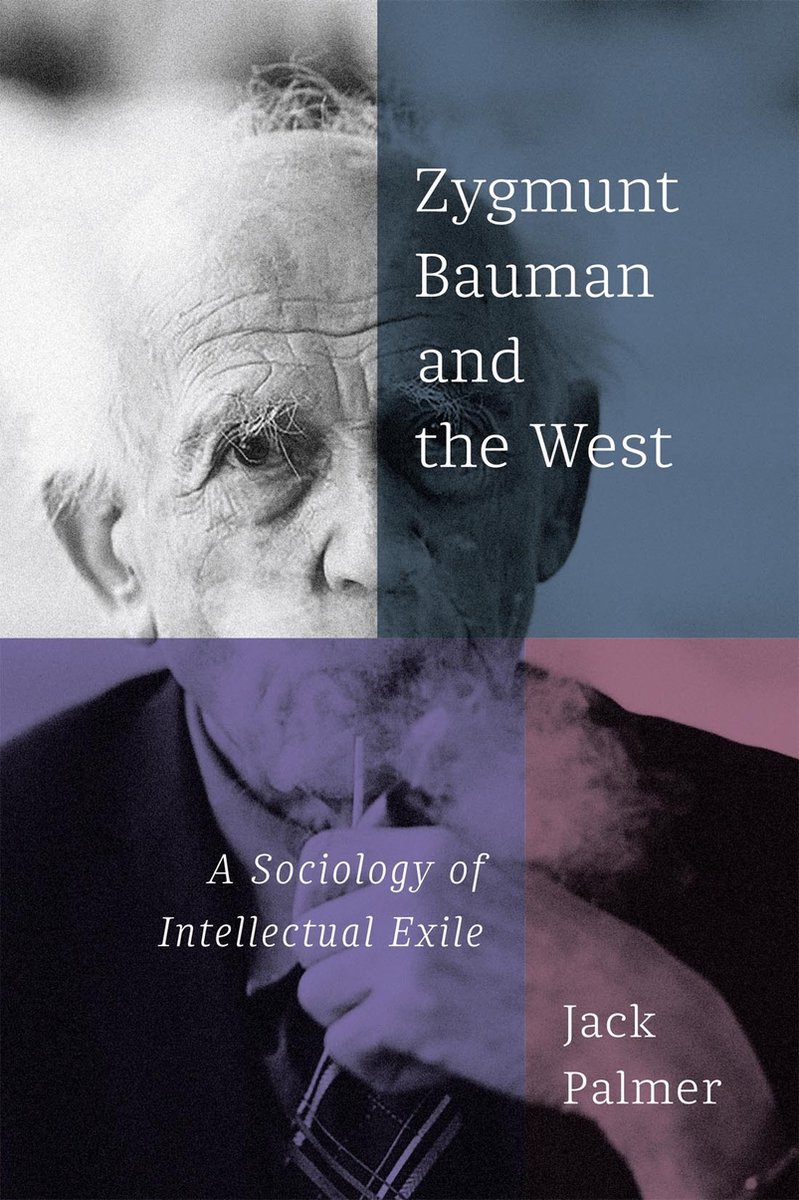
Palmer begins Zygmunt Bauman and the West with two important goals: First, to complicate and even counter arguments that position Zygmunt Bauman’s works within the cannon of Western social thought, thus making them minimally if not completely irrelevant to post-colonial and decolonial studies, and second, to engage with Bauman’s works in ways that many believe he would have wanted his readers to engage with them – that is to use them as a departure point for their own studies or projects, ones that center on building a more just world. To say that Palmer meets these goals would be an understatement; he accomplishes them and more. Zygmunt Bauman and the West is not simply a book about Zygmunt Bauman. Instead, it is a book that reflects and addresses Palmer’s own questions through Bauman. Throughout this rigorous study, Palmer’s voice emerges with an insightful interpretation of not only the literature surrounding the life and work of Bauman, but also on the greater exilic position and its impact on decolonial and post-colonial studies and social theory in general.
A quick tour of Palmer’s book speaks to both the breadth and depth of his ideas. In his chapter, ‘The Exilic Position’, he distinguishes it from the act of being exiled or the condition of exile, both potentially disempowering to individuals or groups. He also unearths in it the potential for creation, that the exilic intellectual is the universal stranger, and that critical sociology is exile. ‘Writing the Multiplicity of Modernity’ challenges the positioning of modernity as a straightforward linear progression embodying inevitability. The chapter speaks to the possibilities that exist within modernity, a garden of forking paths (a metaphor borrowed by Bauman from a Borges short story) so to speak, and a reality constructed with fragments pieced together without the aid of an instruction manual or blueprint. In ‘Decolonizing Zygmunt Bauman’, Palmer draws on Bauman’s work on culture – culture’s active, semiotic function of reducing indeterminacy rather than culture as a vehicle to impose order – to tie it to critiques of colonial domination. Notably, Bauman recognized, and Palmer highlights, that modern, Western forms of life were/are not superior to others; rather, the projection of their superiority is a product of economic power and political domination. ‘Postmodernity as Jewish Experience and Interpretation’ engages with Bauman’s works on postmodernity and his recognition of the radical indeterminacy and ineradicable plurality of the world, both standing in stark contrast to the totalizing ambitions that have at different times, yet in related ways, ravaged both Europe and the colonized world. In ‘From Solid Communism to Liquid Post-Communism’, Palmer fractures the image of a homogeneous Europe, pointing to the colonizing superpower that was the USSR. Indeed, in Europe’s various iterations of internal colonizations, thinkers like Bauman were forced into a sort of extraterritoriality, both evicted from and never fully invited into space, a space-less-ness that exposed for him, and them, the impossibility of modernity’s ordering projects, paving the way for a recognition that future-oriented projects need be horizons to be approached in solidarity. Palmer’s conclusion expounds on Bauman’s belief that there always exists the possibility of a better world, but that creating it requires remembering and registering damages, losses, and erasures in both the past and the present. Bauman’s writings on the multiplicity of meaning and human action as choice is an act of hope, a recognition of human freedom, as it displaces modernity’s totalizing ambitions with multidirectional memory reflecting the multiple ways humans can exist, and do so together.
So, what might it mean to suggest that Palmer’s book decolonizes Bauman? Most prominently, it means that he problematizes both the oversimplifications that position Bauman simply as a product of the West and moreover, the notion that the West itself is homogeneous, with both charges being regularly levied so as to exclude the applicability of ‘Western’ thinkers, Bauman included, in non-Western affairs. Bauman’s Polishness and his academic career working out of Leeds, England has, for some, reduced him to simply another European thinker and worse yet, as part of the dominating tradition that is Eurocentrism. As a Jewish Pole, he was forced to flee Nazi occupied Poland, returning to fight alongside the Soviets to free it from Nazi occupation, only to be exiled again in 1968 alongside others, most who were also Jewish, under the accusation of holding and promoting ‘subversive’ politics. And while Palmer traces the exilic position through Jewish thinkers and the Jewish tradition, a tradition that Bauman himself suggested gave the world its moral self, Bauman was never Jewish in a nationalist sense. Indeed, he regarded Zionism and its militarized constitution of the Jewish state as having ignored the lessons that should have been learned post World War II. Palmer lays out the criticisms of Bauman’s positioning or, rather, how he has been positioned: at times he was too Jewish, too socialist, too Communist, too eastern-European while also too Western, too European, too modern, and too postmodern, or in some cases, not enough of these categories, while in reality, he was none or all of them in different combinations and to varying degrees. Reflecting modernity’s uneasiness with ambivalence, the categorizations that have been affixed to Bauman reflect the need for others to position him, and neglect the ambivalence of his exilic location, the place that is nowhere, everywhere, and between.
What is it about the exilic position that contributed to the conditions that made Bauman, and many others, among the most intuitive of modernity’s interpreters? According to Palmer, exile forced the creation of ties between multiple intellectual networks – as Bauman put it, following Derrida, to be not so much homeless as having the ability to be at home in multiple places, cultures, and languages. These networks, often populated with other exiles, vitally produced a pluralistic world view. Exiles were rootless (or, rather, uprooted) and their world was (or became) centerless, yet also expansive. Rather than letting exile force them into a life without ties, they searched for and found ways of living that emphasized humanity’s interconnectedness.
Interconnectedness recognizes the multiplicity of culture. Rather than approaching culture from the colonizing position of ‘taming’ lesser ones, it emphasizes co-constructing shared meanings, an aspect of Bauman’s work that Palmer highlights throughout. It is also an aspect that he identifies as being fundamental in decolonial and post-colonial studies. Palmer points to the ways that, for example, British colonial establishments imposed themselves onto spaces they colonized as well as those who inhabited them; the colonized represented ambivalences that ‘needed’ to be managed, populations that human management techniques could be practiced on. Notably, many of the designed technologies of human management practiced by colonizers were employed by, for example, the Nazis in their own camps, an intra-national colonization to be sure and one that is central in Bauman’s sociology. Furthermore, Palmer notes that colonies were both repositories for surplus beings and deposits rich with consumer markets and raw materials, themes which Bauman addressed in, among other places Wasted Lives (2004) and Does Ethics have a Chance in a World of Consumers (2008). Colonialism itself is a descriptor, a process, that presents itself in different contexts, yet to privilege one form over another is to ignore the global interconnectedness and interdependencies that lie at its heart. As noted by Bauman and alluded to by Palmer, the relinquishing of colonies did not end colonialism – it continues and acts under different, often less obvious banners. This is modernity in its ordering, regulative, colonizing form.
Palmer notes that as an interpreter of postmodernity Bauman’s insights reflected a shift from the radical determining that was central to the enlightenment project. He expressed disenchantment with modernity and accepted both the ambivalence and plurality of the world. At the same time, what Palmer captures is Bauman’s ability to adapt to the postmodern condition with a style of thought that mirrors the ambivalence of the time. Yet far from this adaptation taking on the complexion of a free-for-all where anything goes, for Bauman it represents an ambivalent third that lies between chaos and determinacy. It feeds a moral position that requires cross-, even inter-cultural and trans-historic dialogue. If colonialism attempted to give the world form yet did so by ridding it of its ‘weeds’, Bauman’s sociology recognized the ever-incompleteness of this form, that there are no weeds, or rather that weeds as subjects exist because of, relative to, in opposition to, or in spite of those who define them as such. The process of ordering will happen, but Bauman’s hope was that it would proceed dialogically and democratically – or justly, with justice being defined through dialogue.
Bauman’s sociology was, according to Palmer, ultimately one of melancholic hope. For Bauman utopia is active, and needed to be active, a vanishing point off in the distance that could never be met, only strived toward, rather than a terminal end goal. If, understatedly, we regard Bauman’s life as interrupted by the horrors of the 20th century, horrors that themselves were a function of human choice, of solid design, then for him, the active element of choice also holds the promise for better. Humans, blessed and cursed as they are with the obligation to choose, can always choose differently. Tragedies have happened and have been avoided because of human choice. While there is no turning back the hands of time or any way to erase the consequences of choices made, future choices can be made from different, more just vantage points – hopefully. For Bauman, togetherness and interconnectedness, both emerging from recognizing and appreciating the ambivalence of the social world, offer such a vantage. Indeed, while human choice may have made him pessimistic about the present, it also gave him hope for the future. Bauman recognized the present as a time of diaspora, and a paramount task is learning to live with difference. If people can learn that, then the promise that is the future is boundless.
The strengths of Palmer’s book are plentiful. He shows readers that Bauman was not simply a Western thinker, but rather that his works are applicable beyond even the ambitious scope for which they were written. One of the greatest strengths of Palmer’s book is one that Bauman would have signed on for: That is that we, as readers of Bauman, continue his conversation with others, in other ways, with our own ambitions of working together to build something together. Palmer, in his book, did just that. Be it in decolonial or post-colonial studies, as Palmer explored, or some other field of study, imagining differently must happen in the company of others – we either build a world together or have one imposed on us. If Palmer’s goal was to decolonize Bauman, then he did so masterfully. What he gives us is a thought-provoking text that shows what we can do when we, instead of pigeon-holing thinkers, ideas, or texts into convenient boxes, take a legacy of important conversations and run with them.
References
Bauman Z (2004) Wasted lives: Modernity and its outcasts. Malden: Polity.
Bauman Z (2008) Does ethics have a chance in a world of consumers?. Cambridge: Harvard University Press.
Bauman Z and May T (2001) Thinking sociologically (2nd ed). Malden: Blackwell Publishing.
Ferris E (2023) The (dis)order of U.S. Schools: Zygmunt Bauman and education for an ambivalent world. London: Routledge.
Palmer J (2023) Zygmunt Bauman and the west: A sociology of intellectual exile. Montreal: McGill Queen’s University Press.
Author Bio
Eric Ferris is a high school math teacher in Michigan, in the United States, and a graduate from Eastern Michigan University’s Educational Studies Program. He is the author of The (Dis)Order of U.S. Schools: Zygmunt Bauman and Education for an Ambivalent World (2023).


 thesis eleven