Peter Beilharz, Chain’s Toward the Blues (Bloomsbury Academic, 33 1/3 Oceania series, 2023)
Reviewed by Harry Blatterer (Macquarie University)
(This is a prepublication version of this review. You can find the published version in Thesis Eleven Journal, on the T11 Sage website)
What is this book? What was Chain? Toward the Blues is more than an appreciation of the iconic seventies Australian band Chain. Charting cultural exchange and social change, Peter Beilharz traces developments in a music scene on the cusp of becoming an industry that was harnessed to the national self-image, and so signals shifts in the culture at large. This is no mean feat for a slim volume that makes no ambit claims, refuses the temptations of nostalgia and follows a singular ‘logic’: an abiding love of music, anchored in an equally deep understanding of place and history.
Peter Beilharz centres the book on a particular cultural artefact and constellation of creators as indicative of a culture with local and global inflections: the 1971 album Toward the Blues by Melbourne band Chain, ‘a period seventies blues band with jazz skills and manoeuvres; kind of a prog band, on the cusp of Oz pub rock but not of it’ (p. 2). Chain’s iconic iteration comprised the innovative guitarist Phil Manning (conversations with whom inform substantial sections of the book), Matt Taylor (vocals, harp), Barry ‘Little Goose’ Harvey (drums) and Barry ‘Big Goose’ Sullivan (bass). The album produced a hit single, ‘Black and Blue’, ‘a convict work song’ (p. 2) that for all its localism was covered by the likes of Manfred Mann and, later, Jimmy Barnes.
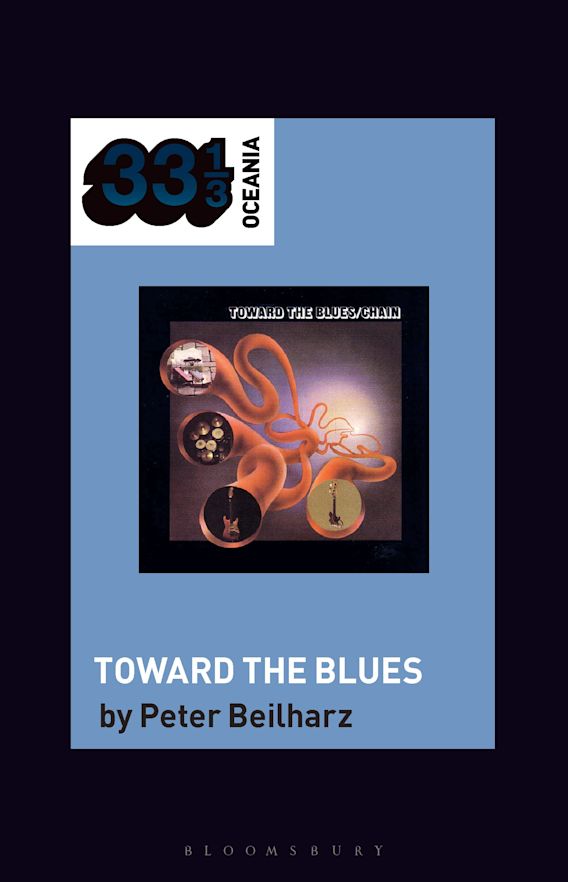
Though not the only protagonists in a story of cultural transformation, Chain nevertheless constitute ‘a measure of their moment’ (p. 4), a moment lived, shared and co-constructed with other musicians, producers, managers and labels, with purveyors of a scene that took on specific significance at a time when new technologies and pathbreaking styles converged. Chain itself was a product of ‘cultural traffic’ (p. 6), of a confluence of musicians and genres from different parts of the country and their responses to a constellation of musical influences from the blues tradition to Jazz, British rock and prog rock.
Peter Beilharz’s interpretation of songs – the music as much as the lyrics – is always thick. Whether it is tracing ‘32/20 Blues’ back to its origins, sketching other versions and giving blow by blow descriptions of the song’s unfolding; whether he relates details concerning modifications to Phil Manning’s guitar and the sounds they allowed him to conjure, or connects lyrical content and musical dynamism to Matt Taylor’s ‘share of trouble with the police in Brisbane’ (p. 20); whether he identifies ‘a moment of rare and chilling beauty in period Oceanic rock’ in ‘Booze is Bad News Blues’ (p. 22), or offers a quick aside on the emergence of the slide guitar – Beilharz’s take and commentary go beyond the expertise that his liberal references to various music anthologies and compendia and to his conversations with Phil Manning affords him. He not only manages to convey the sonic and social resonances of the tracks, to mine the spaces between the notes and beats, but to convey the specificity of this music, this band, this cultural moment as felt experience by way of interpretation. Peter Beilharz, is in other words, a musician, a conveyor of feel.
An astute observer of the culture, Beilharz turns to ‘the slow untangling of a new nationalism’ in the 1960s. The time of early Chain was marked by a kind of ‘cognitive dissonance’ (p. 32): Australian settler colonialists are neither of the land they stole and denied its rightful owners, are neither British nor American in cultural orientation, yet sing their ever looming cousins’ songs. Criminals become heroes, Maoism is celebrated by parts of the Left, white masculinity is construed as larrikinism with its inevitable redefinition of rock. Is it a coincidence then that Chain moved toward(s) the Blues; that rather than making it their home, ‘[t]hey were liminal, somewhere in between’ (p. 31)?
Now the score changes keys: from the tracks to contexts, both in respect of Chain’s own prehistory and half a century of iterations comprising some 30 members (a veritable ‘who’s who of period rock, jazz, and studio players’ [p. 40]), and the social, cultural and political world that shaped the music, and which its kind shaped in turn. Significant to the band’s own development, there is GTK (Get To Know), the public broadcaster’s attempt to breathe creative life into the public imagination in 10-minute instalments of local and global music. There is the move of venues from small, dingy clubs to pubs, and a first commercial turn from singles to albums, both studio-recorded and live. The unavailability of certain instruments meant that musicians used what they could (e.g. the Hohner clavinet as ersatz Hammond B3). And if they couldn’t get their hands on the latest amp or accessory, they experimented with strings and pickups, squeezed what they could from locally made products, shaped sound to their liking, gave it their own flavour. Technology followed creative needs.
Beyond technology, there are co-creators, partners: Michael Gudinski, co-founder of Mushroom Records, doyen of all things rock and pop in the Australian music scene from the 1970s well into the next millennium, here too functioned as enabler, not to speak of a host of musicians and bands that criss-crossed each other’s paths in that most musical metropolis, Melbourne. Place matters.
This was white boys’ blues, to be sure. The demographic distribution of style and genre differed from the US where biracial rock continued to break the colour line, just as Jazz had done for decades. In Australia, country and western, then ‘rap, reggae and hip hop’, are typical domains of Indigenous musicians, with Georgia Lee’s 1962 The Blues from Down Under a remarkable exception. Notable too is the Maori presence in the blues scene, with Reno Tehei, Leo de Castro, Phil Key, and Charlie Tumahai (a one-time member of Chain) key players (p. 51).
The Vietnam War, the Pentagon Papers, the strictures of the conservative life course, ‘factory food, factory fodder, the prospect of endless, pointless work, a rising war machine, generalized conformism, older people who would gratuitously abuse you on the street’ (p. 56) – these were but some of the experiences that cut an unbridgeable cleft between the generations. Generational self-consciousness intertwined with a new creative self-confidence marked by an unhesitating acknowledgement of musical lineage leading elsewhere in time and space. Peter Beilharz turns our attention to Matt Taylor’s ‘I remember when I was young’ (1973), lyrics nodding to the Beatles, the Delta Blues, and the need to strive towards the blues, here in this place. For that generation of young Australians the kind of music produced by Chain seemed ‘to keep a window open to some small utopia’ (p. 54). And then another possibility beckoned: to drop out. The bush beckoned urban creatives. The promise of self-sufficiency went hand in hand with a rising ‘musical nationalism’. Now Sunbury was our own Woodstock, if of a different time already, its cast largely male and virulently so; louder than anything that came before, but distinctly ‘ours, all local’ (p. 59).
There is something disquieting in this cultural shift. As much as it signalled a new self-confidence and augured the rise of Oz Rock as marketable badge of national belonging, it also signified a narrowing of permissible (masculine) repertoires of expression. Music had begun to align itself with the most sacred of Australia domains—sport. Pointing to the Sunbury festival as indicative of the change, Phil Manning puts it plainly: ‘That whole aspect of the alcohol fuelled crowd basically brought music back to the level of sport. And sport is fine but music is an art form’ (p. 61). Gentler days, it seems, were passing with the passing of Toward the Blues in the collective memory. As the 70s waned, rock threatened to become ‘a blood sport’ (p. 61).
Chapter 4 is a 22-page tour de forcesketching Australia’s social complexities over time: the politics of dispossession and convictism; our brand of multiculturalism that though ‘leavened by the other’ (p. 67) continues to resonate with an ‘English imagination’ (p. 64); the turn from fairness and democracy to real estate and home improvement; US-American influences in film and music assisted by war alliances. All this interspersed with the patterns of music and musical lives that accompany and carve the twists and turns in a cultural landscape that Beilharz swiftly, though never carelessly, charts and traverses. There are other places where rock flourishes. Adelaide, of course. And what would ‘our’ music be without Aoteoroa/New Zealand? But whatever the local hues, in Chain’s early days the musical topography was already city-modelled. Melbourne was already the centre in a global periphery.
The 1970s especially felt ‘ruptural’ (p. 67), and Chain was a link in the confluences of politics and culture. Whitlam heralded more openness. No more White Australia policy, an end to conscription. The culture – and not least conservative Melbourne’s creative underbelly – heaved a sigh, responded. As Beilharz reminds us, there was no nexus between economics and style comparable to Detroit-Motown. In that context, rock as ‘mode of production’ (p. 70) meant DIY innovation. Whether it was style or technology, ‘creative mimesis’ (‘additive’ rather than duplicating) was how it was done, and of this too Chain, with its easy drift between Jazz-inspired prog rock and the American blues tradition, is exemplary. Neither solely derivative nor wholly inward-looking, the music was caught up in a process of cultural traffic in which Australian rock and pop has for long exceeded the role of peripheral receptacle and has to varying degrees been part of its reciprocal flow.
The book closes with two short sections on the shifting personnel of Chain and on Peter Beilharz’s own personal engagement with the music and Phil Manning – a fitting coda to a book that connects the intimate and the public with great sensitivity.
It is tempting to conclude that Toward the Blues goes beyond the music. Clearly the book goes beyond the Jamersonesque basslines Beilharz’s keen ears pick up, beyond Manning’s generations-inspiring guitar work, beyond Matt Taylor’s remarkable voice (not to mention his harp’s flirtations with dissonance that only the blues can tame to the heart), beyond the lockstep groove of ‘The Geese’ interspersed with Barry Harvey’s textured drum virtuosity and semi-composed solos. But in another sense Peter Beilharz doesn’t go beyond music at all. He has an unusual capacity to combine musicality with cultural-historical knowledge and personal experience towards a single aim: to show us the culture that ‘Chain developed and blossomed in’, while themselves ‘emblematic part to the whole’ (p. 82). In that process, he manages to get to the very edge of the chasm that separates word from music – that fortuitous chasm without which either music or language would be unnecessary, mute.
Having listened to and read Toward the Blues, I wonder what price we have paid in that seemingly innocuous drift from club to pub, from scene to industry, from a more openly eclectic music to a narrower, much louder if more self-confident version of Oz Rock that came to characterise Australian music for a time. Did the changes, all too easily imaginable as contained in a cultural sphere of its own, signal changes in the national psyche, in the social self-imagination and modes of self-presentation? Did Phil Manning’s consternation about the sportification of music originate in a sense that it was emblematic of a reduced Australian self-image that had found a most profitable, self-acclaiming soundtrack? And have we not ourselves become louder, more at ease with rewarding brashness and self-acclamation? I don’t know. Suffice to say that this labour of love stirs the imagination.
That Peter Beilharz’s writing has an inimitable, flowing backbeat will not surprise those familiar with his writing. Nor does it distract from Chain’s own. In fact, you may be well advised to use the book as the score while you ‘plug in those cans and travel across time, towards the blues, close to the sun’ (p. 85).


 thesis eleven