
This post is a part of the online special edition Peter Beilharz: The Life of the Mind, Friendship, and Cultural Traffic in Postmodern Times
by George Steinmetz
I first met Peter, I believe, at the meetings of the American Sociological Association in Montréal in 2006 at a session on ‘Discipline and Hybridity’. I presented a paper modeling interdisciplinary relations through analogies to different forms of imperial and nonimperial international relations. After the panel I struck up a conversation with Peter, went out for coffee with him, and discovered two amazing things. The first was that Peter was the beating heart of the journal Thesis Eleven, which I had been familiar with since graduate school. But I had always associated it with Agnes Heller and other émigré members of Lukács’ Budapest School. This was largely due to the orientation of my professor, Ivan Szelenyi, to his former Hungarian colleagues in Australia. I had never really noticed that the journal’s most frequent contributor was Peter Beilharz. Secondly, I realized that I had just read Peter Beilharz’s book on the great Australian Art Historian, Bernard Smith, while writing my book on precolonial ethnographies and German colonialism (Beilharz 1997). Smith was a leading expert on Captain Cook’s voyages, as well as the German writer Georg Forster, and Beilharz was the expert on Smith. I was delighted to discover a someone – a fellow sociologist, no less – whose interests aligned so closely with my own. Peter also gravitated toward versions of historical sociology that emphasize contingency, cultural specificity, historical difference, and social theory (Beilharz 2003, 2005). The journal, like the New Left Review in its early years, remained defiantly anti-disciplinary and open to encounters with literary critics, art historians, philosophers, and theorists like Heller, Castoriadis, and Bauman who were marginal in the mainstream social sciences.
My conversation with Peter led to his inviting me to write an overview of the first thirty years of Thesis Eleven for the journal’s 100th anniversary issue. I returned to the journal and began to recognize some of the similarities between the course of leftwing social theory in Australia and the US during the intervening years since 1980. For example, there was a steady decline in references to Marx in the journal’s pages from 1980 until 2000 (Steinmetz 2010). This echoed the US sociology’s turn away from Marx. And unlike most neo-Marxist sociology in the US, Thesis Eleven never gravitated toward epistemic positivism or mainstream acceptance in the sociology discipline. Unlike the New Left Review, however, and more like Theory, Culture, and Society, Thesis Eleven had a clear grounding in sociology, broadly defined, even as it eschewed disciplinarity and expanded out into the humanities and arts. These were some of the issues running through my head as I ploughed through the mountain of issues of Thesis Eleven that Peter sent me to help me prepare my survey.
Colonialism, Nazism, Germany
In addition to these intellectual movements, from Marxism to aesthetics and beyond, some of the most interesting things that I have discovered about Peter Beilharz since this time circle around his intellectual and family connections to the history of global colonialism and to Germany. None of this was visible at all to me at the beginning, and it was certainly unexpected.
During the first decade of the 21st century, American sociology was still struggling to come to grips with postcolonial theory. In reviewing Thesis Eleven this seemed less true of Australian sociology, at least at La Trobe. Already in 1991, a Thesis Eleven editorial anticipated one of the main arguments of ‘Southern Theory’ (Connell 2007), writing that ‘Australians, being peripheral, like Gramsci, had something of pertinence to say to the radical inhabitants of the centres.’[1] The journal’s programmatic statement starting in 1996 described Thesis Eleven as ‘European in the continental sense, but also transatlantic and colonial.’[2] Peter was clearly involved in these statements and programmatic decisions. The contrast with American sociology could not be sharper. Until very recently, American sociologists struggled to recognize ‘colonialism’ as a relevant category, to recognize the discipline’s colonial legacies, or to acknowledge postcolonial theory as legitimate.[3]
Peter and I met again at the meetings of the American Sociological Association in 2009 in San Francisco. It was around that time that Peter invited me to Thesis Eleven’s thirtieth anniversary celebration in 2010.
Colonial themes loomed large for me during my visit. Arriving in Sydney in 2010, I was able to visit some of the key sites of Australian colonial history, including the La Perouse monument at Botany Bay National Park, and I was able to see the famous Bangarra Dance Company at the Sydney Opera House. In Melbourne, I stayed with La Trobe sociologist and Thesis Eleven editor Trevor Hogan and his family in the city centre, a short walk from two major art museums with collections of indigenous and colonial art. I saw the statue in front of the State Library of Victoria of Charles Joseph La Trobe, first Lieutenant-Governor of the colony of Victoria, holding a colonial decree or law book. I saw Captain Cook’s Cottage in Fitzroy Gardens.
I have come to recognize that my own combination of interests in colonialism and German history, including Nazism and the Holocaust, resonates with Peter. His collection of Australian Essays (2015) circle around the categories of ‘colonization’, ‘dispossession’, and of an ‘Anglo (and Colonial) racism built within the frame of the British Commonwealth before decolonialization’ (89). His writing on Bernard Smith pinpoints an ‘alignment of concepts … characteristic of Smith’s way of thinking: Marxian; colonial; modern, modernism, each term necessary to locate and make sense’ (Beilharz 2021: 317). In some ways, this could be taken to characterize Beilharz himself. Australia has always been a site of exile and emigration, and this is illustrated by Peter Beilharz’s parents (see below) and many of the intellectuals to whom he was most strongly attracted and who published repeatedly in Thesis Eleven, from Agnes Heller to Zygmunt Bauman to Ghassan Hage.
A powerful connection between colonialism and Nazism emerges from Peter’s family history, which he mentions briefly in Intimacy in Postmodern Times (Beilharz 2020). Peter’s father was born in 1923 in Stuttgart but was ‘taken as a babe-in-arms by his family to the Templer colonies in Palestine’, where he spent the next 18 years of his life (Beilharz 2020: 105). As Peter writes:
These were dissident Lutherans, farmers and artisans whose tradition involved some utopian dimensions, including the idea of settling in the Holy Land, and striving towards the achievement of the kingdom of God on Earth. Not, as I later came to reflect, a bad idea; though they may have picked the wrong place. In 1939 the Templers were interned, fenced in within their own homes in Palestine; they were enemy aliens, German nationals in a British protectorate. They were in the wrong place, and world history moved them on, to Australia. Some of my relatives, the menfolk just older than my father, were called up to the German armed forces. They did not escape into compulsory exile in Australia, but were sent to the Russian front. It occurs to me as I write these lines that it is remotely possible that they were shooting at Bauman’s troops at some point, and his troops at them. In 1941 the Templers still in Palestine were transported to internment camps in Australia, where they were imprisoned till 1947. At this point they were given an option: to return to Germany, in ruins, or to stay in Australia. My father and his family opted to stay.
Beilharz 2020: 105
He then discusses his mother, who was born in Germany and whose family stayed there during WWII, ‘when my mother worked in the land army’ (Beilharz 2020: 105).
Peter emphasizes that he grew up in an era of prosperity and security, but it is remarkable how he seems to have been increasingly drawn to the turbulent earlier history of the mid-20th century, the period before ‘Liquid Modernity’ (Bauman) and before Parsonsian ‘solid modernity’ – the period he calls ‘modernity in ruins’ (Beilharz 2020: 110; see Hell and Schönle 2010). This was the era in which Peter’s parents were drawn into the maelstrom of fascism and colonialism. Peter writes that ‘with the passing of my years I have become increasingly aware of my attachment to some of these leading members of the previous generation, who, unlike me, had experienced the age of extremes, as well as the age of austerity and the space called the bloodlands’ (Beilharz 2020: 110).
Initially, even though he had German ancestry and traditions, Germany had meant to Peter ‘only one thing, or at least One Big Thing: Nazism’ (Beilharz 2020: 53). Up to the age of 43, he recalls, ‘although my parents were German, I had to this point spent my life in denial, and in the Antipodes’ (Beilharz 2020: 52). But it ‘somehow now seemed right to seize the time with my German past’ (Beilharz 2020: 53). Peter ‘collaborated on an honours course on the Holocaust and social sciences with Robert Manne’, revisiting ‘the literature on the Holocaust’ (Beilharz 2020: 73). Peter’s contribution was to cover ‘Bauman and some other recent arrivals, such as Goetz Aly and Omar Bartov’ (Beilharz 2020: 73). In his book on Zygmunt Bauman’s writings, Peter devotes a chapter to Bauman’s ‘most influential book,’ Modernity and the Holocaust (Bauman 1989); he also discussed the life of Janina Bauman and her experience of the Warsaw Ghetto (Beilharz 2000: Chapter Four; Beilharz and Supski 2021). Zygmunt Bauman started thinking about the modernity of the Holocaust and about anti-Semitism and the ethics of the Other when Janina Bauman broke her silence about surviving in Nazi-occupied Poland, writing her first autobiographical text (Bauman 1986). After all, as Bauman argued, Nazism and the Holocaust were forms of modernity; the same is true of colonialism. I expect that Peter will continue to explore these and other aspects of ‘modernity in ruins’.
Conclusion
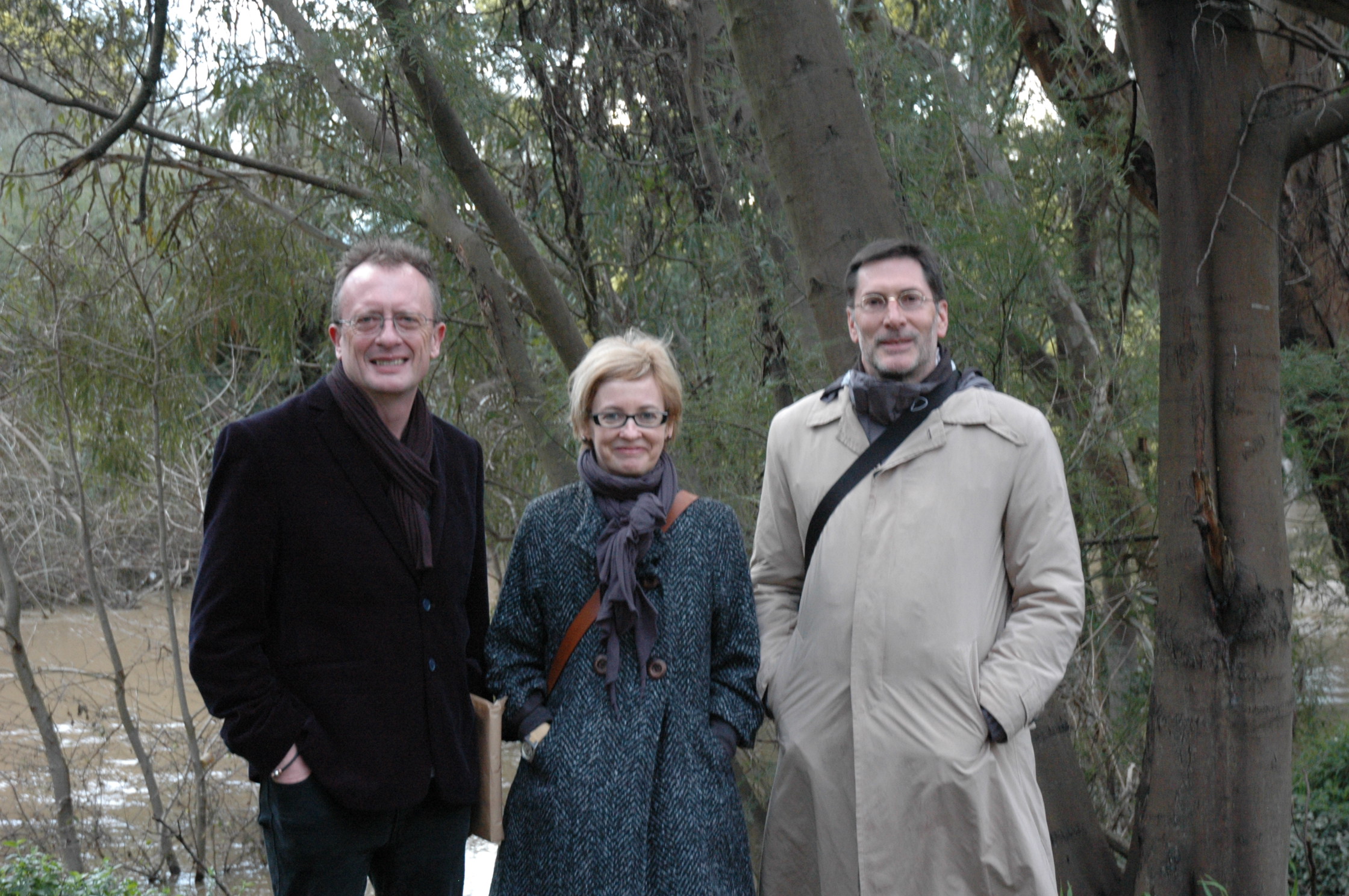
When I visited Melbourne for the Thesis Eleven event, Peter took me to the Heide Museum of Modern Art in the Heidelberg district, where we walked along the Yarra River together with the Melbourne University anthropologist Ghassan Hage and Peter’s coauthor and future wife, sociologist Sian Supski. Ghassan took a photograph of Peter, Sian, and me that day (above).
I adore Peter’s enthusiasm, energy, and intensity, his indifference to disciplinary and theoretical camps, and his mixture of critical social theory and aesthetics, modernism and postmodernism, seriousness and playfulness. In his extremely readable book Intimacy in Postmodern Times, Peter asks whether his relationship to Bauman might have had something of the father-son relationship (Beilharz 2020: 108). Peter feels to me not like a father figure but like a long-lost brother.
References
Bauman, J (1986) Winter in the Morning : A Young Girl’s Life in the Warsaw Ghetto and beyond, 1939-1945. London: Virago.
Bauman Z (1989) Modernity and the Holocaust. Ithaca: Cornell University Press.
Beilharz P (1997) Imagining the Antipodes: Culture, Theory and the Visual in the Work of Bernard Smith. Cambridge: Cambridge University Press.
Beilharz P (2000) Zygmunt Bauman: Dialectic of Modernity. London: Sage.
Beilharz P (2003) Reviews. Thesis Eleven 73: 122–127.
Beilharz P (2005) Thesis Eleven: 25 years on. Thesis Eleven 85: 6–7.
Beilharz P (2015) Thinking the Antipodes: Australian Essays. Melbourne: Monash University Publishing.
Beilharz P (2020) Intimacy in Postmodern Times: A Friendship with Zygmunt Bauman. Manchester: Manchester University Press.
Beilharz P (2021) Circling Marx: Essays 1980-2020. Leiden: Brill Academic Publishers.
Beilharz P and Supski S (2011) ‘To Love and to be Loved’: Janina Bauman’s ordinary life’. Thesis Eleven 107(1): 101-105
Bhabha HK (1994) The Location of Culture. London: Routledge.
Connell R (2007) Southern Theory: The Global Dynamics of Knowledge in Social Science. New York: Polity.
Hell J and Schönle A (eds) 2010). Ruins of Modernity. Duke University Press.
Krippner GR (2019) Theory in the trenches. Perspectives (Newsletter of the Social Theory Section of the ASA) 41(2): 2-5.
Said EW (1979) Orientalism. New York: Vintage Books.
Steinmetz G (ed) (2013) Sociology and Empire. The Imperial Entanglements of a Discipline. Durham, NC: Duke University Press.
Steinmetz G (2006) Decolonizing German theory: An introduction. Postcolonial Studies 9(1): 3-13.
Steinmetz G (2023) The Colonial Origins of Modern Social Thought: French Sociology and the Overseas Empire. Princeton: Princeton University Press.
Notes
[1] Text from back cover of Thesis Eleven, 1996–2002, and inside back cover from 2002-2005.
[2] ‘Introduction’, Thesis 11 28 (1991: 1).
[3] I worked with another Melbourne-based journal, Postcolonial Studies, to publish the first entire issue of a journal dedicated to exploring the connections between colonialism and (German) social theory (Steinmetz 2006) and structured my book The Devil’s Handwriting (Steinmetz 2007) around the ideas of Edward Said (1979) and my former Chicago colleague Homi Bhabha (1994). The colonial (and anticolonial) entanglements of sociology did not become a central concern in US sociology for another decade (Steinmetz 2013), although this them has emerged as a central front in criticism of classical sociological theory more recently (Krippner 2019; Steinmetz 2023).
Biographic Information
George Steinmetz is the Charles Tilly Professor of Sociology at the University of Michigan. His latest publication is The Colonial Origins of Modern Social Thought: French Sociology and the Overseas Empire (Princeton University Press, 2023.


 thesis eleven