
This post is a part of the online special edition Peter Beilharz: The Life of the Mind, Friendship, and Cultural Traffic in Postmodern Times
by Julian Potter
Describing people you care about can be a difficult business. This is just a fragment of a complex prism: a student reflecting on his teacher. Thankfully, Peter has provided a model I can follow in his memoir of his friendship with Zygmunt Bauman, Intimacy in Postmodern Times (Beilharz 2020). Thirty years separate Peter and Zygmunt, another thirty separate myself and Peter. These are generational spans, time enough for considerable changes that challenge traditions. Through my story, I would like to suggest that the refounding of intellectual traditions on friendship, instead of, and sometimes in spite of institutions, or enframed goals such as politics, is one of Peter’s gifts to his postmodern students and those who have met him along the way. Another is the vital question for scholarly endeavour: ‘Is it interesting?’ And for me, the love of books.
I’ve known Peter for around a decade and a half, since the latter part of my undergraduate degree at La Trobe University in Melbourne. The majority of that time followed his recruitment of me into the editorial team of Thesis Eleven where I served first as an editorial assistant, then production assistant, and now editor. The journal and, more importantly, the people involved in it, have been not only the centre stage for my intellectual formation, but also the locus of a potential alternative to institutional academia. This was all possible, in certain respects, because of Peter, or as we to refer to each other in the journal minutes by initials, PB!
I came to the discipline and department of sociology relatively late. I was an intentionally terrible high school student, an organic cynical realist (that is, naïve), and found refuge from the pressure of academic imperatives in the printmaking room, the woodwork room, and the photography studio. My very low TER (Tertiary Entrance Rank) fulfilled my quiet rebellion against the institution – these ‘easy’ subjects lowered one’s rank. After high school I went to tech school and learned about audio-visual technology while taking Japanese language lessons at night. These pursuits led to paid employment and also my first interests at university: linguistics, and Japanese. How did I get into university? A two-hour aptitude test that replaced two years of high school. I took philosophy out of curiosity in first year, but it would quickly become my focus especially after a two-year hiatus, travelling and working in the UK and Europe. I rarely do things in straight lines.
These details are here to demonstrate the significance of what happened next. I chose theory and it chose me: My best grades were in theoretical subjects, and theory became all that I wanted to learn. Somehow through bureaucratic alchemy I took all the theory units on offer across the disciplines and emerged with a double major in philosophy and sociology. Social theory arrived in final year and, in the manner of a Hegelian Aufhebung, it absorbed, transformed, resituated, and elevated what had preceded it. This happened in Peter’s units on the sociology of modernity – Marx, Weber, Simmel, the Manifesto, the Protestant Ethic, the Metropolis and Mental Life. The abstract moment of philosophy returned to earth and found itself in history, in living people. Peter showed the importance of the historicity of theory, but also of the shape and movement of culture which offers the experiences of being modern. Intellectuals are people, too, and they have friends, lovers, connections.
As well as teaching his students that theory is historical and essential for the sociological imagination, Peter also taught them that being Australian can be interesting, even in the suburbs. Perhaps this seems obvious, but Australians, and Australia’s academy in particular, can suffer the colonial ‘cultural cringe’ that always looks to America or Europe for what is new, hip, or important. This is especially true in theory and philosophy, with only a minority of voices calling for representations of local experience, or even a general southern hemisphere one. The cultural cringe is real – so much material culture is now imported that young people must grow up unconsciously wondering what the point of Australia is, especially when nearly everything is American or an imitation of it, and the superior things are European. In many of the units I’ve taught, American textbooks (still!) dominate the syllabus and there is the presumption that US theory and case studies hold good for Australian sociology, politics, geography students, not as American, but instead as universal. My cohort was fortunate enough to be one of the first to use Australia: Place, Time and Division (Beilharz and Hogan 2006), Peter and Trevor Hogan’s collaborative effort to collect Australian voices to serve as an introduction to an Australian sociology, and I think it went a long way in filling out the expression of Australian society as being ‘born modern’, connected to global flows via its colonial past but also containing a unique culture worthy of serious study.
There was a tendency in my cohort of students to be combative and eviscerating when writing about theories and theorists. A philosophy tutor, Jon Roffe, after reading our essays on postmodernists, appealed to us to make friends with the authors we read. I don’t know why my generation of students had this attitude, including me. Peter as undergrad lecturer implicitly taught friendship in our relations with intellectuals, in books and in life, and consistently modelled it as well throughout the time I’ve known him, especially with Thesis Eleven. Friendship is, in a way, counter-cultural in the contemporary university – academics are urged, structurally, to be individualistic, promotional, and competitive, as Peter reflects in Intimacy, which assists the managerial edifice in partitioning, deploying, and inhaling and exhaling bodies. Bonds born from mutual care have a strength that survives ‘restructuring’ and ‘disestablishment’ and so create an informal solidarity that can withstand this treatment. Perhaps then scholars generate a peri-institution (PB, I’m trying to not say ‘network’!), symbolically lowering the particular university from a home where one belongs and contributes, to a gig, a material job-provider.
Through philosophy I had developed an interest in Heidegger and his students. In one of Peter’s classes, he had students review a classic book of social theory. I chose Karl Löwith’s (2002) Max Weber and Karl Marx. Löwith became the first thinker I ‘made friends with’ – Peter suggested I write an Honours thesis and that I should do it on Löwith. Later on, I floated to him the idea of doing an ‘interdisciplinary thesis’ (all the rage!) across the Philosophy and Sociology departments. He responded, with characteristic simplicity and unstated depth: ‘We can do it [the philosophical stuff] in Sociology, and it’ll be less paperwork’. In that moment, I chose Sociology. Being a sociology noob, I didn’t know very well at the time that ‘mixing’ or ‘crossing over’ sociology and philosophy is contentious in the Anglo academy (Beilharz 2020: 4), yet this is a tradition that he and Thesis Eleven have been intimately and productively involved with via Zygmunt Bauman, Agnes Heller, and many others. I was thusly inaugurated into this world, with less paperwork.
I commenced my PhD at La Trobe in 2009. Trevor Hogan was my second supervisor; he and Peter worked ‘as a team’. My education continued, the Aufhebung of my philosophy learning into social theory was not yet complete. The peculiarity of Peter’s mentorship, at least in my case, was how he could distill his own vast learning into an apparently modest suggestion, here and there, that in retrospect were like Faust’s magic key to the underworld. ‘Why don’t you take a look at Spengler?’ he suggested at the beginning of my research. Spengler, of course, was one of the ‘reactionary modernists’ of the Weimar Republic, along with Heidegger. My knowledge of that history developed and along with it a broader intuition of that reactionary Zeitgeist – I began to historicise my understanding of Heidegger. This forest path culminated in a paper on Spengler, Heidegger, and Adorno, and the impact of World War One on their different philosophies. However, the more significant idea to be found in Spengler was the figure and role of the ‘Faustian’ that would end up animating my thesis. I have a feeling that Peter may have wanted to write something on the Faustian at some point – it appears fairly often in his writings, and with good reason, too, for it captures something essential about modernity and progress, but with much ambivalence. My thesis may have gone in other directions though. The ambivalence of the image of Faust made it difficult to pin down thematically or theoretically, so I took a step back to observe socio-theoretical uses of the Faust figure in intellectual history, with an undercarriage of the critical theory of reason. We can do this in Sociology.
How did my rebellious teenage self, a cynic towards bookish learning and institutional education, become a scholar writing about books about books (and even run a bookstore)? It was a bendy road and looking back it still surprises me. Peter was pivotal in those undergraduate moments, steering me gently towards something he recognised I had talent and interest in, with a suggestion here, suggestion there, never closing off directions or limiting inquiry to some. This, I have been made to understand through the stories of others, is not the common method of conducting a PhD student in the formative stages of a thesis, which in my case lasted several years, but rather one perhaps limited to particular departments (the culture of old La Trobe?), or maybe even just Peter. I don’t think I would have engaged with a tough supervisor or rigid instruction, and I had other goals in life for after university. Reflecting on his memoir on his friendship with Zygmunt Bauman, I can see an affinity between our criticisms of institutions and the need for genuine ones built on caring relationships and shared goals. It also seemed to be classical in a way, a time for broad exploration, while PB and TH ran defence against the demands of the university on behalf of their students.
Joining Thesis Eleven meant joining a small community of friends, rebels in search of alternatives, who work together for the sake of the intellectual project that it represents and the shared values that go with it. Peter has stewarded the journal softly through different challenges and guarded its unique working culture from the modern demand for constant acceleration, while also making sure it continued to be productive. The editorial team has changed in its composition over time, but the spirit has remained, I think, because of the discerning eye that selected its personnel. It also has meant meeting and working with many interesting and significant thinkers from all over the globe, which Peter continues to play a major role in fostering.
The universities are changing and with them our expectations. During the late 2000s and early 2010s, there were a number of PhD students at La Trobe researching in theory and interpretive sociology. This was remarked on several occasions as being an unusual occurrence as usually there were very few. Unfortunately, during the same period, the university enacted a dramatic restructure of the Humanities departments leading to the redundancy or departure of many of the long serving scholars that had built the university’s reputation. In this purge the social theory core lost two key professors: first Peter, then John Carroll, both in 2014. This has apparently been the story across Australian universities since. It made for an unusual candidature time for us PhD students, where both the quantity and quality of jobs seemed to be in constant decline. Combined with the growing sense that the world, or maybe more accurately the Anthropocene, is generally becoming worse rather than better, I think has compelled this budding group of theory students to focus more on their present than their futures, enjoying being-on-the-way rather than racing to the finish line. Or at least, few of us were punctual. Peter and Trevor, being sound critics of the hurried life, did urge timeliness as per the administrative expectation, but did not enforce it, preferring to instead share their enthusiasm for this type of research and its living process.
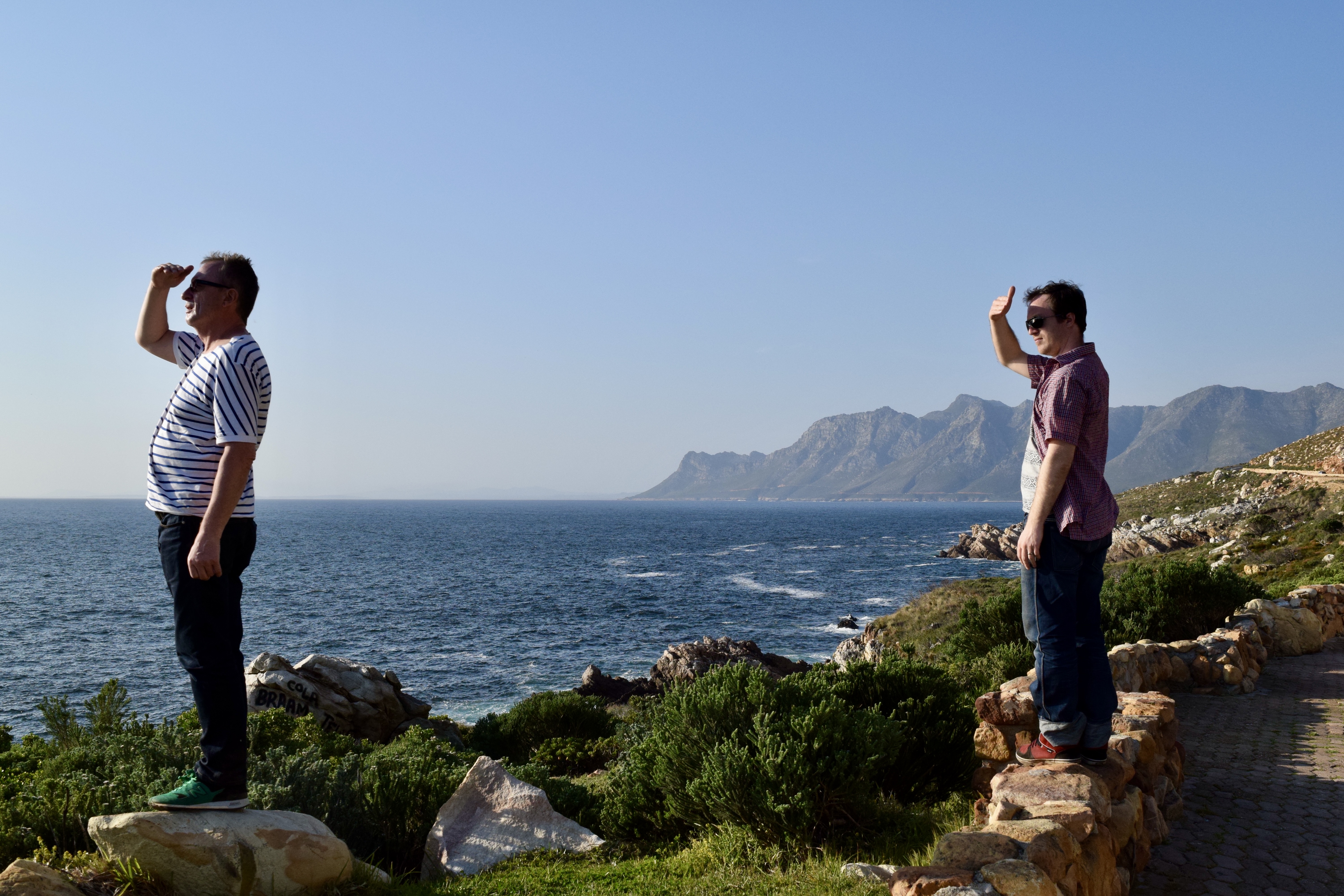
Peter has written on his departure from La Trobe in Intimacy – how it first appeared as an end, as the retirement Bauman recommended he take, but it very quickly led to tremendous opportunities for new experiences and encounters. As always, he brought his students along when possible, such as my visit to South Africa. He had to clean out his office at La Trobe first, filled from floor to ceiling with books that needed to be ‘dispersed’ (Beilharz 2020: 23). I am one of the fortunate PhDs who netted some of these dispersed volumes, invited into the office during the removal chaos to browse and select. The building was shoddy – as I write I’m browsing my damp-warped copy of Postmodern Socialism (Beilharz 1994) that once lived in an inclement corner. At the time it seemed like a mutual favour, we students collectively solved his problem of too much paper while receiving the boon of literature. Seeding our own mountains of paper with fresh old books at our PhD desks also felt like a defiant observance of tradition when administrative executives were attempting to remove bookshelves from offices. I didn’t realise at the time that Peter was undergoing an ‘emotional challenge’ at the dispersing of his library that was fifty years in the making (Beilharz 2020: 24). I once teased him as he and Trevor pored over the pleasant form of a newly arrived book – bibliophiles! He responded with a shrug: ‘Yeah!’ Books are much more than their printed contents, they have the stories and journeys of their collectors, often contain messages and dedications, the marks of previous readings, and can be worthy of appreciation as craft objects with manufacturing and shop histories. I’ve caught the bibliophile bug, too, and have built a small library of my own, floor to near ceiling. Opening a volume to see the cursive P Beilharz on the front endpaper always reminds me of these connections, and I try to piece together the curiosity that led him to this or that particular book, alongside my own.
References
Beilharz P (1994) Postmodern Socialism: Romanticism, City and State. Melbourne: Melbourne University Press.
Beilharz P (2020) Intimacy in Postmodern Times. A Friendship with Zygmunt Bauman. Manchester: Manchester University Press.
Beilharz P and Hogan T (2006). Sociology: Place, Time & Division. Oxford: Oxford University Press.
Löwith K (2002). Max Weber and Karl Marx. New York: Routledge.
Biographic Information
Julian Potter is an editor of Thesis Eleven, an Honorary Adjunct of La Trobe University and a sessional academic at Australian Catholic University. His award winning PhD thesis on Faustian Modernity examines the image of Faust in modern social theory and considers through it the meaning of myth in post-Enlightenment society.


 thesis eleven