
This post is a part of the online special edition Peter Beilharz: The Life of the Mind, Friendship, and Cultural Traffic in Postmodern Times
by David Roberts
Australian identity is anything but self-evident. If it is anything, it is paradoxical. For to be Australian is to be here and elsewhere, at home and away. As a migrant colony, Australia became home from home, the place of arrivals and returns, where ‘home’ oscillated between the poles of old and new identities. As a first paradox, we might think of Australian identity with Derrida as ‘supplementary’, that is, as constituting both less and more than an ‘original’ identity (Derrida, 1967), a condition both impoverishing and enriching at the same time but never wholly the one or the other and so caught in an endless tango of exchange. Peter Beilharz captures this ongoing process of exchange, fed by the flow of people, goods, capital and ideas between the old and the new worlds, between metropolitan centre and open frontier in terms of cultural traffic. Cultural traffic in turn can be understood both in the direct and wider sense as translation. The term is itself the Latin translation of the Greek concept of metaphor: the carrying from one place to another of words, meanings, ideas, practices and religious beliefs, translated since earliest times by migration, exile, diasporas, merchants and traders. As the act of relocation, transformation and recreation, translation epitomizes the idea of supplementarity and in turn the question of identity. In the following, I shall be thinking with and against Peter’s thinking of the Antipodes with the idea of translation in mind.[i]
The Antipodes becomes the place and object of Peter’s thinking with the recognition that his intellectual identity, predicated on the commitment to social equality and justice, had reached an impasse. Looking back to the early 1990s, he realized that he had to jump ship:
All my previous work and intellectual inspiration was tied up with socialism and the labour movement. The object of my desire was disappearing before my eyes. I registered this in Transforming Labor and Postmodern Socialism, but had not yet understood its intellectual consequences. I would have to write about something new, change my life. And I began to work with a new lifeline, which I found in the work of Bernard Smith, our most important antipodean.
Beilharz, 2015: xix
The documents of this fundamental reorientation are gathered in Part One of Thinking the Antipodes: Australian Essays (Beilharz, 2015). In these essays, written between 1989 and 2008, Peter works his way towards a rethinking of the history of Australian settlement, to be understood as a plural process, taking the Australian art historian Bernard Smith as his guide and mentor. Once Smith’s history of the encounter of European vision and the South Pacific is grasped as social theory, this encounter becomes the key for Peter to think about Australian identity in relation to the idea of the Antipodes.
The decision to jump ship was tied to the demise of what the prominent national journalist Paul Kelly (1994) called the Australian Settlement, institutionalized at Federation. Australia had reached its economic limits with the collapse of the minerals boom in the late 1960s, which marked the end of postwar expansion. Precisely the process of stocktaking, undertaken by the Hawke–Keating Labor government in the 1980s, set Peter’s own stocktaking in motion. What is left? was the question behind both his revisioning of Labor and his ruminations on Australia, the Unhappy Country and its discontents. Against the received narrative of the two Australian settlements, in which the original penal colony was transformed into the social laboratory of Federation, Peter proposes a counter-narrative, aimed at reframing the singular idea of the nation in terms of the divided consciousness of two nations:
What remains…is a sense of cultural divide…between a rural and regional culture of survival, mateship and adversity and an urban and suburban proclivity either for civic privatization and life style ghettoes, or else for cosmopolitanism and alternative values in alternative life style ghettoes.
Beilharz, 2015: 43
On this two-nation reading, the class conflicts that had been contained by the Federation-era Australian Settlement had mutated into the familiar culture wars of today. What remains out of focus here, however, is the suburban middle class in all its diversity, the suburban heartlands between rural mateship and inner-urban lifestyle enclaves. Does it follow that suburbia is part of a situation of cultural divide without solution (Beilharz, 2015) or is suburbia not rather the solution, in that it (the Australian middle) dissolves all singular questions of identity? To put my question more sharply, is Australian society today not better understood as the historical realization and very expression of the founding paradox of Australian settlement, which Federation, Kelly’s Australian Settlement, sought to resolve in terms of the unifying concept of the Nation, of the Commonwealth? But here, too, Peter’s tale of two nations was already present, as John Hirst (2001) argues, in the divide between the urban civic-liberal democratic vision of the sacred cause and moral purpose of nationhood and the popular vision of Australia as a land pioneered by bushmen and diggers that turned out to be so readily susceptible to imperial nationalism. Hirst reminds us that nationalism in its creative phase was the work of a minority. And yet, for all that Federation represents for Hirst, an ‘amazing democratic movement’, it is nevertheless the case that most Australians are scarcely aware of their founding act. Federation coincided with the Boer War and the nationhood that it inaugurated would owe more to the spirit of Gallipoli and to participation in British imperial nationalism than to civic nationalism.
In 2001 at the centenary of Federation it was indeed appropriate to speak of Australia’s two foundations or settlements (the penal colony and Federation). At the time I proposed (at a Thesis Eleven workshop) a tale of two centuries, premised, however, on the idea of a third settlement that reconnected with the 19th century, and did so across the limits and limitations of the Australian Settlement and its specific idea of the nation. The tale of two centuries had imposed itself forcefully on me when I arrived in Melbourne in 1964 in the contrast between the ‘Marvellous Melbourne’ that sprang up in a surge of civic confidence and creativity in the wake of the 1850s Gold Rush and the miserable Melbourne of the 20th century that suggested the Chicago of 1900 frozen in time. Hardly a just judgement but entirely appropriate as I understood in retrospect on reading about the singular, indeed world-historical, significance of these two cities in the Introduction to James Belich (Belich 2009) Replenishing the Earth: The Settler Revolution and the Rise of the Anglo-World, 1783–1939, to which I come back later. If, as it appeared at the time, all life had fled the urban centre to the haven of the car-driven sprawl of triple-fronted brick veneers of Robin Boyd’s Australian ugliness beyond the inner, train-served Victorian suburbs, the 1960s was nevertheless the watershed decade, the moment of cultural and political reawakening, summed up for me in the passion of the anti-Vietnam War protests, student mobilization, new sexual freedoms and the riotous fun of the Carlton Pram Factory theatre. Thesis Eleven was to come out of this political and cultural renewal with its accelerated traffic in ideas and ideologies and was to be from the beginning the expression of here and elsewhere, of intellectual exchange, invigorated by the arrival of Johann Arnason and the Budapest School in Melbourne and Sydney. We were all home and away at Thesis Eleven and, if Peter was to find his new home with Bernard Smith in the Antipodes in the 1990s and I in the turn from German literary history to aesthetic theory in the 1980s with Ferenc Fehér and Agnes Heller, we both had in common the Marxian-inflected transformation of social into cultural theory.
The idea of the Antipodes is the reference point for Peter’s themes and thinkers in Thinking the Antipodes (Beilharz, 2015). Given that Bernard Smith and Robert Hughes are key figures, it is somewhat surprising that the connections and correlations between Australia’s settlements and Australian art history are posited rather than explored, connections that I think need to be made. The closest Peter comes to these interconnections is in the essay, ‘Robert Hughes and the provincialism problem’ (Beilharz, 2015) – the problem that has preoccupied Australian art history and theory. The debates encapsulate in pointed form the paradoxes of Australian identity. Like Australia’s settlements, Australian provincialism is a plural story. Thinking the Antipodes requires thinking through (in both senses of the word) the provincialism problem. This problem is the pivot between Peter’s reading of the two Australian settlements and my counter-reading, which, as indicated, presupposes a third settlement. For Peter such a third position is already given in the idea of the Antipodes and for me in the overriding idea of cultural translation, where Australian art history will serve as a refraction of the wider problems of settlement, provincialism and identity.
Australia’s settlements
If Thinking the Antipodes (Beilharz, 2015) is written with Bernhard Smith in mind, it is written against Paul Kelly’s (Kelly, 1994) manifesto for the decade of Hawke/Keating reforms, The End of Certainty, which declared the demise of the Australian Settlement, launched by Federation. It leads Peter in response to contemplate two, three or four settlements: (1) from 1788 to 1901; (2) from 1901 to 1983 and the Labor/trade unions’ Accord; (3) from 1983 onwards; eventually to (4) a future reconciliation with the First Peoples of Australia, presaged by the 1998 High Court Mabo judgment, Prime Minister Paul Keating’s 1992 Redfern speech and, despite the outcome, the 2023 national referendum on Voice. But what lies beyond the second Federation settlement comes into focus only indirectly in terms of two negative theses: first, that when it comes to making sense of Australia today ‘neither imperial nor nativist mythology will do’ and second, that in the process of revisioning the Antipodes, ‘it is time to transcend teleological stories of the Australians as an emerging popular subject’ (Beilharz, 2015: 5). But again, it is necessary to historicize. Both theses need to be read as a critique of Australia’s second settlement. They do not explain, however, Peter’s ambivalence in relation to the demise of the second settlement and the brave new world announced by Kelly: Peter’s ambivalence belongs not to the problems of the two settlements but rather to Peter’s own tale of two nations. In respect of the tale of two nations (rural v. urban, mateship v. civic privatization, struggle v. lifestyle), Kelly displaces Smith and reinforces the focus on Kelly’s Australian Settlement. And here the first, truly foundational settlement of 1788 is presupposed rather than examined: in Peter’s reading, the penal colony that comes good with the discovery of gold. That gold made the settlers ‘rich, lucky, complacent, and democratic’ (Beilharz, 2015: 34) hardly does justice to Australia’s golden age. To conclude that prosperity spelt mediocrity, as WK Hancock did in 1930 (Hancock, 1930), looks to be a judgement more relevant to Australian society after 1918 than to the second half of the 19th century. It is in fact little more than a lead into Kelly’s image of Federation Australia as the old, redundant, closed society, dismantled by the structural reforms of the 1980s. Kelly’s model derives from Hancock, but that does not mean that the Federation settlement itself can be reduced to monolithic closure. Between Hancock in 1930 and Kelly in 1994 lies the post-1945 economic reconstruction and expansion, fuelled by a new wave of British and European immigration. As Peter himself observes:
If Australian modernity was anticipated in 1901 … it was only filled out in the postwar moment, when Australian modernity took the shape that made us, the children of the nineteen fifties, and became the frame for all that was to follow.
Beilharz, 2015: 91
And again:
The significance of the Second World War for the project of nation-building in Australia cannot be underestimated … If Federation was the first serious political attempt to make an Australian nation-state, the Postwar Reconstruction was its practical sequel and extension in a world where nation-building and rebuilding was now a global imperative.
Beilharz, 2015: 63–4
Peter’s tale of two nations (struggle v. lifestyle) is still latent because postwar nation-building found its social democratic culmination in the brief moment of the Whitlam government 1972–75, when Australian modernity for Peter came closest to the Antipodean image of the social laboratory and where, as opposed to 1901, the transformative effects of immigration gave cultural nationalism a ‘cosmopolitan inflexion’ (Beilharz, 2015: 38).
I am not persuaded that the claim to Australian exceptionalism can be identified with its institutionalization at Federation in the form of industry protection, wage arbitration and the White Australia policy, under the aegis of state paternalism, seconded by imperial benevolence. The opening of the economy to competition and Australian society to multiculturalism in the 1980s has as much a claim to exceptionalism as the preceding 80 years of nation-building – an exceptionalism, moreover, that like its predecessor achieved bipartisan consensus, despite the paralysis in policy-making that bedevilled government following the defeat of the Liberals under John Howard in 2007, and to which a leading advocate for Australia’s new post-Federation settlement, Kevin Rudd, fell victim. The occasion was the launch of Paul Kelly’s follow-up to The End of Certainty (1994). In The March of the Patriots, Kelly (2009) put forward the idea of a new bipartisan exceptionalism, still faithful to the Australian values of economic pragmatism and social egalitarianism, deemed capable of steering a course between the twin dangers of American neoliberalism and the bureaucratic over-regulation of the European Union. Rudd, also offering the idea of a new exceptionalism, was insistent that the claim to exceptionalism applied to the whole history of Australian settlement: ‘A nation that has carved an economy from an inhospitable earth to build one of the most prosperous on earth.’ And again: ‘A nation that has often led the world in social progress like rights for women and rights for working people – building one of the most open, most progressive, least class-based societies in the world’ (Rudd, 2009). The almost inalienable sense of fairness in the Australian DNA, of which Rudd speaks, never extended to the Indigenous Australians.
What is the case that Kelly and Rudd were making for exceptionalism? Rudd envisaged a ‘great Australian contract’ to secure the ‘epic achievement’ of the Hawke–Keating reforms, which would build the public support needed for the difficult challenges of modernizing the economy without sacrificing the idea of a decent society – laudable aims, but hardly exceptional. Rudd is more persuasive when he singles out the exceptional capacity for adaptation and change evident in the remarkably peaceful transformation of White Australia into today’s multicultural society. Here it is worth noting that immigrants as a percentage of the population had been falling since Federation and reached at 10%, its lowest point in 1947, to rise to nearly 30% in the space of two generations – a demographic revolution that cannot be reduced to a tale of two nations. From a population of some 4 million in 1901 to 26 million in 2023, immigration is probably the most important index of Australia’s economic fortunes since Federation. More important: demographic change was the driving force determining the demise of the statist White Australian nation-building project of Federation, a project that subsequently was subsumed into the open question of Australian identity. Here I want to come back to Peter’s emphasis on the vital formative importance of the Second World War for Australian modernity – ‘Indeed, my own sense is that this is when modern Australia emerges. It is posited by Federation, the Great War and the earlier reconstruction, but it emerges only with war, planning, federal powers, Postwar Reconstruction’ (Beilharz, 2015: 50) – because it is important to add that this formative moment was prefigured in the rapid growth of cities and population in the second half of the 19th century. It was this era that produced ‘Marvellous Melbourne’, one of the great Victorian cities.
Seen in this light, I want to argue that the second half of the 19th century and the second half of the 20th century were the two vital formative epochs in Australia’s history. The first culminated in Federation, the second in the transformation of Anglo-Australian society into one of the most ethnically and culturally diverse and harmonious societies in the world. For the Federation era, ‘two nations’ might continue to reflect the continuing city/rural divide, but the divide is a residual one, and one over-determined in many ways by the inner-city v. suburban nation divide, which itself was already evident in the 1970s. The first epoch (the last half of the 19th century) worked towards the founding, defining and confining of Australian identity in the nation-state at Federation; the second epoch worked towards rethinking an exclusive national identity in terms of an inclusive civic nationalism that looks for identity in diversity rather than unity. If the discovery of gold helped make Australian society in the second half of the 19th century a social laboratory that attracted world attention, it was the impetus of postwar reconstruction that set Australia on course to be the laboratory of the social experiment in assimilation that still finds its limit in relation to Australia’s First Nations.
The provincialism problem: Colonial, national, global
If Australia’s story is exceptional, is it also provincial? I will argue that exceptionalism and provincialism are the two sides of the (self-) perception of Australian settlement, which find a particularly interesting reflection in Australian art history. Bernard Smith set the scene in 1960 in European Vision and the South Pacific (1985). The two poles of his title proclaim equivalence: the South Pacific is as significant for Europe as Europe is for the South Pacific. In this meeting of two worlds, the European vision of the South Pacific was a matter of science as much as of art. It found its primary expression in the attempts to capture the ‘essential qualities of a particular kind of geographical environment’ (Smith, 1985 [1960]: 4) in order to render the typicality or, in Alexander von Humboldt’s term, the physiognomy of the new landscapes. The typical landscape became thus the type of the encounter between European vision and the South Pacific. Indeed, the image of the Australian landscape was to be the defining image of Australian art up to Sidney Nolan, Arthur Boyd and Fred Williams and beyond (Williams’ connection with the Heide group is given through his friendship with Albert Tucker after Tucker established himself at Hurstbridge, close to Melbourne, in 1964 after his return to Australia in 1960), just as this reciprocity of metropolis and frontier has remained determinate both for Australian exceptionalism and provincialism – a question that Smith struggled to resolve from European Vision in 1960 through to the fourth edition of his history of Australian painting since 1788 in 2001.
Thus, in Australian Painting (Smith, 2001 [1962]), we find side by side two statements difficult to reconcile. First: from the beginning Australian art ‘has been the product of a perennial commutation between the northern and the southern hemispheres. It still is.’ And second: ‘the European art of Australia has continued to be provincial art carried on for almost two centuries now in a south-east Asian situation far from such metropolitan sources as London, Paris and more recently, New York’ (Smith, 2001 [1962]: 333). Is then the distinguishing feature of Australian art its provincial dependence on the imperial centre – even though Smith makes a point of quoting Charles Darwin’s enthusiastic endorsement of Sydney in 1836 – ‘ancient Rome, in her imperial grandeur, would not have been ashamed of such an offspring’ (Smith, 1985 [1960]: 284) – or does it lie rather in the ‘perennial commutation’ between the old and the new worlds? Both apparently contradictory positions presuppose the two-way flow of cultural traffic. The question, however, is the following: is this traffic best understood as cultural translation or as cultural imitation? Smith (2001 [1962]: vi) compounds the problem by making the answer dependent on the development of a national tradition in Australia when he writes in the ‘Introduction’ to Australian Painting:
A national tradition always matures slowly and in the arts very slowly indeed. So in this book we study seed-time, the harvest still being beyond knowledge…One thing is certain, however: Australian art will not emerge fully formed until it produces masterpieces which fashion from the Australian experience of life something of lasting value for the whole field of human experience.
The prediction of a national tradition to come, of a future harvest to be gathered into the world pantheon of masterpieces, could perhaps have been entertained in 1962. In 2001 such belated historicism amounts to nothing more than a nostalgic archaism, a throwback to the idea of the national as a native essence, an inborn originality waiting to slowly develop and unfold, and, as such, internally determined rather than reciprocally constituted and functioning not just as a surrogate projection of Australian nationhood but as its quintessential expression. Smith’s future harvest is uncritically reminiscent of 19th-century cultural historicism, in which a national school of painting is the corollary of a nationalist version of the nation. This kind of art history is responsible for making the brief moment of the Heidelberg School between 1885 and 1890 the enduring popular image of the ‘Australianness’ of Australian painting and its subsequent enshrinement as a ‘national legend’ after the First World War, when the ageing expatriates, led by Arthur Streeton, returned as patriots to install ‘academic neo-impressionism’ as the ruling norm (Smith, 2001 [1962]: 168). Pace Smith, the idea of a national school of Australian painting belonged not to the future but to the nation-building project of Federation, more specifically to the cultural protectionism (hostile into the 1940s to European modernism and avant-gardism) that carried over into the postwar climate of a provincial national conservatism. Up to the watershed decade of the 1960s, this cultural complex went hand in hand with an ongoing tradition of artistic expatriation.
Robert Hughes was one of these expatriates, the modernist in search of the metropolis: London, before he found his ‘homes from home’ in New York and Barcelona. Like Bernard Smith, Hughes was a historicist, whose time – the revolving door of New York avant-gardism – was already running out when he left Australia. Hughes straddles two distinct iterations of the provincialism problem in Australian art: the one in relation to 19th-century colonial painting, the other the inescapable contemporary subjection of Australian artists to the assumption of an ever more relentless provincialism, dictated by the domination of the metropolitan centre (Smith, 1974).
The first, more interesting problem is drastically exemplified in Hughes’ (1970: 51) rubbishing of the whole period of colonial art in Australia (and with it Smith’s European Vision and the South Pacific):
No country in the West, with the possible exception of Patagonia, was less endowed with talent. Granted the minor exception of Gill, Glover, Martens and Buvelot, a whole century passed without producing anything but mediocre, amateurish or thwarted painters. There is little in the history of Australian art between 1788 and 1895 that would interest an historian except the way that painters set down in an environment for whose forms their training had not prepared them, accommodated themselves to it.
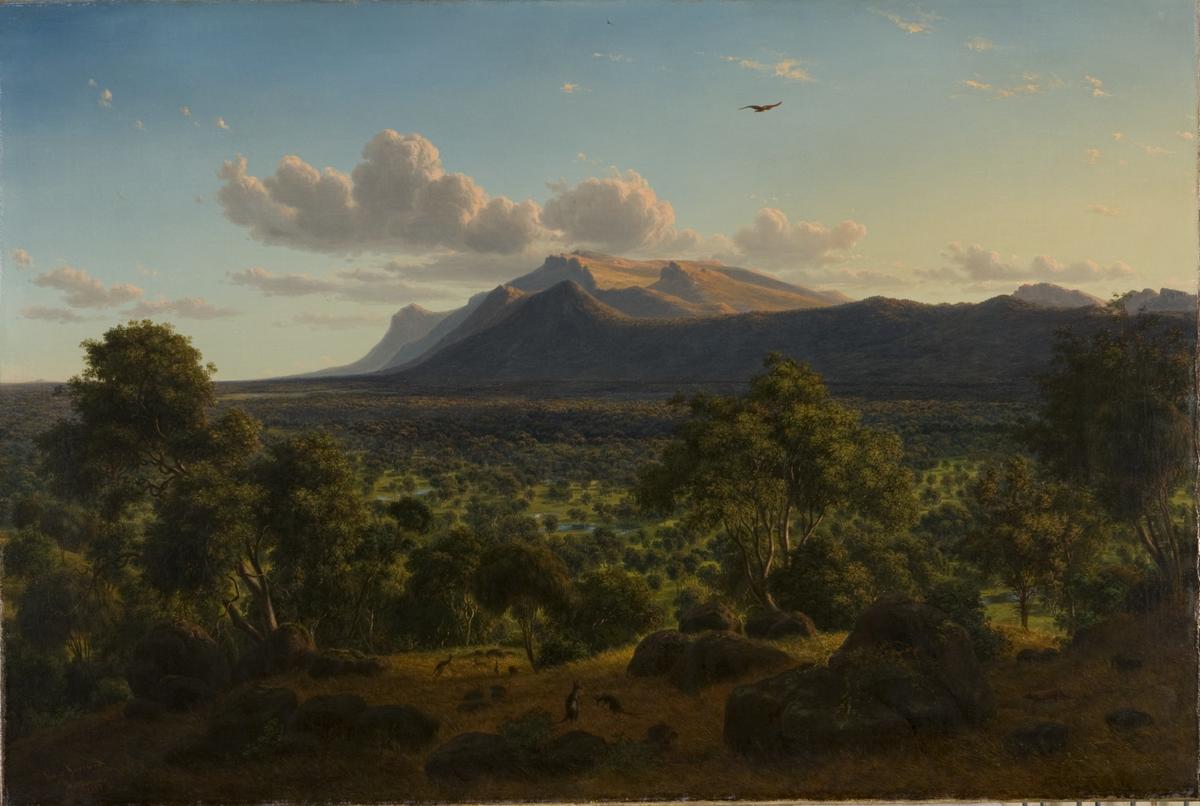
Hughes anticipates Terry Smith’s ‘relentless provincialism’ and projects it back into the 19th century along with a dismissive acknowledgement of the historical interest of Bernard Smith’s account of the encounter with an alien environment. Besides the latter’s nuanced study, Hughes’ brash prejudice is painfully provincial. Nevertheless, Hughes and Smith have more in common than might appear. To take one not so minor example: Eugene von Guérard is not even listed among Hughes’ minor exceptions; he is absent from Smith’s (1945 [1979]) Place, Taste and Tradition and credited with no more than a ‘polished accuracy’ in Australian Painting 1788–2000 (Smith, 2001 [1962]: 58). These omissions are indicative of the distance that separates both art historians from the revisioning of Australian colonial art that has finally done justice to the creativity of the translation of European vision into the colonial imaging and imaginary of Australian and North American nature in the 19th century (for which one of the most important common sources was the contribution of artists from the Düsseldorf School of Art, notably Guérard in Australia and the artists George Caleb Bingham, Richard Caton or Worthington Whittridge, the teacher of Albert Bierstadt in the States). I am referring here to the exhibition New Worlds from Old: 19th Century Australian and American Landscapes (Johns, 1998). The catalogue to the exhibition has as its cover illustration an 1857 painting by Guérard, ‘Mount William from Mount Dryden, Victoria’. The ‘Foreword’ by the Directors of the Galleries, which mounted the exhibition, the Wadsworth Atheneum in Hartford, Connecticut, and the National Gallery of Australia, Canberra, sums up the theme of the exhibition: ‘There are many revelations of this show, which systematically examines how two cultures convert nature into landscape and, while coming to terms with received traditions of their European heritage, creatively recast those conventions for their own purposes’ (Johns, 1998: 8).
In the process of bringing what is known to the experience of the unknown, these cultures illuminated ‘the most profound relationship that we have – that with the land on which we live’ (Johns, 1998: 12). Patrick McCaughey (Johns, 1998) speaks of an ‘inner imaginative awakening’ (Johns, 1998: 17) that has made it impossible to imagine either Australia or America in the 19th century without recourse to landscape depictions from Glover to Tom Roberts or from Thomas Cole to Winslow Homer. This meant recognizing in the process that Glover and Guérard are ‘artists of substance’ (Johns, 1998: 17). McCaughey’s question: ‘Why should such a distinctive and distinguished national school have won such little recognition beyond its shores?’ nicely captures the problem of exceptionalism and provincialism as the two sides of the same coin. Did the exhibition answer the riddle of metropolitan non-recognition? Yes and no, according to McCaughey. On the one hand, Australian art came of age by being placed in the comparative context of another expanding and developing society (America). On the other hand, even though the art of both colonies can lay claim to ‘remarkable historical achievements’, it remains the case that neither corpus of works amounts to more than an object of curiosity to European taste: ‘The new worlds may mean something to each other, but their past presses lightly on the imagination of the old’ (Johns, 1998: 20–1). In other words, the process of a post-Eurocentric reorientation needs to go beyond ritual obeisance to post-colonialism to a rethinking of the metropolitan–frontier symbiosis, that is, by reframing and recontextualizing the problem of provincialism, whether colonial or national, within the larger historical context of an expanding and developing Anglo-American world system since the late 18th century (Belich, 2009).
The contributors to the New Worlds catalogue were fully aware that Australian art did not suddenly come into being with the Heidelberg School but that the latter represented the culmination of a century of colonial endeavour (Smith, 2001 [1962]). It was rather the rise of cultural nationalism from the late 19th century that relegated colonial art to a mere precursor of the new national school, elevating the Heidelberg School to the solitary splendour of a national legend. The naturalistically rendered image of the sunlit Australian landscape was the pastoral projection of an urbanized population, which it peopled with rugged rural workers. If this orthodoxy, inimical to new tendencies, became the new nationalist version of provincialism after the First World War, its other face was expatriation – escape to the metropolis. The progressive institutionalization of art from the 1870s in the form of art galleries and art schools led in Australia as in Europe to the formation of small (bohemian) subcultures of professional artists, for whom the metropolis beckoned with the prospect of study and advancement, patrons and profit, which Australian society was too small to satisfy. Of the artists who left for Europe between 1880 and 1914, Bernard Smith distinguishes between the short- and the long-term visitors, that is, between visitors and expatriates. The latter comprises a long list, from the Heidelberg painters Roberts, Streeton and Conder to the society painters Rupert Bunny, Hugh Ramsey and George Washington Lambert. Expatriation proved to be a mixed blessing. Bunny and Lambert achieved success as portrait painters. Severed from its native soil, the Heidelberg diaspora, however, suffered a drastic loss of inspiration (Johns, 1998; Smith, 2001 [1962]). In the light of this expatriation, we must speak of an aborted national school in relation to the first four decades of Federation, whose substitute, as we have seen, was the cultivation of the national legend of the Heidelberg School. For Smith (2001 [1962]: 196), Streeton after his return to Australia became the embodiment of a ‘pathological nationalism that had been growing in the country since the Anzacs had stormed the Dardanelles’.
The brief moment of the Heidelberg School and its dispersion is repeated in the second brief moment of the florescence of Australian painting, the years of rebirth (Smith) across the angry decade (Hughes) of the 1940s. Tempting as it would be to revisit the querelle between Hughes and Smith (Berryman, 2021), let me just refer to the distinction Smith draws between Australian isolation and isolationism in his response to Hughes. Where for Hughes it was geographical and cultural isolation that defined Australia’s perennial provincialism, it was isolationism for Smith that defined the provincialism of Australia between the wars, against which the Heide artists around Melbourne-based John and Sunday Reed revolted. But here again, the lack of public recognition and support in the 1950s and 1960s played a major role in dispersion and diaspora. When Albert Tucker departed in 1947 he thought of himself as a cultural refugee; Nolan moved from Melbourne to Sydney in 1947 and then to London in 1951. Arthur Boyd moved to London in 1959 to return as a celebrated artist in 1971. For all three, their greatest work was created before leaving for Europe. One can only concur with Hughes’ (1970: 227) harsh verdict on Nolan: ‘As one passes from his African paintings to his Antarctic series to his latest Australian landscapes, one becomes uncomfortably aware that a cast-iron technique is being applied to a sequence of superficial tourist views.’
We are left with the two brief moments of Heidelberg and Heide as the two defining episodes of Australian art as tokens of a national school of landscape painting, with figures in a landscape in its second incarnation from Ned Kelly to Boyd’s Breughelesque biblical scenes and his first Aboriginal series ‘The Hunters’ and ‘The Lovers’ – tokens, because they were followed by expatriation.
Hughes himself left for Europe in 1964, first to Italy, London in 1965 and then to New York in 1970 as the art critic for TIME magazine. And it is from the metropolitan centre that he can formulate the question that signals the end of the fatal entanglement of nationalism, provincialism and diaspora: ‘When does one stop talking about Australian art’ (Hughes, 1970: 310)? When do we stop talking about it ‘as if it denoted some kind of shared relationship to an environment among painters’ (Hughes, 1970: 312)? Bernard Smith also discerns signs in the 1960s of a change in Australia’s ‘provincial situation’. Although Australia remains as distant as ever from London, Paris and New York, it is by this time beginning to create a metropolitan centre of its own, which Smith (2001 [1962]: 334) attributes to postwar migration and the growth of cosmopolitan art circles and improved possibilities of travel and communication, in short, the emergence of the critical mass capable of generating its own creativity. For all that, Smith’s survey into the 1990s of the pluralized postmodern art scene concludes that the ‘double-binds of provincialism’ (2001 [1962]: 554) have now been recast in more complex forms.
The cultural turning point of the 1960s anticipated the end of Kelly’s Australian Settlement, which Robert Hughes articulates in his view of the irrelevance of the idea of a national school of Australian art. If Smith registers the multiplication of art centres as a new stage of globalization, it is Hughes who spells out the consequences for art in Australia: the generalized dissemination of images across the world announces the condition of an ‘unstable eclecticism’ (1970: 313), which was soon to be dubbed postmodernism. Hughes is not ready to abandon the double-bind of provincialism, however. Despite the new global context, Australian isolation persists. On this view the spatial isolation of the 19th century had mutated into the temporal belatedness of the 20th century that left Australian artists limping a generation behind the European avant-garde. It was precisely this identification of art history with the ever-accelerating ‘Shock of the New’ (Hughes, 1980) that led in 1974 to Terry Smith’s globalized, hence ultimate, statement of the provincialism problem. Despite the fact that by the 1970s there were many art worlds they all shared the same fatal problem: the problem of provincialism – or ‘subservience to an externally imposed hierarchy of cultural values’, brought about by their common submission to the New York art world as the global metropolitan centre, the sole font of the New, the factory of ‘accelerated avant-gardism’ (Smith, 1974: n.p.). Echoing Hughes, Terry Smith laments the inescapable belatedness of the periphery as the condition of provincialism, defined as the impossibility of being anything but derivative. When Smith (1974) characterizes Nolan and Boyd’s work as ‘eccentrically eclectic blends with a local accent’, it is in order to qualify Nolan as a great Australian artist, as opposed to Jackson Pollock who is a great artist tout court (n.p.). Terry Smith pushes the provincialism problem to the limit. But whether we take Bernard Smith or Terry Smith or Robert Hughes, we are confronted by the irresolution of the double bind premised on the thesis that the provincial artist cannot choose not to be provincial – the very dilemma exemplified by the history of Australia’s expatriates (cf. Beilharz, 2015: 230).
Terry Smith’s own unresolved double bind is itself belated in all sorts of ways. His vision of the chosen few, riding the crest of the avant-garde wave, who were alone able to propel their work into the long-term history of art, was indeed a vision of art history, which had reached its own self-destructive limit and whose end – the dernier cri of the New – was soon to be proclaimed, in New York of course. To declare the whole world, including all of the United States, apart from New York, provincial totally inflates at the same time as it totally devalues the term. Terry Smith is thus left stranded between the one world of art history as progress and the alternative global conception of multiple art worlds as the expression of multiple modernities. Once this alternative global perspective is recognized as the counterpart to the end of the Australian Settlement, then the provincialism problem and with it the obsessive question of what the identity of Australian art is ceases to be a problem.
This is the argument of Rex Butler and ADS Donaldson (2017). With the advantage of 40 years’ hindsight, they question not only Terry Smith’s ‘relentless provincialism’ but equally the validity of the term itself. Their reply to Smith takes the form of two theses:
First: ‘An understanding of Australian art in terms of the national, and hence in terms of its provincialism, can no longer stand.’
Second: ‘Australian artists of all kinds have always thought of themselves as – and actually were – not provincials existing in a mediated relationship to a faraway metropolitan centre, but contemporary with and immediately connected to what was happening elsewhere’.
Butler and Donaldson, 2017: n.p.
Their counter-polemic clears the ground for the reappraisal of Australian art history, which, to a degree, has been underway since the 1980s. The one example that I have highlighted is the exhibition ‘New Worlds from Old’, which helped to transform the understanding and appreciation of colonial art in its own right precisely by presenting it in a comparative context. The question of context is crucial here as I shall argue in conclusion. In relation to Australian art in terms of the national, the comparative context takes the more familiar form of comparison with Europe, most notably in The Antipodean Manifesto of 1959, in which the debates over the direction of Australian modernism in the wake of the revolt of the angry decade of the 1940s against the cultural provincialism of a protectionist nationalism came to a head. The Manifesto was largely authored by Bernard Smith for ‘The Antipodeans’ exhibition in Melbourne in August 1959 and co-signed by the artists involved: Charles Blackman, John Brack, Arthur and David Boyd, John Perceval and Clifton Pugh (Berryman, 2021). In 1983 Terry Smith defended the Manifesto as the assertion of the distinctively Australian moment of the 1940s, defined by its creative fusion of the Australian and the European against the postwar invasion of a Sydney-based American modernism (Smith, 1983). By 1983 Terry Smith is ready to move on beyond his own earlier reading of this Australian moment of modernism as an eccentrically eclectic blend with a local accent to one that can now embrace the social realism of Noel Counihan and Josl Berger as well as the Heide artists.
If the globalization of art worlds was the precondition of this process of re-evaluation of Australian art history, it is paralleled by the re-evaluation of cultural translation that has established itself during this most recent wave of globalization. As I indicated in the introduction, cultural translation seems to me to be the concept that captures best the reciprocity involved in the relationship between the old and new worlds, as relevant to the whole endeavour of Australian settlement as to the more focused question of the pictorial representation of the new environment. Just as the significance of translation has at last come to be recognized in the field of literary and linguistic studies as the precondition of world literature since the collapse of the paradigm of national literary histories, so in turn has the historical significance of translation as the very condition of the formation of cultures and of cultural creativity (the European Renaissance and the Reformation are inconceivable without translation). The translation of texts has always been more than a linguistic exercise for it always involves a process of transmission, transfer and transformation of the encounter between two semantic worlds. The conventional understanding of translation as secondary to an original source makes translation as it were exceptional and provincial at the same time – as long as we understand that exceptional and provincial represent the two sides of the same assumption of the supplementarity of the act of translation. Rather than arguing for exceptionality as a compensation for provincialism I think it is essential to grasp translation as the act of re-creation of the source and thus in relation to settler societies as the re-creation of the old world in the new. To put my argument in pointed form: to be Antipodean is to live in a state of translation. Furthermore, the idea of translation is a pivotal way of understanding Australian exceptionalism. The act of translation coalesces the exceptional and the provincial, making them ultimately each a version and a mirror of the other. Acts of translation cast a fundamental light on both the question of Australian art history and that of Australian settlements. In brief:
- Colonial art in Australia was not provincial. On the contrary, as the meeting of European vision and an unknown environment, it documents the translation of the old world into the new and the translation of the new world back to the old.
- Strictly speaking, the provincialism problem is the other of nation-building not of colonialism. Provincialism is less a problem of spatial distance and temporal belatedness than of a self-confining and self-confirming understanding of national identity as reflected in the expectation of a national school of painting.
- In a globalized world of multiple artworlds the Australianness of Australian art and with it the problem of provincialism lose their purchase for the same reason that the question of Australian identity has been transformed into one of reciprocal translations.
Australian identity understood as a set of reciprocal translations (between old and new, new and old, and so on) brings us back to Peter’s reading of Australia’s two settlements, which I want to reread in the form of two counter-theses:
- The first settlement – the penal colony of 1788 – was Australia’s most important social laboratory, whose outcome was ratified and codified at Federation. It was the progressive, even explosive construction of a new world from the old and its greatest creation was its cities, also in the wider sense of the building of the institutions (the common institutions of the Anglo-World) that were the precondition of Federation.
- The second, Federation settlement set out to translate and channel the social laboratory, the social experiment of the 19th century into the project of nation-building. It was overshadowed up to the Second World War by the adverse external environment of the Great War and the Great Depression and internally by cultural conservatism and protectionism, mirrored in the ongoing decline in immigration. The Second World War shook Australia out of its retreat into complacency and initiated the second formative moment of self-creation, driven by the energies of renewed immigration that has progressively transformed Australian society since the 1960s into the social laboratory of multiculturalism that, to my mind, answers Peter’s diagnosis of Australia as the unhappy country. The pluralizing of Australian identity through reciprocal acts of translation goes beyond Peter’s divided nation (earnest struggle v. civic privatism). Moreover, it represents the historical outcome of Peter’s own thinking of the Antipodes as constituted by cultural traffic. The creative energies of immigration, which Federation sought to channel into an Anglo-Australian imperial identity into the 1960s, have long since transformed Kelly’s Australian Settlement into a third multicultural settlement, which as yet has failed to find a way to include the country’s First Peoples.
To conclude, I want to argue that the work of translation, which occurs in all encounters between different cultures and civilizations, establishes the significance of cultural reciprocity in relation to the all too reductive focus on the priority of power differentials of European globalization since the 16th century (cf. Wallerstein’s economically determined world system). Cultural reciprocity (Peter’s traffic) forms the first crucial context for the encounter between Europe and the South Pacific and for the successive extensions of Australian settlement across the 19th century. It is the context that has underpinned Australia’s distinct fusion of exceptionalism and provincialism, itself premised on the polarity of metropolis and province and the two-way flow of goods, capital, people and ideas. The second crucial context is that of economic reciprocity, which focuses on the dynamics of growth generated by migrant flows that generate in turn the dynamic symbiosis of metropolis and open frontier, central to the rapid expansion and development of the settler societies in North America, Australia, New Zealand and South Africa and the rise of the Anglo-World to global dominance since the Napoleonic Wars. If Bernard Smith revealed for Peter cultural theory as social theory, then James Belich’s reframing of the debates about Australian exceptionalism and provincialism within the larger world-historical context of the rise of the Anglosphere reveals economic history equally as cultural theory, underpinning my parallel reading of Australia’s colonial, national and global settlements and art history. More importantly, Belich’s rethinking of the Antipodes in a comparative global context opens the way to putting the Antipodes back on its feet by giving it its proper due as the amazingly successful creation of new worlds from old.
References
Beilharz P (2015) Thinking the Antipodes. Australian Essays. Melbourne: Monash University Publishing.
Belich J (2009) Replenishing the Earth. The Settler Revolution and the Rise of the Anglo-World, 1783-1939. Oxford: Oxford University Press.
Berryman J (2021) Bernard Smith and Robert Hughes: a critical dialogue. Journal of Art Historiography 25 (December 2021)
Butler R, A D C Donaldson (2017) Was Australian art ever provincial? ARTmagazine 6(1); 6-32.
Derrida J (1967) De la grammatologie. Paris: Les Editions de Minuit, 203-226.
Hancock W K (1930) Australia. London: Ernest Benn.
Hirst P (2001) Federalism: Destiny and Identity. Parliamentary Papers 37. About Parliament.
Johns E (1998) New Worlds from Old. 19th Century Australian and American Landscapes. Melbourne: Thanes & Hudson.
Kelly P (1994) The End of Certainty. Power, Politics & Business in Australia. Sydney: Allen & Unwin.
Kelly P (2009) The March of the Patriots. The Struggle for Modern Australia. Melbourne: Melbourne University Press.
Rudd K (2009) Speech Launching The March of the Patriots. https://parlinfo. aph.gov.au
Smith B (1979) Place, Taste and Tradition. A Study of Australian Art since 1788. Melbourne: Melbourne University Press.
Smith B (1985) European Vision and the South Pacific. A Study in the History of Art and Ideas. Yale: Yale University Press.
Smith B (2001) Australian Painting 1788-2000. Melbourne: Melbourne University Press.
Smith T (1974) The Provincialism Problem. Artforum 12(1): 54-59. arthistoriography.files.wordpress.com/2011/05/Smith-provincialism-problem =1974pdf.
Smith T (1983) Writing the History of Australian Art. Australian Journal of Art 3: 10-24.
Notes
[i] I would like to thank Peter Murphy, Jill Redner and Margaret Rose for reading my paper and for their helpful comments.
Biographical Information
David Roberts is Emeritus Professor of German Studies Monash University. His most recent publications include History of the Present: The Contemporary and its Culture (Routledge 2021). (with Robert Savage) Hans Blumenberg. The Readability of the World. (Cornell University Press 2022, and (with Andrew Milner and Peter Murphy) Science Fiction and Narrative Form (Bloomsbury2023).


 thesis eleven