
Fathers and Sons, Nikos Papastergiadis on John Berger: A Conversation with Peter Beilharz
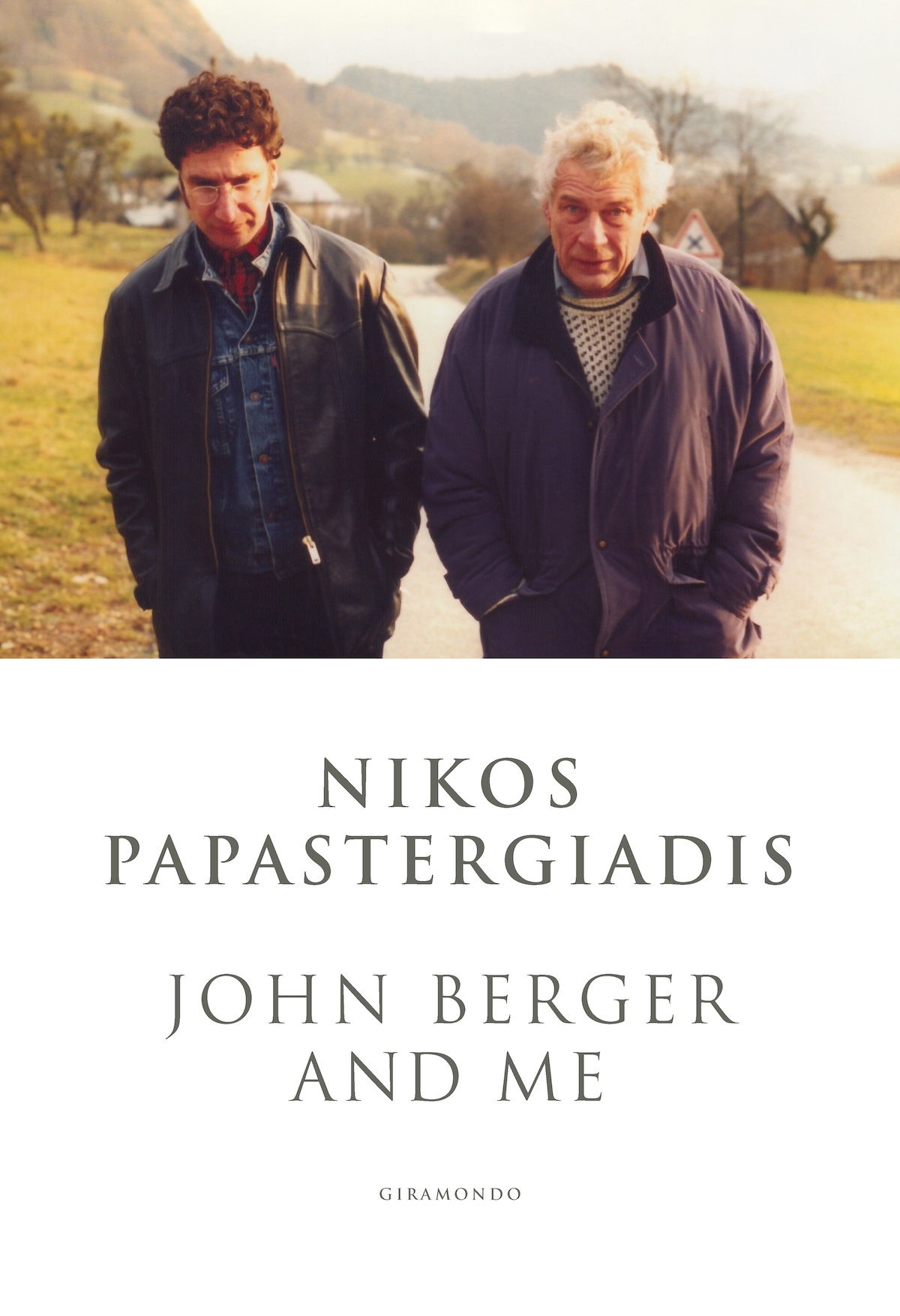
Nikos Papstergiadis, John Berger and Me (Giramondo, 2024)
PB You got your hands dirty with John Berger, mucking in the French Alps. Got to scrape that shit right off your shoes. What kind of exemplar was he?
NP The village was beautiful, austere, majestic and fundamental. I once met Edward Said early on in my Phd candidature. I told him about my research and he extolled the virtues of John Berger, but then added: “Whatever you do, just don’t go to visit him there. There are pigs and shit everywhere.” I said, “it sounds like my father’s village.” It was not a turn off to me. Once I got there, I didn’t see any pigs. The pig sty was empty. It later became a storeroom for all the books that John published. John, himself did not even keep copies of his books. His library was always confined to books and material that addressed the current task at hand. The toilet was an outdoor shed, with a hole in the ground. I quickly adjusted and even enjoyed reading the Guardian Weekly while on the bog. Every year, John would disassemble the shed and empty the waste. He seemed at peace in the village. He was much more at home there than in any restaurant or museum. After the first time I stayed with him I came away with the feeling that the way he moved in the house and among his neighbours was close to the way he saw connections between ideas and experiences. His way of cooking and showing hospitality became a model to me of his working methods.
PB Was this a stopping place in the ruins of modernity?
NP I think so. When I first went to the village there were no young people there. Mostly elderly bachelors. They were the last generation of peasants. A way of life that had survived for millennia. Now the village has had a rebirth. The people of Yves’s generation, John’s youngest son, have chosen to stay. They have found work in the tourist sector and the manufacturing of micro engineering. The village provides a new balance between work and sociality. The small dairy farms have been amalgamated and the cows seem to enjoy their new digs. There is a modest but nevertheless an unexpected prosperity, and I would say that not all the old values have been lost. There is still a fierce anarchic streak there. Still a deep distrust towards authority and strong sense of looking out for each other. In a weird way COVID deepened some of the old bonds.
PB Berger turns to the land at the same time as your parents exit the peasant life for Melbourne. Your mother was delighted by the connect offered between their worlds in A Seventh Man (1975). ‘How could he know this?’ You say you never saw your father read a book, though he venerated education, loathed the amorphote. How can we begin to understand this crossover? And, how do you begin to explain the astonishing leap in lifeworlds across a single generation?
NP The epistemic leaps and technological advances that were experienced in the generation of my parents continues to astound me. I am left speechless when I think that my father was born in a mud house in the mountains of Greece, he left his life as a shepherd and worked as a taxi driver in Melbourne. Berger in French means shepherd. He was in awe of the stories I told about my parents. However, he found a multicultural city in a former English colony equally mind boggling. His imagination could never seem to get there. A number of French thinkers have noted this transition with equal astonishment, Michel Serres and Pierre Bourdieu tried to comprehend this leap and make sense of it. They also carried this journey in their body memories. My book was an attempt to at least trace this cross-over. It is a stunning achievement for people, like my parents, to be able hold together such different worlds. Although my father’s strategy was to bury himself in games of luck and strategy, like cards and backgammon, my mother and her friends tended to be more willing to talk. The way they gossiped was close to hermeneutics. My mother told my daughter that when she was a child there was no electricity in the village. My eight-year-old daughter was stunned: “So what did you do all day and night!” “We told stories and sang.” Replied my mother.
PB The two of you, John and Nikos, astride those big motorbikes across the French countryside, avoiding the motorways. It reminds us of C Wright Mills and his BMW, if not Che and The Motorcycle Diaries. Can this narrative be written without love, or romance?
NP That is brilliant. I didn’t know about C Wright Mills. Che and his bike was an inspiration. Although his bike was constantly breaking down. My BMW was the masterpiece of German engineering – solid, smooth, enduring. John preferred the latest Honda – fast, streamlined, delicate. We were both very careful riders, but my bike was from the industrial age, his was like a jet, one wrong twitch and you could be catapulted to another country. There is a deep and silent kind of love that purrs alongside you on these bike journeys. There was a thrill of eros in getting there every year. It redefined the whole year. It also marked a period in my life where I learned how to set an agenda for myself. At first, I just thought I could hitch onto John, but then I discovered I had to make it for myself. The romance is bittersweet.
PB How do you write the country without the pastoral? How did Berger do it?
NP It was very simple – avoid sentiment and keep the spectrum that connects all life alive. The pastoral in my mind can bracket the human. At the other end there is the fallacy of an anthropocentric worldview. What I admired about John’s relation to the village, is the care in all connections and the tenderness that comes from this toward people and place.
He once told a story about helping a neighbour clear the edge of a field with horse and cart. As they were working a Swiss couple stopped at the side of the road. The woman stepped out of their Mercedes Benz, and she patted the horse. Not once did either of them acknowledge let alone speak to John and his neighbour.
PB You are 12 years away from Melbourne. What are ya? Cosmopolitan? Antipodean? European, saturated with the Greek? Where are you at home?
NP I am at home when I am in the company of strangers who are all curious about each other. I am all the things you say, even if they contradict each other, or don’t fit in well together. It is an agona feeling at home. When I see the blue Aegean I feel I am seeing eternity.
PB Elephant in room. You write about contact with and inspiration by Zygmunt Bauman. So there is us, as friends and collaborators; you, and Berger, and me and Bauman, in my memoir, Intimacy in Postmodern Times (2020). I also had the Hungarians, at a distance Castoriadis and others. Serious Greeks. Staying home was good for me, until I stepped out, with Thesis Eleven as a passport. I also had a series of local fathers, from Saffin to Davidson, the latter another exile in the French paysan. You had John, and Giddens and others. Giddens and Thompson became major promoters of Bauman. You and I both had these father type figures (and maybe recessive fathers at home), though with Bauman I arrived formed, with a book called Labour’s Utopias (1992) as a bridge between us, after he turned my head with a book called Legislators and Interpreters in 1987. You began with Berger, in Modernity as Exile in 1993. Is the debt now repaid? How do we deal with these fathers? How do we live with our ghosts? How do we get these guys off the pillion?
NP Bauman’s book Modernity and Ambivalence was like a big hug for me. I absorbed it deeply and felt embraced by it. All its contours seemed familiar, even if, his tone and content was coming from his own place and journey. Early on in my studies I read Georg Simmel’s essay ‘The Stranger’. This short piece crystallized so many of my feelings into thought. Bauman took me back to Simmel and opened a new path into the contemporary scene. I hear Simmel’s stranger in all of Bauman’s words and this makes his more mournful views on ‘liquid modernity’ more pungent and sharper.
Our experiences with contemporary life and with father figures are both singular and typical. My father barely knew his father. My grandfather was murdered in the Second World War. He was walking home and was shot by a Nazi for no particular reason. My father was still a child. My grandfather’s life in the village would have been similar to all his ancestors. My father left that village and came to Australia. He went to places and did things for which he had no map. He always found it difficult to give me advice or teach me anything. His only motto was: ‘study hard, so that you don’t become like me.’ It was emasculating. In turn, I went to places and did things that he only dreamt were possible. It is natural, that people like you and me, looked elsewhere for examples and guidance. We had the benefits of public education, and found inspiration in literature, philosophy and art, something, which my mother always said was, a luxury that only the rich could afford. The breaks of modern life are part of our intellectual biographies. But it one thing for a life to exist in literature and the screen, and it is another to live side by side a person who embodies the ideas you only imagined. We both needed exemplars of our imagination, and guides, even if what they did best, is to push us out of our seats.
John was aware of all these epochal transformations. However, he could not discuss them in theoretical abstractions. His approach was more grounded in narrative and practical examples. My book Modernity as Exile, which was a survey of the philosophies of homelessness and an investigation into the figure of the stranger in his writing. It was densely theoretical. He was encouraging and supportive, especially because it was my first book, and he could see that part of my labour was the need to establish academic credentials, but he also confessed that he found this kind of writing as ‘constipated’. I laughed then and I still smile now. He is right in every sense. It was agony.
I am not sure I will ever repay my debts to John and his family. John was unaware of the logic of credit and debit. He had almost no sense of accounting. He was not frivolous. When buying clothes, furniture or appliances he chose the ones on discount. When buying food, he immediately homed in on the finest cuts of meat and had an eye for spotting rare fish in the market stalls. If anyone needed something and he had it, he would give it without thought. Generosity was a reflex not a calculation. In a way he just wanted love, and to be free, especially to be free from things.
However, I do regret that I have written this book after he passed away. I would love to sit and read him some passages, in particular, the chapter on Louis, I am aching to know what he made of that one. But I also feel him near me all the time. So, yes, the ghost of his presence, the pull of his example, even the smell of his cologne is ever present.
PB Finally, a practical note. How did you experience the writing of this book?
(My experience writing my Bauman memoir was cathartic and seriously wrenching, the stuff of wrangling and tears at the same time.) Your book seems to combine the flow of soft contemplation with the dirt and shit of life – more for some than others – ease, and staccato, the frustration and small triumphs of growing and stretching. How did you make the step from mourning, then reckoning, to style, words on the page, a text to push away, in order to move on?
NP This book was an accident destined to happen. Like all accidents it happened fast, seemingly inexplicable, and not really the fault of anyone.
John had always urged me to write in the voice I told stories while we sat in the kitchen or by the fire in the evening.
In the year of COVID I was invited by Jim Bossinakis to give the inaugural John Berger Memorial Lecture at the Greek Centre in Melbourne. I was, like everyone else, stuck at home, I was unable to access my library at work and therefore I could not produce my usual scholarly lecture. Given the circumstance I cut myself some slack and decided to experiment by composing the lecture as a series of anecdotes.
Every morning, I would sit on my bed with a couple of blank pages of A4. For no more than 20-30 minutes I would write whatever came to my head. It was the most effortless and joyful experience of writing in my life. I would then put the handwritten notes to the side and go back to my normal work. I was also writing the book The Cosmos in Cosmopolitanism (2023) at that time.
After the fantastic reception of the lecture, I decided to type up my notes and keep writing. Again, sticking to the formula of letting stored memories, and heightened experiences come to the fore. When tough episodes, such as my feelings of jealousy and loss came to the fore, I tried to be as direct and as simple as I could be. There were names of flowers and other things which I could not recall which I found when I reread John’s trilogy on peasant life Into Their Labours. I also went back to the village in France to cross-check some of the details with his son Yves, but he said: “The book flows really well, bien sur, you have gotten some of the names and places wrong, but what does it matter, it is your memory, your book.” So, we drove to the hardware store to buy some new pipes and sand.
It is ironic, that 30 years after John’s exhortation for me to write a book in the voice I used in the kitchen, that this book, which interweaves my memories of him and my father, just suddenly arrived. I hope sharing it will register the memories and the friendship as well as the ease and intensity of learning.
Biography
Nikos Papastergiadis is Director of the Research Unit in Public Cultures and Professor at the School of Culture and Communication at the University of Melbourne. His publications include Modernity as Exile (1993), Dialogues in the Diaspora (1998), The Turbulence of Migration (2000), Metaphor and Tension (2004) Spatial Aesthetics: Art Place and the Everyday (2006), Cosmopolitanism and Culture (2012), Ambient Perspectives (2014), On Art and Friendship (2020), The Museums of the Commons (2020, The Cosmos in Cosmopolitanism (2023). His new book John Berger and Me: A Migrant’s Eye, was published in 2024. He is author of numerous essays which have been translated into over a dozen languages and appeared in major catalogues such as the Biennales of Sydney, Liverpool, Istanbul, Gwanju, Taipei, Lyon, Thessaloniki and Documenta 13.


 thesis eleven