The Oxford World History of Empire, Two Volumes: Vol. 1 The Imperial Experience and Vol. 2 The History of Empires, edited by Peter Fibiger Bang, C. A Bayly, and Walter Scheidel (Oxford University Press, 2021)
Reviewed by Krishan Kumar (University of Virginia)
(This is a prepublication version of this review. You can find the published version in Thesis Eleven Journal, on the T11 Sage website)

The evident revival of interest in empires is shown not just by the proliferation of monographs and edited volumes on empire, but also by the recent appearance of several large-scale encyclopedias, handbooks, and companions. These include Immanuel Ness and Zak Cope’s 2-volume Palgrave Encyclopedia of Imperialism and Anti-Imperialism (Palgrave-Macmillian, 2021), and several such edited collections in French and German, such as M. Gehler and R. Rollinger’s 2-volume Imperien und Reiche in der Weltgeschichte (Wiesbaden, 2014). Until recently pride of place would probably have gone to John M. Mackenzie’s monumental, 4-volume, Wiley-Blackwell Encyclopedia of Empire (Wiley, 2016). Mackenzie, one of the most prolific and influential writers on empire, is also the founder-editor of Manchester University Press’s book series, ‘Studies in Imperialism’, which under his general editorship has produced over a hundred volumes to date, forming perhaps the most wide-ranging and invaluable set of resources for students of empire (for a collective tribute to this enterprise, see Andrew Thompson, ed., Writing Imperial Histories, Manchester University Press, 2013).
One hears too that, perhaps inspired by this example, Polity Press is considering launching a multi-volume series under the general title, the Polity History of Empire. Not surprisingly, this vast output on the history and workings of empire has been accompanied by an almost equally large volume of large-scale general works on the end of empire, or de-colonization, as in The Routledge Handbook to Decolonization, edited by Dietmar Rothermund (Routledge, 2006), and The Oxford Handbook of the Ends of Empire, edited by Martin Thomas and Andrew S. Thompson (Oxford University Press, 2018). One might also mention, in this context, a number of successful one-volume world histories of empire, such as Jane Burbank and Frederick Cooper’s Empires in World History (Princeton University Press, 2010). These too have been matched by ambitious one-volume ‘global histories of decolonization’, such as Martin Thomas’s The End of Empires and a World Remade (Princeton University Press, 2023).
Why the renewed interest in empire is a fascinating and much-debated question. One obvious spur was the aftermath of 9/11, with the American invasions of Afghanistan and Iraq provoked renewed debate about the ‘American empire’. This lead to an outpouring of works, some comparative, such as Charles Maier’s Among Empires: American Ascendancy and Its Predecessors (Harvard University Press, 2007), some full-scale re-examinations of the American experience as quintessentially imperial, such as in A. G. Hopkins’ 1000-page door-stopper, American Empire: A Global History (Princeton University Press, 2018) (an earlier and compelling work in this vein is V. G. Kiernan’s America: The New Imperialism. From White Settlement to World Hegemony, first published in 1978 and reissued by Verso, to suit the times, in 2005).
Maier’s comparative exercise was matched by a number of others that saw the need to re-think empire in a wider perspective, geographically and temporally. If the American Empire was one stimulus to this, so too was the fall of the Soviet Union – ‘the last empire’ -in 1991. This too produced some valuable works of comparative analysis, such as Karen Barkey and Mark von Hagen’s edited volume, After Empire: Multiethnic Societies and Nation-Building: The Soviet Union and the Russian, Ottoman, and Habsburgs Empires (Westview Press, 1997). This work focused on the Western land empires, but increasingly it became obvious that to re-think empire seriously one would have to include not just the European maritime empires but also non-Western empires, and not just the modern period but that of the ancient world as well. That, in part, was what made Burbank and Cooper’s Empires in World History so welcome, covering as it did both Western and non-Western empires and stretching back into remotest antiquity (it is good to see a chapter by them in the work under review, the Oxford World History of Empire, updating some of the arguments of that book).
There might be deeper reasons for the revived interest in empires, going beyond the immediate stimulus of 9/11 and 1991. These perhaps might have a Hegelian flavour, in the spirit of Hegel’s view that the owl of Minerva flies only at the dying of the day. The day of empire is not necessarily over, of course – this too remains a hotly debated topic. But one important phase – the latest one in the history of empires, that relating to the overseas empires of the Western powers – seems to be over, at least formally. The Western land empires, those of the Habsburgs, the Ottomans, and the Romanovs, collapsed after, and largely because of, the First World War. The overseas empires were wound up after, and again largely because of, the Second World War, mostly in the 1950s and 1960, though with a long-drawn-out coda in Portuguese decolonization in the 1970s and the handover to China of Hong Kong and Macau in 1997 and 1999 respectively (in European colonialism, Portugal was the first in and the last out).
For a while, the metropolitan populations of the erstwhile European overseas empires seemed inclined to turn their backs on the whole imperial experience, as a mistaken if not a shameful venture. The continental countries busied themselves with setting up the European Union, an enterprise which Britain later joined only to leave after a few rocky decades. But whether in or out of the European Union, the British – who had built up the largest empire in world history – also seemed uncomfortable with their imperial past. The British politician Enoch Powell, formerly an ardent imperialist, went so far as to declare that the British Empire was a ‘myth’ and that the British people had never had any intention of creating any such thing. A well-known historian of empire, Bernard Porter, did not go to the extent of denying the existence of the empire but in his book The Absent- Minded Imperialists (Oxford University Press, 2004) he argued that the empire had meant very little to the majority of the British people and that its legacy was negligible, at least at home.
This period of amnesia about empire now seems to be over. For many people in the Western world, especially younger ones, empire is now part of history. They were not involved in it, and can now feel that they can reflect on it, drawing out lessons, issuing warnings, putting it in the perspective of their wider history. The mood of these reflections can be melancholic, nostalgic, or bitter and accusatory; occasionally, and increasingly in some cases, such as the British one, it is celebratory, expressing pride in having had a world-spanning empire.
A particular concern that has emerged is ‘legacies of empire’ (or, with a more theoretical focus, ‘post-colonial’ approaches, many stimulated by the writings of Frantz Fanon and Edward Said). Empire may be over in a formal sense, but its effects continue to shape a good deal of the world, both in the metropolitan societies and their former colonies (see, among many others, Paul Gilroy, After Empire, Routledge, 2004). Among these legacies, and the one most scrutinized and discussed, is the slavery that accompanied so many of the European overseas empires. What was that experience, and what its continuing effect? Was slavery essential to empire? All of this is part of a wholesale re-examination of the phenomenon of empire in world history, as a central component of that history.
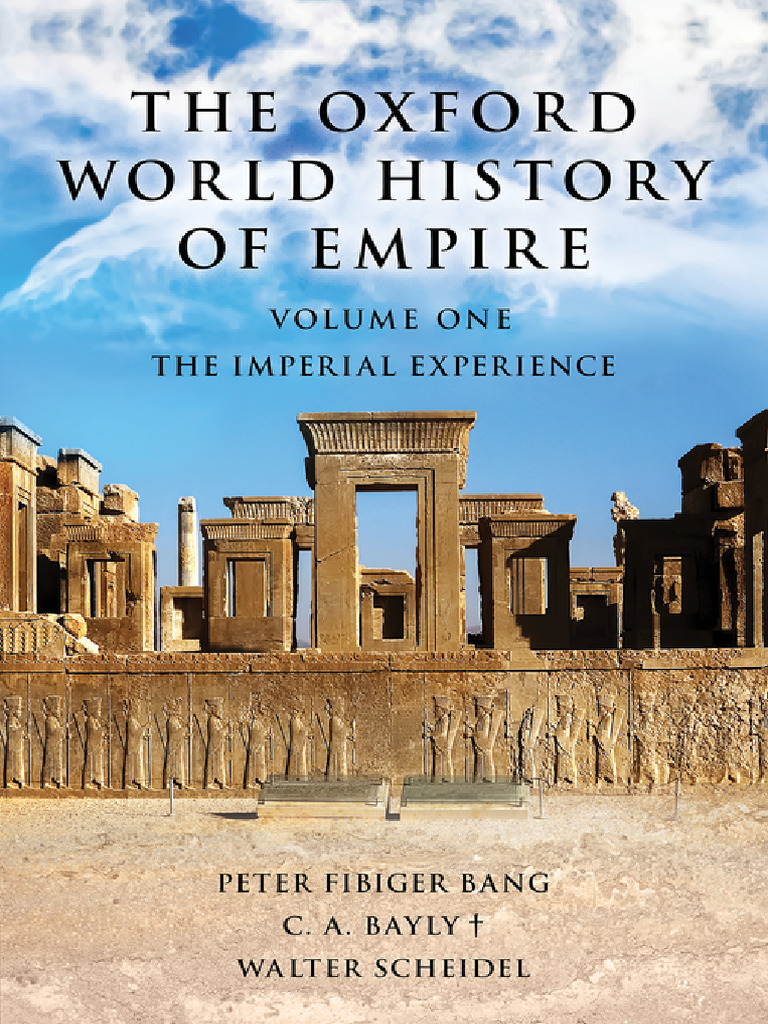
Legacies are not a principal concern of the new Oxford World History of Empire, though many of the contributors make some reference to them, and Phiroze Vasunia contributes a thought-provoking and finely-illustrated chapter on ‘Memories of Empire’ that raises some of the most important questions. There is also a powerful ‘Epilogue: Beyond Empire?’ by Frederick Cooper that indicates the continuing force of its presence. But in general the Oxford World History of Empire it is a timely and welcome response to the new awareness and interest in empire. These two majestic volumes must now stand as the best available synthesis of much of the recent work on empire. But they present far more than a synthesis. Some of the best scholars of empire have been given the opportunity to re-think their own work, and to present it to a wider public in a shorter, more accessible, form. What we now have is a series of masterly essays that cover nearly all the main concerns of the study of empires.
These are nicely and helpfully divided into two volumes. The first, ‘The Imperial Experience’, deals with concepts, theories, and some important general features of empires. These include empires as ‘systems of power’, considered in their political, economic, and military aspects; empires as ‘cultures of power’, concerned with ideologies and symbolic displays; empires as forms of hierarchy and difference, engendering resistance and rebellion; and empires as subject to decline and dissolution, and the memories they imprint in the literary and artistic record of imperial societies.
The much larger volume two, ‘The History of Empires’, contains chapters on all the principal empires in world history, with some fifty or so covered, though some of course only briefly. The approach is largely chronological, starting with Bronze and Iron Age empires, such as the Akkadian, Assyrian, Egyptian, and Achaemenid empires, continuing with empires of ‘the classical age, roughly 323-BCE-600 CE , such as the Chinese, Mauryan, and Roman empires , and followed by ‘the ecumenic turn’ (c. 600-1200 CE), which includes the rise of the Islamic empires and the Christian empires of Byzantium and Charlemagne’s Holy Roman Empire. Then comes ‘the Mongul Moment’, which covers the steppe empire of Chinggis Khan and its successors, but also those contemporary with it and often affected by it, such as the maritime Venetian empire and the Ming empire. There is then a section entitled ‘Another World’ which takes in the Aztec and Inca empires of pre-Columbian America, with their own separate evolution. Next comes ‘the Great Confluence’ (1450-1750) which shows the consolidation of the great land empires of the Ottomans, Habsburgs, Mughals, and Manchus, but also the momentous rise of the new European colonial empires, Portuguese, Spanish, Dutch , French and British.
The next section, ‘The Global Turn’ (1750-1914)’, shows the increasing global hegemony of the European overseas empires, the growing weaknesses of the land empires, and the challenge posed by the rise of the new power of the United States. The final section, ‘The Twentieth Century’, dwells largely on the dissolution of the European overseas empires, and their replacement by two flanking super-powers that can fairly be considered in the perspective of empire, the Soviet Union and the ‘global imperium’ of the United States. The final chapter by Frederick Cooper includes a consideration of the effects of the fall of the Soviet Union and of a world increasingly, after the short hiatus of the Pax Americana, descending into disorder.
Merely to enumerate the chapters of these two volumes is to indicate the monumentality of the exercise and the extraordinary quality of its achievement. One of the editors, Peter Fibiger Bang, remarks, somewhat apologetically, that the work ‘has been long in the making’, conceived about a decade ago. One might think that in fact, given the scope and ambition of the project, the time period for its realization been remarkably short. Far shorter and more circumscribed works have often taken much longer. The editors are to be congratulated on a singular achievement, the result of sustained and heroic endeavours on their part.
An extended word about the three editors is indeed in order. Halfway through the project one of them, Chris Bayly, suddenly died in 2015. This must have been, and is to all of us, a great loss, given that Bayly was one of the most important and best-known students of empire, both of the British Empire and of empires in general (see, e.g., his The Birth of the Modern World, Blackwell, 2004). The two other editors continued the work to its completion; but it is in no way to slight the contribution of Walter Scheidel (who apart from his editorial work contributes an invaluable essay on ‘The Scale of Empire’) to say that the work as a whole bears very strongly the imprint of the other editor, Peter Fibiger Bang.
The most obvious evidence of this is the extraordinary, nearly 100-page, essay by Bang that introduces the whole work. ‘Empire – A World History’ is a virtuoso piece that serves not merely to introduce – making vivid use of maps – the chronological sections of volume two, but at the same time allows Bang to reflect at length on some of the principal theories, themes and questions in the study of empires. It is impossible to think of anyone who would not profit from a close reading of this essay, not merely students embarking on the study of empires but also seasoned scholars of empire.
Bang makes the case not merely that empire demands a world history, occurring as it does from the very dawn of civilization in the third millennium BCE right down to our own time. He also stresses that this is an enterprise not just for historians, however central their work must necessarily be. There is room, and need, for social scientists of all kinds, sociologists, anthropologists, economists, political scientists, geographers. Ecologists and environmentalists too have much to contribute. There is also plenty of material for historians and critics of art and literature. All of these disciplines are represented in the two volumes, making them together a sustained and exemplary exercise in interdisciplinary studies.
One of Bang’s central points, echoed by several contributors, is the sheer diversity of empires, ancient and modern, Eastern and Western, and the heterogeneity and variability of the imperial experience. This makes definitions more than usually hazardous, not to say foolhardy (one remembers Max Weber’s warning, that definitions should be attempted, if at all, only at the end of a study, not at the beginning). Put another way, one might say that empire is a prime example of what the philosopher W. B. Gallie called ‘essentially contested concepts’, not simply in the sense that their definition eluded agreement but that that was of the essence of them, that they contained mutually contradictory elements. Empire can mean aggression and defence, contraction or expansion, acceptance of other empires or single-minded pursuit of world domination. It can evoke passionate defence as well as equally passionate opprobrium. Explanations of the rise and establishment of empires are as diverse as explanations of their decline and fall. As Bang says, ‘empire has been too important and many-sided a historical phenomenon to allow for consensus to develop or for the various approaches to fuse.’

This must point to the need for detailed examination of individual empires at the expense, if need be, of more general or theoretical treatments. The editors of the Oxford World History of Empire have been right to make the second volume, with its many chapters on individual empires, more than twice as long as the first volume, which deals with general features. Theoretical and comparative approaches are valuable, and necessary, but they cannot substitute, as they sometimes do in social science accounts, for detailed treatment. Many of the contributors to these volumes offer their definitions of empire, but nearly all stress the looseness of the terms and the need to understand them within particular contexts. The same applies to theories of empire. Once again a warning by a famous social scientist seems in order: Ian Morris quotes Clifford Geertz’s observation that social science generalizations run the risk that, ‘stated independently of their applications, they seem either commonplace or vacant’. Morris himself heeds the warning, as do most of the other contributors to these volumes. Specificity and concreteness are indeed the qualities that make them so appealing. One might instance here the splendid essay by Cecily Hilsdale, ‘Imperial Monumentalism, Ceremony, and Forms of Pageantry’, which by the detailed examination of an Egyptian obelisk in the Hippodrome of Byzantine Constantinople throws a flood of light on the central role of monuments and ceremonies in sustaining imperial power.
Bang’s contribution is not limited to his general editorial role and the long introductory essay to the work as a whole. He has written the chapter on the Roman Empire, on which he is an acknowledged and much-cited expert; and in addition he introduces every one of the eight, chronologically conceived, sections of volume two, in the form of short and highly-illuminating essays. Here he sketches out the main developments of the period in question in each section, highlighting certain themes and episodes, drawing out parallels and indicating enduring effects. In doing this he serves as invaluable guide to the vast and complex terrain of empire, with its long history and extensive geographical reach. We come to see empire, with all its variations, as in some sense a unitary and unifying element in world history. The Chinese empire might differ from the Roman, the Aztec and Inca from those of Eurasia, ancient empires from those of the modern period. All empires have their particularities and peculiarities. But they are still empires. They still share certain basic characteristics, however difficult it might be to pin these down or to give a definitive list. John Darwin once observed that empire has been the ‘default mode’ of political organization in world history, and as such must surely command our attention. We might, on the basis of these excellent volumes, conclude that empire was far more than simply a political experience. It reached into all corners of society, artistic, spiritual, ideological, as well of course as economic, military, and technological. It would be difficult to think of a phenomenon more deserving of study in all its dimensions, drawing on a multiplicity of disciplines.
There remains the need to comment on some of the individual chapters of the two volumes. Given the number and range of the empires discussed, I must necessarily be highly selective, mentioning just those I have a particular interest in and know something about (see my Visions of Empire: How Five Imperial Regimes Shaped the World, Princeton University Press, 2017). It is gratifying, for instance, to see a chapter by Chris Bayly on the British empire, even though his untimely death prevented the final revision of a lecture that was the basis of his chapter. This has nevertheless all the characteristic qualities of Bayly’s work, being a subtle exploration of what he calls ‘the complex and multifaceted phenomenon’ of empire, warranting therefore neither outright denunciation nor unqualified approbation, and requiring an approach that recognizes the mixed nature of empire.
Corresponding to this conception, Bayly describes a British empire markedly heterogeneous both in its political make-up and in its ideologies. He identifies four key ‘elements’ of the British empire: a ‘naval-fortress empire’, an ‘empire of defence’ serviced above all by Britian’s navy, concerned with protecting the homeland, strategic islands and military bases, and Britian’s vital trade routes across the globe. This was buttressed by an ideology of patriotism and Protestantism. Then there was the empire of ‘settler colonialism’, the empire of the ‘white dominions’ of Canada, Australia, South Africa, which was sustained ideologically by a doctrine of Lockean ‘possessive individualism’, laced with quasi-racialist ‘Anglo-Saxonism’ and the stress on the civic rights of ‘free-born Englishmen’. The third element of empire was the ‘directly ruled imperial province’, of which the outstanding example was the British Raj in India, and where an ideology of ‘conservation’ ruled, involving a sense of paternalism and an attempt to preserve ‘traditional society’, often through the intermediary of local elites. This shades over into the fourth element of empire, ‘the protected indigenous monarchy’, examples of which include the princely states of India and the indigenous chiefs of Africa, and where ideology reflected what David Cannadine has called ‘ornamentalism’, the attempt to replicate the rituals and hierarchies of the metropolitan society in the overseas territories.
Bayly stresses that all these four elements are ‘ideal-types’, and that actual cases frequently involved a mixture of elements. Indeed, in an elegant and persuasive narrative, he shows how the strength and persistence of the British empire depended on the frequent coalescence and concurrence of the four elements. As he says, ‘in all the great crises from 1837 to 1939, the ideals of white settler civic republicanism could be combined with indigenous monarchism, bureaucratic paternalism, and naval and military authoritarianism to create a powerful amalgam of force and sentiment. Thus the British Empire was the truest fascist state in history, in the Roman sense of the term. All the different constituent fasces were bound together, creating a resilient whole’.
Particularly important in Bayly’s treatment is the enormous importance he attaches to ideologies of empire, as being at least if not more important than economic, political or military interests (this puts him at variance with say John Darwin, another leading historian of the British empire). Ideology is also stressed in David Todd’s splendid chapter on the French empire, which he titles ‘An Imperial Nation-State’. France, he shows has always had a yearning for empire, going well beyond any utilitarian considerations. As General de Gaulle once said, ‘France cannot be France without grandeur’. This self-conception has not been dented by the fact that France nearly always found itself defeated by a superior imperial power, be it Spain or Great Britian, despite repeated endeavours at hegemony under Louis XIV, Napoleon, and various republican leaders. One sees it even today, argues Todd, in France’s efforts to remain central to the efforts at European integration. If France’s culture no longer enjoys the preeminence it once achieved among Europe’s upper classes, France has not given up the ambition to project its power and influence beyond its borders.
France’s contribution to European imperialism might indeed best be seen in ideological terms: picking up the Roman inheritance in the idea of the mission civilisatrice, the civilizing mission, seen as almost necessarily defined in the terms of the French Enlightenment and the ideals of the French Revolution. France stood for Europe and indeed the world, in its modern guise. And despite its reversals, France did succeed under the Third Republic in building up the second largest empire in the world, after the British. The results can indeed be seen in the persistence of the French language and culture in many parts of Africa and South-East Asia, and of French connections with many of its former colonies, especially in Africa and the Caribbean. Todd’s conclusion is that despite the many set-backs, France’s imperial ventures were crucial in the establishing of the French nation-state: the two were not alternatives but complementary. France developed an ‘imperial nation-state’: one could indeed say that about many of the European nations.
That would certainly be true of Russia, whose empire (1453-1917) is the subject of the chapter by Dominic Lieven (author of the splendidly wide-ranging comparative analysis, Empire: The Russian Empire and its Rivals, Yale University Press, 2001). One might think that Russia has never been a nation-state, even now, and has always either been an empire or had imperial aspirations. Lieven, drawing on his deep knowledge of Russian history, traces this in a brisk survey of developments form the 15th to the 20th century. He sees the Russian empire as fundamentally an ‘agrarian empire’, comparable in many ways with the Ottoman empire, and like it poised on the margins of Europe. This means that it has been profoundly affected by the European states system, engaging at various times with some of its principal members, antagonistically as with France and Britain during the Crimean War, but also often in alliance, as in the Great Power coalition against Napoleon, and again in 1914 in that against Germany.
But Russia is also an Asian power, which expanded gigantically eastwards across Siberia and Central Asia. As others have noted, this allows for comparison with the westward movement of the United States and the creation of an American land empire. But Lieven also compares it, more interestingly, with the transoceanic settlements of the European overseas empires. He indicates how Russian rule over Muslim societies in Central Asia and tribal societies in Siberia often resembled European rule over the many exotic societies that they conquered and colonized overseas. The Russian empire therefore shows aspects of both land and overseas empires, suggesting that the usual distinction between them is not hard and fast and that several empires – the Spanish and British among them – embody both kinds.
These three examples have all been drawn from the section on ‘The Global Turn’, dealing especially with the increasing dominance of the European empires in the 18th and 19th centuries. It might be worth considering in addition a non-Western example, such as China, which gets no less than four full chapters and an additional half of another. This of course rightly reflects not just its importance, but its longevity, extending as it does from the 3rd century BCE to the early twentieth century. Mark Edward Lewis, who has authored the relevant two volumes in the Harvard History of the Chinese Empire, takes us through the establishment of empire under the Qin and Han, then deals with its full flowering under the Tang. There is a fairly brief account of the Mongol Yuan dynasty in the chapter on the Mongol empire by Nikolay Kradin, before David Robinson takes over with his chapter on the Ming. Robinson is invaluable, and unusual, in treating the Ming state systematically as an empire, and in opposing the conventional view that sees the Ming as inward looking and isolationist. Pamela Kyle Crossley, well-known for her studies of the Manchus, in her chapter on the early Qing effectively and clearly reprises the argument of her well-regarded study of Qing imperial ideology, A Translucent Mirror (University of California Press, 1999). Rana Mitter, equally acclaimed for his work on twentieth-century China, takes us through the late Qing and the fall of the empire in 1911. All that is lacking in what is otherwise a more or less complete history of the Chinese empire is an account of the medieval Song – a pity, as for many people they occupy a critical place in its development, especially as regards technical and economic achievements.
But that is a very small thing, in what is a welcome and generous treatment of an empire that often gets left out in comparative analyses. China is often thought of, by both Chinese and outside scholars, as sui generis, its empire – if indeed it can be called that – of a very different character from most others, Western and non-Western. What these chapters show is that that is a mistaken view. Whatever its peculiarities – and all empires have those – the Chinese empire conforms in most respects to other instances of empire. As Mark Lewis shows, the early Han dynasty established many of the basic features of the empire, features that can be found not merely in most other East Asian empires but empires more generally.
Thus there is the sanctification of the emperorship, lifting the emperor above and beyond the levels achieved by mere kingship (cf. the Persian shahanshah, ‘king of kings’). There is a shift from peasant conscription to reliance on a professional army, often bolstered with recruitment of non-Chinese steppe people. There is the pattern of alternating conflict with ‘barbarians’ beyond the imperial border to alliances with them, on the model of ‘using barbarians to control barbarians’ (cf. Roman practices of ‘divide and rule’ and the incorporation of barbarians into the army and the bureaucracy). There is the establishment of a basic reciprocal dependence of state and local elites, with local landowners dependent on state service for continued power and prestige at the local level, in return giving loyalty to the state (a point also strongly made by Bang for the Roman empire). There is the canonization of the Confucian texts of the Zhou era, the study of which, and proficiency in, becomes the basis of appointments at the highest levels of state administration.
The importance of civil service examinations as the basis of recruitment of the ruling scholar-gentry or literati was, as Max Weber pointed out, something unusual among pre-modern states (though there is a parallel in recruitment to the central bureaucracy of the Catholic church). This was a development more particularly among the Song, though it first appears among the Han. Unusual too in the Chinese case was the extent of ‘foreign’, non-Chinese rule of the empire, the outstanding examples being the Jurchen Jin dynasty, the Mongol Yuan dynasty, and the Manchu Qing dynasty. If one adds lesser periods of non-Chinese rule (e.g. the Northern Wei dynasty, 386-534 CE, of the Tavghach people ), for almost half of the two-thousand-year period of the ‘Chinese Empire’, China was ruled by foreigners.
That too of course is not so unusual. As Bang clearly shows, the Roman empire throughout its existence relied on the assistance of client-states, and in its later years was frequently ruled by Romanized ‘barbarians’, such as the Libyan Septimius Severus. The British empire was built up first by Welsh Tudors, then by Scottish Stuarts, later and most effectively by German Hanoverians. The longevity of dynastic rule under the same family among Ottomans, Habsburgs, and Romanovs, is perhaps the thing that needs explaining, not the frquent change of ruling families. And, if China is thought not expansionist – the stereotype of ‘the Middle Kingdom’, still centre of the world – we are reminded that Rome too in certain respects was a ‘reluctant imperialist’, dragged (like the British empire, according to some) into interventions and eventual rule by unruly clients and threats at its borders.
Still, one does not want to downplay the peculiarities of the Chinese empire, ‘an empire with Chinese characteristics’, we may say. It merely serves to underscore the point made again and again by contributors to the Oxford World History of Empire, that empires differ among themselves even as they exhibit many commonalities. Empires make up a family, and like family members exhibit distinctive appearances as well as resemblances.
These comments are reflections on a very small selection of the essays in the Oxford World History of Empire. But I hope they sufficiently convey the flavour of an outstanding scholarly achievement. What we have here is simply the best and most comprehensive treatment of empire to be found anywhere. The authors are aware of the need to make their ideas and material accessible to non-specialists, and in this they succeed splendidly, but without any sacrifice of scholarly rigour. The writing is clear and for the most part free of the esoteric or professional jargon that can so easily creep into such accounts. Academics searching for works to teach courses on empires will need, for the moment, to look no further than these two volumes. They will supply the foundations for most of the relevant topics, in a language that teachers can feel assured their students will understand and respond to. Once more one has to admire the skill and sheer hard work of the editors in bringing off so triumphantly such an immense undertaking.
The study of empires, it is clear from these volumes, is alive and thriving. But it is equally clear from them that this is not simply a matter of reflections on the past, the view that empires, however important and ubiquitous, are now history. The renewed interest in empires has much to do with the perception that their story is not over. This is partly because the signs of them are evident in societies across the whole world, even when and where they have formally been wound up. This is the study and interest in ‘legacies of empire’, both in the metropolitan societies and in their former colonial possessions. The well-known observation of the writer William Faulkner applies with particular force to empires, as it does more generally: ‘The past is never dead; it’s not even past.’
But there is the further point that imperialism, and the imperial form, themselves are still with us and perhaps in the process of renewal. There has always been a strand of thought that regards the United States as an empire – ‘the greatest empire in the history of the world’, John A. Hall remarks in a recent book (Nations, States and Empires, Polity, 2024). The United States may be faltering in certain respects, but its economic and military power still remains formidable, and capable of giving the United States unrivalled influence in every corner of the world. In any case there are other contenders for global power, China being the obvious one. China’s ‘Belt and Road Initiative’, aimed at linking China with the rest of the world through a series of wide-ranging and strategically-aimed economic and cultural projects, has in the eyes of many a strongly imperial cast. And beyond China, India and Turkey have both been held to being empires, or to having imperial designs. Even the European Union can plausibly be interpreted in imperial terms, as several analysts have argued for some time.
Empire today is a dirty word. No-one wants to declare themselves imperialist, no state wants to call itself an empire. That is not an unimportant historical outcome. But it does not necessarily mean an end to empire. Empire has always been a varied and protean project, capable of taking many forms; pronouncements of its demise are likely to prove decidedly premature.


 thesis eleven