Jeffrey Alexander, Civil Repair (Wiley, 2024)
Reviewed by Celso M. Villegas (Kenyon College)
(This is a prepublication version of this review. You can find the published version in Thesis Eleven Journal, on the T11 Sage website)
On November 6, Donald Trump won the 2024 U.S. presidential election. A rightward shift in the polity seems to have buoyed Trump and other Republicans to victory, giving the party control of the U.S. House of Representatives, the Senate, and the Presidency. As Brendon O’Connor writes here in Thesis Eleven, “The crushing defeat for [Kamala] Harris is an opportunity for the Democrats to develop policies that offer real solutions to America’s many social and economic problems.” But there were powerful cultural forces that were as real and as problematic. Anti-trans and anti-immigration ads associated Democratic candidates with moral and policy failures. Soon after the election here in Ohio, USA, Republican legislators quickly passed House Bill 183 which requires students from elementary school to university to use restrooms based on their assigned sex at birth.
In that sense, 2024 seems to be closer to 2004 when Republican George W. Bush’s victory came with state-level referenda that declared marriage was between one man and one woman. In the following years, and despite waves of backlash, an incredible groundswell emerged affirming the public’s support for marriage equality. What felt like utter defeat with the moribund Democrats lost in the darkness was time and again reinvigorated by movements dedicated to showing that love was love. Municipalities and states issued marriage licenses in defiance of existing laws, and even politicians like Barack Obama changed their public positions on the issue. 2015’s U.S. Supreme Court case Obergefell v. Hodges may now be on the chopping block, but in the eleven years between 2004 and 2015 Americans engaged their actions and their feelings towards an extension of basic rights.
In Civil Repair (2024), cultural sociologist Jeffrey Alexander outlines the processes by which damage done to the civil sphere is met with an expansion of fellow-feeling and moral obligation to redress those wrongs. Alexander reminds us that actually-existing civil spheres are rent with contradictions. But civil repair is not a technocrat’s vision of reform, nor is it a theorist’s model of revolution. The cases in Civil Repair point to the self-consciousness, struggles, and resilience of those with “dual membership” in uncivil and civil spheres. They also point to those who have some incentive to “societalize” like journalists, editors, publishers, prosecutors, investigators, intellectuals, and even social scientists. Regardless if actors are institutional or engage in contentious politics, Civil Repair shows us they have a sociological imagination: they narrate and perform biographical links to the social structures that must be repaired, and to history — both to the past but also to their posterity. In doing so, they are like social psychoanalysts, pointing out the discursive pathologies and gaps between action, speech, and reality that leaves dreams deferred.
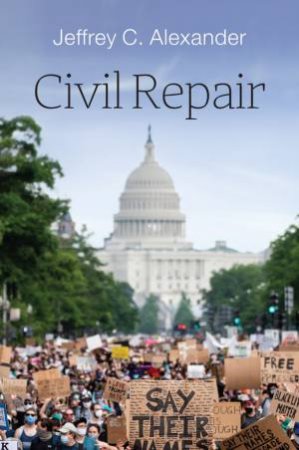
As rendered in Civil Repair, movements as diverse as the 19th century movement for women’s suffrage, the #MeToo movement of the late 2010s, the Civil Rights and Black Lives Matter movements in the U.S., and even the efforts journalists make to establish their independence are all a sort of cultural sociology-in-practice. This means their actions cannot be effectively explained by “reductionist” lines of analysis which would limit explanation to the slow boring of economic, political, and strictly rational boards. Indeed, “we reach the limits of Weberian sociology” (p. 136) several times in this book. For cultural actors we need a cultural sociology; this is Alexander’s wheelhouse. For example, the feminist organizations and journalists of the 1970s had placed discussion of women’s rights on the forefront of public discussion, that Richard Nixon – no feminist himself – was in some sense bound not to the movement itself, but to the opinion now circulating that women deserved equal rights. #MeToo succeeded in resignifying men who harassed women, associating them with anticivil behavior that quickly unseated many business leaders, induced a reckoning in Hollywood, and inspired a new legal morality that extended across institutions. The Civil Rights Movement’s leaders – not just Martin Luther King, Jr., Alexander is quick to note – dramatized their struggle to “leapfrog” the resistant civil spheres of the American South and gain the not just the sympathy of Northern whites, but the attention of Presidents Kennedy and Johnson who understood the Birmingham riots of 1963 as a turning point in American history. In all of these cases, those who hold economic and political power are made subject to the ways in which movements construct new meanings and direct (or constrain) institutions to take action alongside them.
Civil Repair contains significant reconsiderations of concepts Alexander has developed in the past. Readers will note that civil repair was a powerful concept in Alexander’s magnum opus, The Civil Sphere (2006). But in Civil Repair, Alexander trains his focus on civil repair as a valuable concept in and of itself. He develops a “more strictly sociological, and more specifically culture-theoretic” theory of the “public as stage” (pp. 24-25), on which social movements perform. Movements are dramatic vehicles for putting on microcosmic performances of macrosocial inequalities – from “institutional parts to [the] civil whole” (p. 63), mobilizing not only people and resources, but emotional identification and moral indignation so that the machinery of the state can be trained towards justice and redress. In doing so, they transform civil discourse which resonates with sympathetic audiences into “public opinion” and then into “civil power” (pp. 44-47) – a “hegemonic and regulatory” (p. 27) force that foments repair in societies divided by gender, race, violence, and political and social inequality more generally. Readers may also recognize Alexander’s concept of societalization from previous works, but here societalization serves civil repair – it “[effects]… a new set of social meanings” (p. 83) which specify the abstract binary codes of the civil sphere in a more thematized way, to borrow from Habermas. Alexander similarly addresses cultural trauma as a form of civil repair. Germany and the holocaust, World War II and Japan, post-Franco Spain, and post-Apartheid South Africa all indicate how dealing with trauma cannot be satisfied by face-to-face reconciliations, but also require macro-level processes: “powerful symbols must be projected and dramas of civil integration performed” where “antipathy gives way to mutual identification” (pp. 142-143).
On the one hand, Alexander has theorized civil repair in such a way as to impress upon us that it will always be timely — the work of civil repair is never done if the civil sphere is a project and an ideal. On the other, there are always counter-forces looming in the historical cases here, not least of which is backlash. Teased as the twin theme to civil repair (and subject of the next book), explicitly addressed in the chapter on #MeToo, and implicit in the collapse of the Obama-Tahrir-Occupy movements, backlash is the critical-historical reality that pushes back and undermines civil repair. Indeed, a reader attuned to the inequalities and hypocrisies of today might take a decidedly critical stance to any story of hopeful repair – the right-wing backlash to Critical Race Theory in the U.S., the dreams continually deferred of the Black community, the rise of a toxic masculinity among young men that is the cultural face of the second Trump administration, a journalism that retreats to its putative independence and fair-handedness while normalizing the horse-race and spectacular politics of latter-day populists. Indeed, the critically minded might read Civil Repair as not only politically naïve but depicting a process whose empirical unevenness is cause for rejecting civil repair itself as a useful concept. In that space of suspicious rejection, we might fill the void with not only reductionist, overly realist explanations of politics and society, but defer to what Toril Moi calls “theoreticism,” believing that “if you just get the theory – the concepts – right, then the correct politics will follow” (2024: 1169).
But, “…no theory,” Moi writes “will guarantee that its proponents will be politically correct in every context” (2024: 1169). Indeed, as Alexander argues, “The one-sidedness of critical social theory is a product of the narrowness of its theoretical imagination, not keep observation of social reality” (p. 3). I think Civil Repair is a postcritical book, a text that aims at the “second naivete” that Ricoeur (1967) posited as the goal of the faithful hermeneut, a text that is again “willing to be surprised” in the words of literary scholar Rita Felski (2017). Alexander asks us to reread the stories of movements and institutional actors we might already know and to reconsider them as moments that reconstructed feelings for others in substantial ways. These feelings are as real as the hardest of political and economic crystalizations. And, since Civil Repair treats the solidaristic meanings and feelings emergent in the highwater marks of its cases as substantial things, we are reminded of the possibility that “when ideas change, materiality often follows” (p. 86), and in the civil sphere, “life imitates art” (p. 105), not the other way around. To be clear, Alexander is not making a case for idealism, but rather to unpack the moments where it is likely we (that is, you and I) might have felt something that amounted to hope for a better world because of these movements and institutions. In that unpacking, we might learn (again) that they did not feel – nor act – in vain.
So what are the lessons of Civil Repair? Certainly, as Brendon O’Connor notes, there will need to be new coalitions built and a reckoning to be had in the American center and left on the serious stuff of class. But the civil sphere-as-an-ideal is sanctified by the miracles of charismatic movements, resilient journalists, and the symbolic flows that course through the public. The civil sphere-as-a-real-thing is ground out every single day, and subject to the social environments that pass through us and contradict its language, its institutions, and our own sense of belonging. Those contradictory social forces are not all-encompassing: so long as there is a civil sphere, there will always be a degree of freedom to repair them. When the civil sphere surrounds us, we gain our identity as democratic participants in an imperfect world. Civil Repair points to the ways that real people have – so far – made their civil spheres capable of countenancing equality, justice, and peace, even if their realities seem to foreclose these possibilities. Civil Repair is imagination and action, a willingness to look to the past for surprises, and to entrain our energies towards a future that will come.
References
Alexander, Jeffrey. 2006. The Civil Sphere. New York: Oxford University Press.
Felski, Rita. 2017. “Postcritical Reading.” American Book Review 38(5): 4-5.
Moi, Toril. 2024. “Crisis in the Profession, or the Failure to Imagine the New.” American Literary History 36(4): 1161-1182.
O’Connor, Brendon. 2024. ‘Time for the Return of the Sanders Movement?‘ Thesis Eleven. Accessed 12/2/2024.
Ricoeur, Paul. 1967. The Symbolism of Evil. Emerson Buchanan, trans. New York: Harper and Row.


 thesis eleven