Ghislain Deslandes, Postcritical Management Studies: Philosophical Investigations (Springer, 2023)
Reviewed by Thomas Klikauer (Western Sydney University)
(This is a prepublication version of this review. You can find the published version in Thesis Eleven Journal, on the T11 Sage website)
Corporations with shareholders, more so than smaller companies, are generally managed by managers. The idea of management goes back to the French term “manege” and the Italian term “maneggiare” which mean the handling, training, and domestication of a horse (Klikauer 2013). Perhaps even before early management writers like Taylor (1911) and Fayol (1916) justified something called Scientific Management (Lepore (2009), the field has been associated with the domestication of workers (Thompson 1963).
Ideologically, management is secured through what became known as MS or ‘management studies’ (Tourish 2020). A few decades ago, a kind of pretend-to-be but ultimately stabilising corrective system to traditional management studies emerged in the form of CMS or critical management studies (Klikauer 2018). CMS uses selective elements of critical theory to improve management studies, and so the hope of its protagonists goes, and management as well (Alvesson & Willmott 2010). To elaborate all this further, Deslandes’ book provides an insightful addition.
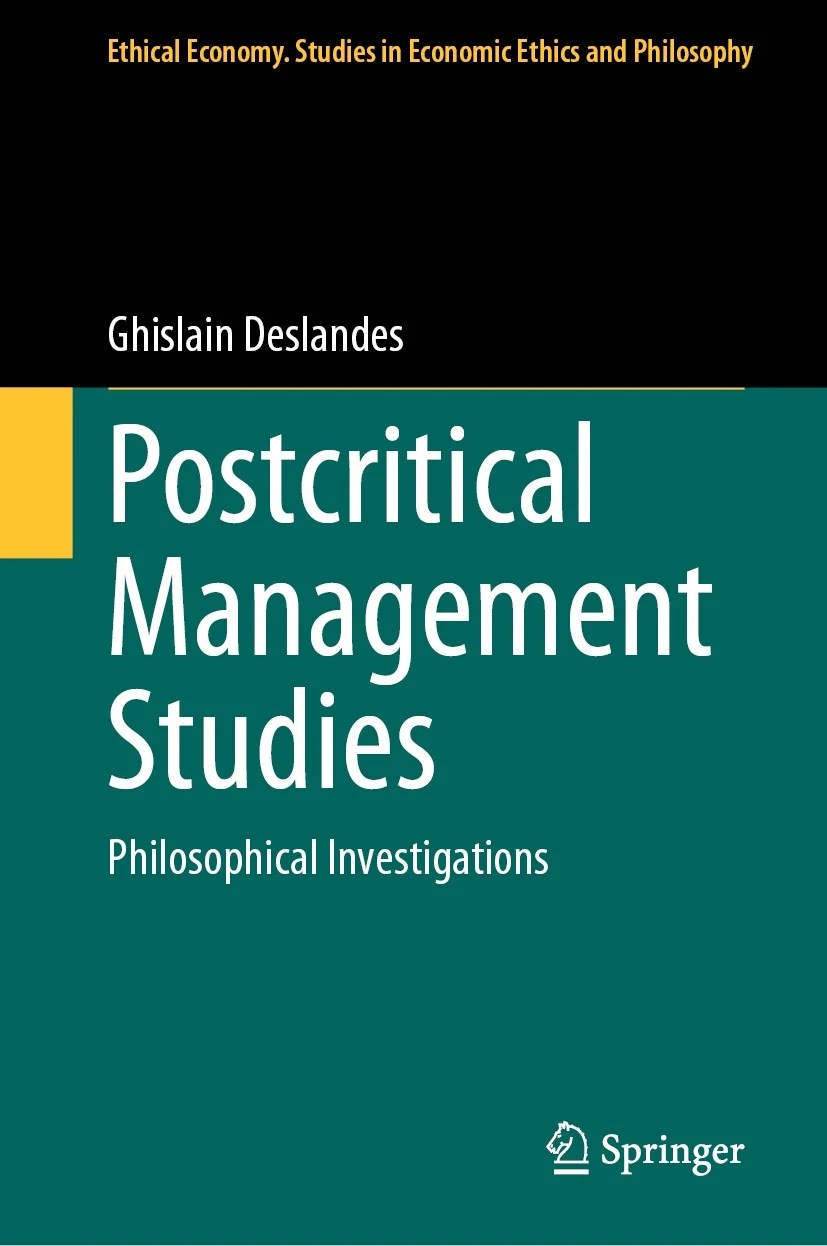
Moving beyond outdated, often rehearsed, and rather “common sensical” management paradigms, Deslandes’s new book – Postcritical Management Studies: Philosophical Investigations – explores the dialectic between strength and vulnerability, as well as the powers of constraint, imitation, and imagination, to propose a re-evaluation of management practices. The book’s uniqueness lies in offering fresh, well-thought-out, critical, and the most illuminating perspectives on contemporary management. It embraces a more holistic, ethical, and socially conscious approach to organisational leadership (Klikauer 2013). Perhaps ever since Taylor and Fayol.
The book starts with an introduction, followed by three thorough analytical chapters, a conclusion, and lastly, a bibliography and index. The introduction critiques old-fashioned management practices rooted in scientific principles (Lepore, 2009), advocating for a post-critical approach. Deslandes highlights the influence of Michel Henry’s philosophy on managerial ethics, and evolving perspectives on individualism, as well as subjectivity in contemporary society (Seyler, 2020). This involves re-evaluating traditional paradigms, prioritizing ethics, and embracing a human-centred perspective.
Deslandes’s first chapter looks back “from Proto-Management to Contemporary Functional Stupidity” (p.1) discovering the different management interpretations and showing contemporary challenges such as motivation loss and dependence on technology. Specifically, “Continental Philosophy and Post-management” (p. 6) shows that management fundamentally intertwines with politics and ethics. Management studies as well as CMS are rooted in so-called economic realities (MS), leadership (MS), gender roles (CMS) and agency theory (CMS).
Adding to this, the author’s “Ethics and Organizations” (p. 9) presents two traditional approaches: economic rationality and bureaucratic norms. Economic rationality emphasizes profit and efficiency while bureaucratic norms centre on organizational rules. However, those traditional approaches are criticized for overlooking broader ethical concerns in managerial decision-making. For Deslandes, ethics in management should be viewed as a structured discipline – like examining business cases from the standpoint of moral philosophy (Klikauer, 2017). Unlike the idea of ethics conflicting with what is known as “return on investment” (p. 9), he sees that “managerial ethics is mostly a way of organizing life together among people who meet in the workplace and whose individual ethics differ” (p. 11). The author encourages critical thinking about ethics in management while also emphasizing the complexity of ethical issues within organizations.
In further clarifying his point, Deslandes examines “The Five Senses of Management” (p. 14). Firstly, “Management as a Technique” (p. 14) prioritizes practical methods for improving performance, followed by “Management as a Science” (p.15) which treats it as an inter-disciplinary field with evolving theories. Subsequently, “Management as a Practice” (p. 17) underscores the real-world application of knowledge, and “Management as Ethics” (p. 19) delves into moral dimensions and responsible decision-making. Finally, in “Management as Politics” (p. 21), the author considers it within the context of power dynamics and organizational influence. He explains that among the five senses, “Management as a Science” (p.17) stands out as it highlights management’s scientific origins and its connections to different fields, including Taylorism. This approach is crucial as it prioritizes productivity and significantly shapes how we perceive human behaviour within organizations.
Although acknowledging the historical importance of management practices in productivity, Deslandes strongly critiques both “organizational stupidity” (p. 23), and “stupidity” (p. 26) in management studies and business ethics within contemporary continental philosophy. The author critiques that “the rise of digital technologies can undermine the autonomy of consumers or users” (p. 28) which can assist in showing the potential consequences of technological advancements on individual autonomy and raising ethical concerns about the manipulation of user behaviour through digital platforms. Broadly, “philosophical stupidity and technological issues” (p. 28) potentially impact on organizational behaviour and performance as well as human behaviour and decision-making, especially, when having to face what the philosopher Hannah Arendt (1994) once called “Banality of Evil”? (p. 31). Consequently, there is a very human desire to transcend basic impulses. This exists in contrast with neuromarketing’s potential to exploit human desires (Stiegler, 2018). Virtually all this demands a new management framework that the author explores in “Rethinking Management” (p. 39).
In “Rethinking Management,” he examines traditional approaches while also proposing alternative perspectives and theoretical frameworks. Deslandes critically re-valuates “Organizations and the Subjective Body” (p. 42) as well as “Critical Management Studies” (p. 42) to gain exact insights into self, subjectivity, and ethics in management, highlighting the influence of individuals’ experiences on decision-making at work (Klikauer, 2015 & 2018). Eventually, Deslandes relies on Henry’s theory because it “echoes the capability approach […] an ontological and phenomenological level of analysis” (p. 51). It provides a connection to the experience of sensibility […] to become more than a simple pragmatic conception of personal contentment and well-being” (p. 51). From that, he outlines the notion of “Desaffectio societatis” (p. 39) to extend the analysis of the body in many ways. “Affectio societatis” (p. 52) alludes to business law and non-contractual aspects of organizational relationships. Deslandes highlights collective action, social roles, and ethical considerations in organizational contexts, providing insights into affectivity and social interactions amid societal changes.
Considering all of this, Deslandes argues that “People want to be better recognized for who they are, what they do or what they long for – be it within couples, in professional lives or among friends” (p. 72). In other words, it is essential to explore alternative viewpoints on employee recognition such as “acknowledgment and claim” (p. 73), “philosophical question” (p.75), “ethics of recognition” (p.76) directed “towards a post-recognition ethics” (p. 80) and “recognition, hope, and capabilities” (p. 82). He emphasises the significance of acknowledging diverse contributions and values beyond traditional approaches. In “Beyond recognition” (p. 72), Deslandes argues that it is crucial in “personal and professional spheres [to foster] fairness, protection, and self-fulfilment” (p. 91). For all of this, the critical task is “rebuilding management” (p. 91).
Deslandes’s final chapter focuses on exactly that – “rebuilding management” (p. 91). Yet, he evaluates current weaknesses before proposing a rebuild. Deslandes does not shy away from revealing a sad reality about management, namely that management’s vulnerabilities often disrupt employees’ collaborative joy. He says, “the powerlessness of the powerful” (p. 91), implying against hastily separating management and leadership, emphasizing their interconnectedness and the risks of viewing them as opposites. He also emphasises that management without leadership is bland, while leadership without management tends to be arrogant. On this, he focuses on “reign”, “charges” and the “power to confer impotence” (p. 95). Worse, common power struggles in business, where management is akin to theatre, and leaders establish authority through symbolic gestures, sometimes relying on deception. The managerial deception is often found in “leaders” using “grimaces” and a “body of signs” to impress others. (p. 99). From that, he concludes that managers influence behaviour of organizational success and raises the question of whether strength alone determines managerial success.
Finally, Deslandes addresses the paradox of excellence in reconstructing management as a “dialectics of containment” (p. 111), where managers often overlook their limitations despite being expected to possess all necessary qualities to be managers. This alone would require re-evaluating management within the framework that is outlined here. One needs to recognize the interplay between strengths and vulnerabilities, as well as authority and burdens. He provides examples of “feeling the void in times of lockdowns” (p. 112) to express how the absence of distractions exposes feelings of inadequacy and emptiness, intensified by the deprivation of social interactions, ultimately leaving individuals feeling restless and unfulfilled. In other words, the challenges of managing issues become too large and too complex. It would suggest restoring balance and moderation, known as “metron (measure)” (p. 113) to navigate these problems while aiming for a middle ground between excess and deficiency.
To handle this dilemma, the author suggests developing “De-Intensification Strategies” (p. 114) by showing a central aspect of human experience while also offering insights into managing fluctuations between emptiness and overflow. In the end, Deslandes redefines management as “a vulnerable force” that is subject to various pressures, existing within the tensions of “a triple power of constraint, imitation, and imagination” (p. 116).
Similar to Boltanski and Chiapello’s (2005) study on “The New Spirit of Capitalism”, Deslandes argues that management needs to be a dynamic force, and that management is not just about control but also about balancing strength and vulnerability. Additionally, he notes that the “managerial condition” (p. 130) often means the blending of politics and ethics to avoid an overly dominant and ego-driven management style. This notion links to “tackling systemic stupidity” (p. 135) of which management has no shortage. This highlights the importance of addressing collective ignorance in organizational decision-making. In other words, “weak management” (p. 118) challenges the traditional idea of strong management. He finally advocates for a more adaptable and responsive approach that understands individuals, acknowledges power complexities, and prioritizes inclusive action of all stakeholders.
All in all, Deslandes’s exquisite book offers a fresh and very French look at management. The book offers insightful suggestions that reflect on the current economic and political climate, as well as on the uncertain future of managerial capitalism. However, it would put additional strength to his argument if more real-life examples would have been used. Overall, Deslandes’ brilliant book offers a rich and fruitful addition to the field of management philosophy.
References
Alvesson, M. & Willmott, H. (eds). (2010) Critical Management Studies (Four-Volume Set), London: Sage.
Arendt, H. (1994) Eichmann in Jerusalem: a Report on the Banality of Evil, New York: Penguin.
Boltanski, L., & Chiapello, E. (2005). The new spirit of capitalism. International journal of politics, culture, and society, 18, 161-188.
Fayol, H. (1916) Managerialism Industrielle et Generale (Industrial and General Managerialism), London: Sir I. Pitman & Sons, ltd. (1930).
Henry, M. (2012) Philosophy and Phenomenology of the Body. Springer Science & Business Media.
Klikauer, T. (2013) Managerialism – Critique of an Ideology, Basingstoke: Palgrave.
Klikauer, T. (2015) Critical management studies and critical theory, Capital & Class, 39(2): 197-220.
Klikauer, T. (2017) Business Ethics as Ideology?, Critique, 45(1-2): 81-100.
Klikauer, T. (2018) Critical Management as Critique of Management, Critical Sociology, 44(4–5): 753–762.
Lepore, J. (2009) Not So Fast – Scientific management started as a way to work. How did it become a way of life? The New Yorker (www.newyorker.com, 12th October 2019, accessed: Wednesday, 15 May 2024).
Seyler, F. (2020) Michael Henry (https://plato.stanford.edu/entries/michel-henry/, accessed: Wednesday, 15 May 2024).
Stiegler, B. (2018) Automatic Society, volume 1: The future of work. John Wiley & Sons.
Taylor, F. W. (1911) The Principle of Scientific Management, New York: Norton Press.
Thompson, E. P. (1963) The Making of the English Working Class, London: Victor Gollancz.
Tourish, D. (2020) Management Studies – Fraud, Deceptions & Meaning Research, Cambridge, Cambridge University Press.


 thesis eleven