Annihilation Aesthetics: On the Disappearances of Hiroshima and Nagasaki.
This special issue of Thesis Eleven will be published in August 2025. Below includes a introduction to the volume accompanied by an artist’s statement by Chantal Meza whose artworks works will be featured in the issue.
Near a decade ago, an edited volume was curated for Thesis Eleven which sought to address the legacies of the bombings of Hiroshima and Nagasaki seven decades on from the atrocities. At the time, it was felt that while the violence of the bombings was fading from memory, there was also a normalisation in the appearance of atomic clouds in every kind of representation that dealt with end of world narratives. This was matched by a declining interest in mass movement protest against the existence and development of nuclear technologies, which offered a marked departure from previous campaigns for nuclear disarmament. Hiroshima and Nagasaki it seemed were fading from memory, as the world was dealing with a multitude of catastrophic threats that marked the post-Cold-War period, even if the aesthetic of the destruction appeared like an ever-present strategic and cultural motif.
Ten years on, we are in a different political and strategic moment. As the spotlight on the history of the bomb has been given renewed cultural focus through Christopher Nolan’s Oppenheimer movie epic, there has also been a stark and ominous return to the language of nuclear annihilation. The threat of nuclear violence has once again loomed over zones of crises, notably Ukraine and the Korean Peninsula. Moreover, as the technological world continues apace, technologists like Sam Altman, chief executive officer and co-founder of OpenAI, now openly call for a new “Manhattan Project” so that the destructive potential of Artificial Intelligence can at least be properly regulated. And yet despite this renewed focus, the violence of those attacks is still often domesticated and the real terror downplayed. Indeed, by recognising that visibility and invisibility are not always opposites, the new kinds of exposure given to those events 80 years ago are creating new forms of forgetting. If Hiroshima and Nagasaki were in fact unrivalled moments of technological violence, which gestured towards what can be seen as “spectacles of disappearance”, so the disappearance continues through the violence of various kinds of forgetting and the absolving of responsibility.
This special edition looks at the spectacle of past and potential nuclear violence to address the aesthetic question of disappearances today. Looking at the importance of imaginaries of total destruction – what we are electing to call annihilation aesthetics, so the volume will attend to the historical present of technologically enabled violence, dealing in the process with concerns with mass terror and mediatisation, the logics of technological violence from the nuclear to the artificial age, the importance of culture in developing a viable critique, a rethinking of the violence of such annihilation through frameworks of human disappearance and vanishment, the importance of art in dealing with the memory and shadows of annihilation, along with the security and strategic imperatives the prevalent public return to narratives of technologically enabled oblivion make altogether more explicit.
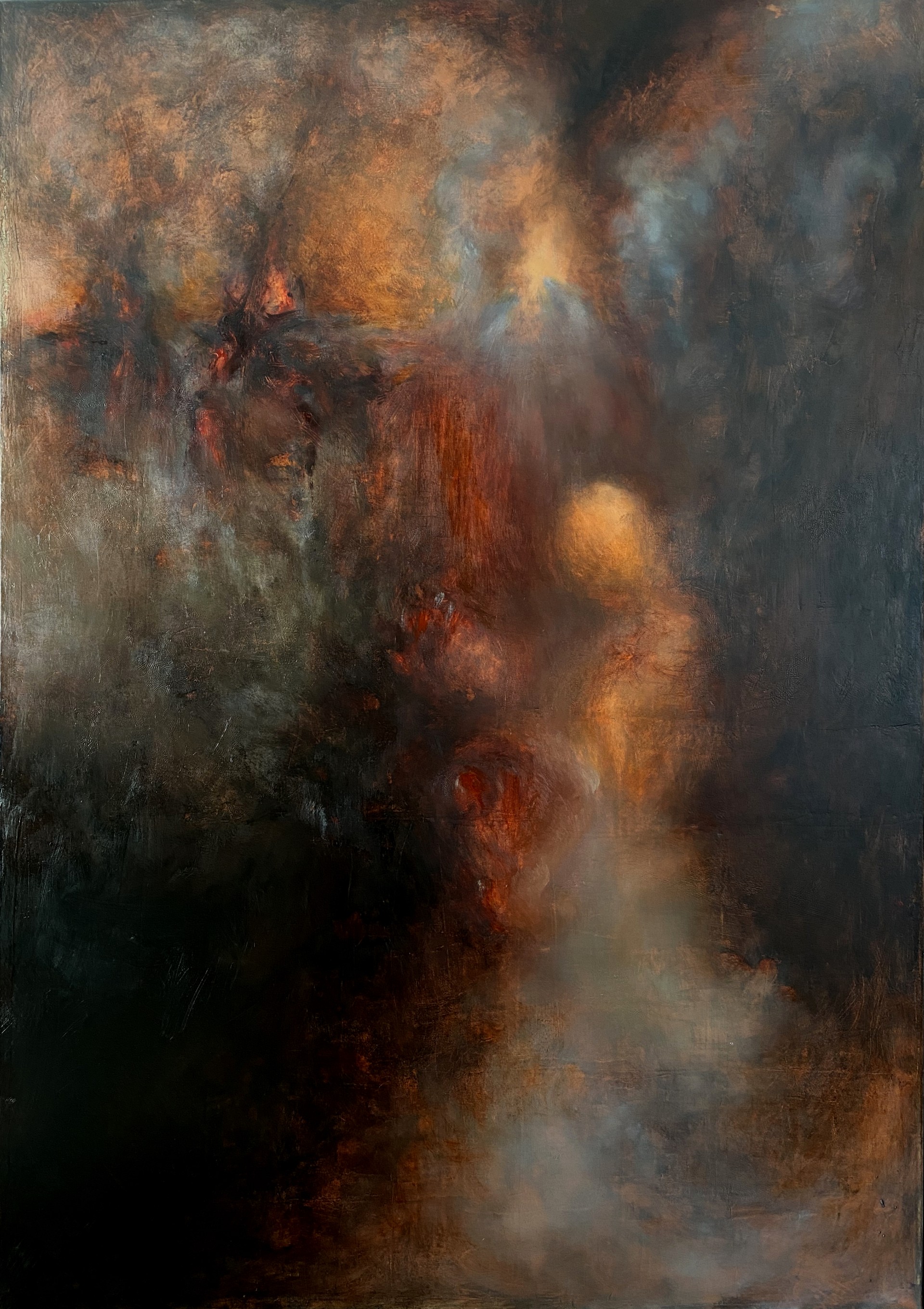
The volume is produced in partnership between the Centre for the Study of Violence at the University of Bath and the Swedish Defence University. A series of artworks by the Mexican painter Chantal Meza (see artist statement below) accompanies the volume. Her current major project has been dealing with the violence of disappearance, which is now extending into critiques of technology and ecologies of annihilation.
Volume Contributors
Chantal Meza, Artist
Dr Caroline Holmqvist, Swedish Defence University
Professor Brad Evans, University of Bath
Professor Elke Schwartz, Queen Mary University
Professor Daniele Rugo, Brunel University
Professor Michael J. Shapiro, University of Hawaii
Professor Alex Taek-Gwang Lee, Kyung Hee University
Associate Professor Emily Ray, Sonoma State
Associate Professor Robert Kirsch, Arizona State University.
Professor Benoit Pelopidas, Sciences Po
Sterre Van Burren, Sciences Po
Alexander Sorg, Sciences Po, Harvard University
A Study for a Bomb
by Chantal Meza
How do I prepare for annihilation?
How do I prepare myself to be annihilated?
How do they prepare to annihilate me?
I as a painter step into the studio. Those as inventors of bombs, step into labs.
There is a study to do, with similar paths, yet our tasks are different. Creation and destruction. But what is being created? And what is being destroyed? Annihilation aesthetics is a curious term. Visible and invisible. Here and not here, present, and absent, but for a trace.
My work is done in solitude, theirs is a joint meeting. Yet I am crucial to their final act which proves their ideas have worked. I provide the testimony, or so it is said. For me, it is crucial for others to see, but my findings prove nothing other than the image itself.
Time for them must be violently cut and severely so. The time I need to present my studies require a silent entry and it can only stop time if someone decides to confront the image.
For them the silence they provoke is a brutal wound that has shocked a body and a soul, now left soulless, as wounded as the world.
I give silence, because an image is seen inside internal eyes, the memory that communicates without words, it is a silence that is loud in its interior, it is buzzing because you permit it to be.
Pope Gregorio the Great who lived in the VI century said: “Painting can be for the illiterate what writing is for those who know how to read”. Underestimating the power of an image is dangerous. Its knowledge has taking centuries of human creation and is yet to be understood.
We observe a tree, and we barely know what we are truly seeing. We experience and see images of catastrophe and still we hardly understand their depths. Does a tree have more meaning once it is scorched and petrified by the violence of the atomic light? How could we ever dare to give to the image such a relegated task?
Some fear the power of images, some struggle to see, some prohibit their creation, some get lost in their complex systems; but regardless, the image continues, we continue, and every day a light enters, and a darkness rises, they are apparitions ghosted by everything else.
The images we create are an abstract mesh which refuses to desist the course of life, those images appear even if we reject them or we decide to be oblivious to them, they are hunters and we can only see them if we enter into their void, our void, our life.
Life is before our eyes, within these eyes there are caves telling of fragmented illusions (our future) and also of fragmented realities, our past and our present.
And where is the human?
This study of mine speaks of civilizations, of species, of earth and everything beyond. Does their study speak of this too?
I see an experiment: one society, one war, the single goal. Such a devastating truth.
Perhaps there is something wrong with our eyes? Why don’t we dare to enter the caves within?
We are blinded by choice, by comfort, by speed and pleasure, all of which are accomplices in annihilation.
80 years: It seems a mere flicker in time?
2,000 years: how much has been forgotten, destroyed?
5,000 years: do we even know anything?
1,000,000: an illusion?
Creators and destroyers of worlds are masters of illusions. Me in my studio, the Manhattan project in the laboratory in the desert, all of us are concerned with conjuring a future. Yet there is a difference. I have no faith of certainty in mine, which is to say, I don’t wish it to follow a clear line. History is not on my side. I cannot curate its projection. Theirs is mapped. An ordinance of destruction. Enola Gay had a flight path that cut the sky. Little Boy, fell from the heavens like a surgical needle. Deadly and sure.
That is the tension.
We know of power, and we don’t. We create and destroy. We invent and we annihilate. We disappear and we die.
We are a glimpsed upon, like those exploding seconds, and yet we seem to belong to eternity. The study for a bomb has already happened, and I was not there. The invention of a bomb has already exploded upon us hundred of thousand of times and yet we continue. It all seems futile, even more so today.
“We accelerate”
“We progress”
“We continue”
I know better than nobody, I am just a creator of images. My studies just observe, I try to bring into existence human life, natural life, every life in the chaosphere of this existence. My dogma is the metaphor which states that the particle of a pigment is the life I observe. It all sounds crazy, but reality is too. Who after all dreams of black rain?
I sometimes dream of dust. Did the dust of New Mexico land in Asia before the dust there was sent into the skies? And where did it land? Particles explode. Pigments testify. Visions appear. Memories shadow.
My only comfort is to know I can be sure these images I paint are truth to the ghosts of disappearance, and I will hunt them, so they don’t hunt me.
I could have been a scientist, a destroyer of worlds, but I am a painter, and the world of art is the sublime space deliberately inhabited with the utmost happiness and pain. My sorrows for the world and my own existence are liberated in a brushstroke.
Whether the world is presented in there or isn’t proves to be of little consequence. But I don’t need to proof anything. Art is not a theorem. My creations won’t be inventions that have sought to annihilate life. The studies will remain as studies, as floating images that once dreamt of disappearance, but they will never be used to disappear.


 thesis eleven