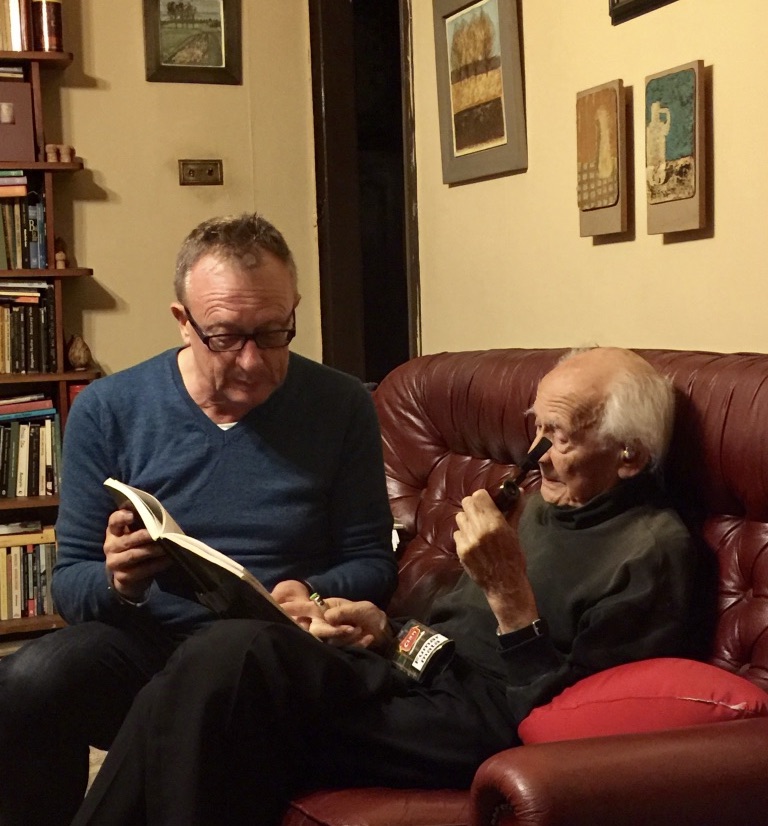
Zygmunt Bauman was born in Poznan 19 November 1925. We celebrate the centenary of his birth by sharing an interview with Peter Beilharz by Southern People’s Weekly. Enthusiasm for Bauman’s ideas remains high in China, as elsewhere. We remember him fondly, as an ongoing friend and inspiration for Thesis Eleven. Happy Birthday, Zygmunt Bauman!
The Chinese version of this interview was published in Southern People Weekly(南方人物周刊).
Peter Beilharz is interviewed by Lin Liuyi, a contributing writer for Southern People Weekly (南方人物周刊) and also an editor at The Paper (澎湃).
Remembering Bauman: In today’s world, what does a moral life mean? Interview with Peter Beilharz
LL: In your work Intimacy in Postmodern Times — A Friendship with Zygmunt, you mentioned that the textual messages of Bauman (his critiques of consumerism, liquidity, and human waste) are highly consistent with his personal lifestyle (simplicity, stability, and his valuation of silence and enduring relationships). What led you to this perception? At different stages of his life, what was the relationship between Bauman’s theoretical works and his life like? Can we understand Bauman as a philosopher who is adept at distilling theoretical ideas from his own personal experience? Or put it another way, is he a person who embodies the unity of knowledge and action?
PB: Bauman was my friend for three decades. This was not something I could reasonably have predicted. I had the good fortune when staying with the Baumans to observe the observer observing on annual visits to Leeds, small talk, table talk, breakfast lunch and dinners, walking, the pub, the odd film crew. Not shopping.
I am fortunate to have had many such teachers, both Australians and others like Heller, Feher and Markus, Castoriadis and later in the USA, Jeff Alexander and Craig Calhoun. I am of the view that a great deal may be learned via the text, but also and perhaps especially through human contact. These are my friends, but also exemplary intellectuals.
You may learn more over coffee than in the lecture hall. Bauman and Heller also lived exemplary twentieth century European lives: two world wars framing their lives, fascism and communism and then liberal democracy. They were diagnosticians of the times, but also of the human condition in western modernity. Experience here connects with theory via praxis. We stand to learn a great deal from practice, or making/doing/being. This was one of the sources of my insight, the company of great minds who are also great people.
Then there are sixty books, in English, which offer a treasure trove of engagement with theory and practice, ideas and life.
LL: In Modernity and the Holocaust, Bauman reveals the ethical dilemma brought about by modernity: by incorporating moral norms into institutional and legal frameworks, modernity weakens individual autonomous ethical judgment, ultimately leading to “moral indifference”. Bauman emphasizes that the Holocaust was not an exception to modernity, but a manifestation of its underlying logic. He first advanced this thesis in 1989—from your perspective, what new insights does this offer for understanding contemporary ethical risks of modernity, such as those in technology ethics and algorithmic ethics?
PB: At the time of its publication Modernity and the Holocaust was a controversial book. The then dominant image of modernity was shiny. We now accept that modernity has a dark side. In the west, this is also a long tradition in the critique of modernity—the idea that, back to the sorcerer’s apprentice, technology is out of control. This is the question I ask my Chinese students: Does modernity have an off-switch? Modernity works against slowness, contemplation and proximity. How do we see the other today? through screen culture. This makes it easier to harm each Other, or to swim in indifference or ennui, the blasé attitude.
I like to think these issues with two connected concepts —irreversibility; and metamorphosis. In the west we still think of rational mastery is our future. But is progress, or instrumental reason, still open to serious reform or reversal? This is the open question about AI. As to metamorphosis, the institutions we build transform into other creatures, not recognizably of our own manufacture. In the west, political parties and university systems may be good examples of this process. Institutions become ossified; social life accelerates. This is what Bauman refers to as Liquid Modernity. As Marx observed as early as 1848, these are likely to be times of turbulence, of ‘everlasting uncertainty’.
LL: Zygmunt Bauman holds that modern society “institutionalizes” ethics (e.g., through compulsory norms of law and religion), whereas postmodern society “returns” ethical responsibility “to the individual”—individuals have to make autonomous choices in the absence of universal rules and bear the risk of “ambiguity”. As you elaborated in your work, this “return of ethics to the individual” is the core distinction between the ethical mechanisms of modernity and postmodernity. Then, how did the ethical mechanism gradually shift from “institutionalization” back to the individual? And in what way has “liquid modernity” transformed the form of traditional morality?
PB: We often think of ethics as inner-directed, and morality as outer-directed. Either I follow my own path, or I conform, and follow the others. Individualization scrambles these distinctions—we have the illusion of autonomy, but really we are only shopping—for consumer goods, for love, for identity. We are able to make many small, consumer choices in the mistaken belief that we are choosing ourselves or our larger shared social goals. The question may be, what goes between individuals and institutions, micro and macro? What is it that holds together societies, offers solidarity and meaning in the in-between, or meso level? Traditionally we think of community as the in-between. Liquid modernity privileges the self-maximizing individual. Now we need to invent new forms of community and interdependency.
LL: Bauman points out that the core of postmodern ethics lies in “the responsibility for the Other”. However, the “cultural segmentation” and “identity opposition” brought about by globalization today (such as regional discrimination and cultural conflict) often lead to the Other being labeled as “opponents” rather than “objects of responsibility”. In light of Bauman’s theory of “the Stranger”, how do you think individuals should break through identity barriers and forge ethical bonds amid differences? As a contemporary intellectual, do you perceive the practical urgency of this issue?
PB: In the west no one is any longer responsible for anything. Or, at most, we may claim to be responsible for our own people, for our tribe. Every day the disasters unfold, explode, or just creep along and fester. After the heyday of the postwar welfare state, we now pull up the ladders. More, the latest wave of globalization since the eighties brings out renewed nationalism and populism, in Europe, the UK and the USA. Strangers are presumed to be enemies. We risk losing the capacity to celebrate difference, to tolerate diversity. So when we are in the company of our Chinese friends, we ourselves look for similarities and for lessons about how others live, rather than judging in advance of experience. This means striving to be open to the world, and to new worlds. Our first instinct should be to listen, to argue for the priority of curiosity over fear.
LL: I would also like to talk with you about “the Bauman phenomenon.” Bauman perfectly practiced the transformation of the intellectual role he proposed—from a “Legislator” to an “Interpreter”. From a “marginal scholar”, Bauman gradually became a globally renowned public intellectual; he is one of the few social theorists with global influence. As a scholar yourself, how do you understand the concept of “Interpreter” proposed by Bauman? What enlightenment does Bauman’s existence bring to the contemporary sociological academia?
PB: Bauman is attracted to the role of interpreter, but he puts a postmodern spin on this. We associate interpretation with hermeneutics, which is based on the close scholarly reading of the text. Now texts are pluralized—but also the image of voice and listening shift from text to conversation. This becomes especially evident in his later reliance on ‘little books’, and then on the conversational format, many books shared with interlocutors, often from the peripheries of the world-system. This represents a shift to authority from the author, or hero, to the public or community. Shared problems warrant shared discussion and possible solutions. Intellectuals should no longer seek to be heroes; we live in an age after intellectual heroes, or with everyday, small versions of heroic or exemplary behavior. Bauman speaks to academics, but by choice more directly to an imaginary public of curious readers who share his concern with the future of the individual and the planet, and all that goes in between.
LL: You have long been engaged in Bauman studies, having published 8 books on Bauman studies, and have maintained a profound friendship with Mr. Bauman for 30 years. Which part of Bauman’s thought once gave you strong emotional support in times of hardship? Are there any specific stories you can share with us?
PB: Bauman was a sociologist, interested in reading the signs of the times, big picture. Culture with big C and little c. Connecting grand themes like rationalization, commodification, alienation, inequality, the hope for dignity to details of everyday life. This is something I hope to share, along with his core ethical values, the critique of suffering and humiliation; the lifelong, emerging project of critical sociology. Socialism, more than individualism. The enthusiasm for Goethe’s pragmatism, modest hopes and remaining dreams of utopia, better worlds large or small.
And remember, he was many things. The persecuted Jewish schoolboy; the young man in the Soviet Union, the student, the traffic cop, the soldier, the husband, companion and father, the Polish patriot, the exile, the photographer, the compulsive scribbler, the clouds of smoke, the aging deaf man cupping his ear at the lectern, the better to hear the question from his audience. The chef, the provider, the host, the racing driver; the correspondent, the traveller, the voracious reader condemned to devour books, and to write them. Teacher. Friend.
LL: When was the last time you thought of your old friend Bauman? In what kind of scene did you think of him? What is his image in your memory often like? Now when you think of him, what is the most memorable interaction you had with him?
PB: I think of Bauman often. I feel his presence, wisdom, curiosity and humour in my everyday life, and I am proud to carry his knowledge and friendship along with others. I lost a friend and mentor but he remains in my life, as do other ghosts, like my parents, and my teachers like Bernard Smith and Stuart Macintyre. But I have many interlocutors and inspirations, including in recent times my Chinese colleagues and young students.
One story? His email to me on receipt of his copy of my first Bauman book, Dialectic of Modernity, in 2000, which opened ‘wowwowwowwow!’ My first Bauman book? A book is an idea, then a promise, if you deliver, though it is also just an object, a thing; just a book. Bauman was waiting for my promise. He liked to say that my task was to put order into the chaos of his writing. I became his interpreter, and this seems to be a job for life, an anchor or perhaps a compass he has left me.
He was a person of joy, as well as sorrow at the state of the world, and well capable of mischief and its companion, irony. He insisted on hope. Bauman was keen to share, not to possess ideas. This is his legacy. Pass it on!


 thesis eleven