The Unexpected Effect of Coronavirus: The Re-Birth of Sociology [and Sociologists]?!?

by Izabela Wagner

We cannot spend our lives being blind and pretending that we are too weak to change the powerful system, especially those of us who are sociologists and scholars, who should be the ‘medical doctors of our societies’. Societies are our sick patients today, and not only because of coronavirus. Our societies are touched by callousness. By insensitivity to the violation of human rights. We, as members of that society, are also ill, because of our passivity. We are imprisoned by our conformism and focused only on ourselves.

Coronacapitalism and Hindu Rashtra in India

by Nivedita Menon

In India, twin processes have driven the country in accelerated mode since the parliamentary elections of 2014, in which the Bharatiya Janata Party (BJP) came to power – predatory capitalism and Hindu supremacist politics. Both have seamlessly melded with the virus to emerge as practically invincible, at least at this moment in time.

Charity in time of plague

by Glyn Davis

Charity might not be ideal, but in a world of limited states it matters that wealthy individuals and organisations address the consequences of inequality. Best they not be required, but better they exist than leave people destitute.

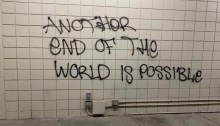
Another End of the World is Possible

by Ayça Çubukçu

There is a utopic element buried in the apocalyptic saying, “Another End of the World is Possible.” It too champions something. In the time that remains, it too affirms the possibility of another reality.

Viral histories: thinking in a pandemic

by Dilip M Menon

Covid-19 has made us reflect on the human condition, the connection with unknown others, in our own societies as much as elsewhere. From Wuhan to Washington, from Johannisholm to Johannesburg, the virus laughs at national borders and travels through human hosts. Virality is however, trumped by nationality as nations put into place more and more restrictions on travel and movement and the body remains marked as ever by colour, class and caste.

Not on the Beach, or Death in Bondi?

by Warwick Anderson

In the Covid-19 pandemic, Australian beaches have been imagined simply as anomalous spaces of contamination, shorn of their ecological and sociological complexity, their actual life worlds. The understanding of viral transmission has been reduced to a mechanical model of contact and contamination, with some alien and stigmatized groups recognized as having special proclivity for carrying and communicating the pathogen–stranger super-spreaders–on safeguarded and sacralized sites, such as the beach.

Photo essay – watching the crown: tangible uncertainty

by Sian Supski

This photo essay was written in the first lockdown in Melbourne, March to June 2020. We are now in the second lockdown. This time the vibe is different, and not easy to explain. The city feels more lonely. We look out our windows at the deserted streets, the empty gallery, the quiet bar and save for the construction noise next door and the passing sirens, it is eerily quiet.

The Virus in the Queues

by Beth Vale

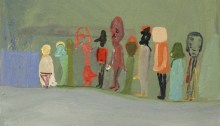
In the queue, the language of ‘social distancing’ is loaded with meaning – illuminating the connections between physical distance and social disparity. Queues make visible the social distance between those who wait and (often far-removed) centres of authority.