
Playlist: Beilharz Blues – Looking Backward (2023)/Looking Forward (1953)
Compiled by Trevor Hogan, Christopher Robbins, and Sian Supski
40 songs featuring some of Peter Beilharz’s favourite guitarists
Compiled by Trevor Hogan, Christopher Robbins, and Sian Supski
40 songs featuring some of Peter Beilharz’s favourite guitarists
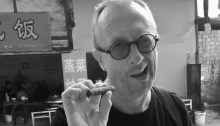
by Eric Ferris
Peter, like my mentor and friend Chris and Bauman (from books), offered me versions of a relationship to teaching and learning – a relationship between teachers and learners – that I can, and will, carry and pass on. This is a ‘how’ and ‘why’ I met Peter, and a glimpse at part of the ‘what’ that underpins my respect for Peter.

by Trevor Hogan
Upon knocking on their front door, the domestic tableau that greeted us included Pete sitting on the floor and leaning against a couch, pen and paper in hand, folder perched on his knee, surrounded by piles of books including an up-ended paperback of E.P. Thompson’s (1963) The Making of the English Working Class, or so my mind’s eye reconstructs the scene of our first meeting. He was preparing lecture notes for his first semester of teaching – first year sociology at La Trobe University. Our conversations moved quickly from beaches and bands to books, critical theory, and politics.

by Alastair Davidson
Peter Beilharz is the only one of the three founding editors of Thesis Eleven to have remained with the journal over the decades since 1980. Three generations of editors joined him in its progress from the tiny, self-financed Australian journal born in Room 681 of the Menzies Building, at Monash University, but he alone saw it through to its transition into a major international journal of the Left, outlasting many other journals born in the same decade. His early energy and enthusiasm, his tenacity, flair and insights accompanied him through the years.

by Christopher G Robbins and Eric Ferris with Sian Supski
To describe this project as a festschrift seems fitting. It is, indeed, a collection of writings gathered together to honour, or pay tribute to, Peter as a scholar. The metrics describing Peter’s scholarship – his contributions to sociology, historical sociology, and social and cultural theory – reflect both its volume and quality and make him fitting of such a tribute.
 thesis eleven