COVID-19 remapping East Asian Modernity

by Mark Harrison

The political meaning of the virus is contending constantly with its biological realities. But as its transmission has slowed in Asia, it is leaving behind newly calcified traces of the long-standing enmities, political compromises and aspirations of different modernist visions set in place in the early 20th century history of modernisation in Asia.
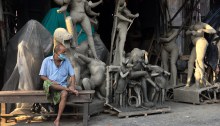
Photo essay – Of Tea and Grit: Kolkata in the Time of COVID-19

by Nilanjana Deb (text) and Jishnu Basak (photos)

Until a vaccine is made cheaply and readily available for all, Kolkata – like all cities – will have to keep moving between phases of city-wide lockdown, limited lockdown within containment zones, and periodic easing of travel and other restrictions to enable businesses and institutions to continue to function.

Institutional and Personal Engagement in the Response to the Covid-19 Medical Crisis, A View from Inside China

by Sikong Zhao

This short essay aims at reflecting upon the way the Covid-19 crisis has consolidated the popular Chinese perception of the connection between official institutions, party membership and grass-roots participatory politics with Chinese characteristics. Nation-wide expectations for effective management, organizational capabilities and rapid implementation have been very popular in a country with more than 1.4 billion people.

Culture in ‘Isolation’

by Donald Sassoon

Consuming culture in almost complete isolation has been possible for years but under the conditions of the current pandemic we are encouraged and even obliged to do so.

The new (un)reality of death: Reflections on death awareness and the ‘Corona Crisis’

by Michael Hviid Jacobsen

Almost overnight, death – after being absent for such a long time – re-entered the collective consciousness of contemporary society. Death, the constant doppelganger of life that we had been successful in keeping at arm’s length for so long, suddenly kicked in the door and made itself something to be talked about, acted upon, dealt with. This time, death (or at least the prospect of and potential for it) presents itself as the ‘Corona virus’, which within a few months has become a worldwide problem and transformed the way we live.

The Unexpected Effect of Coronavirus: The Re-Birth of Sociology [and Sociologists]?!?

by Izabela Wagner

We cannot spend our lives being blind and pretending that we are too weak to change the powerful system, especially those of us who are sociologists and scholars, who should be the ‘medical doctors of our societies’. Societies are our sick patients today, and not only because of coronavirus. Our societies are touched by callousness. By insensitivity to the violation of human rights. We, as members of that society, are also ill, because of our passivity. We are imprisoned by our conformism and focused only on ourselves.

Coronacapitalism and Hindu Rashtra in India

by Nivedita Menon

In India, twin processes have driven the country in accelerated mode since the parliamentary elections of 2014, in which the Bharatiya Janata Party (BJP) came to power – predatory capitalism and Hindu supremacist politics. Both have seamlessly melded with the virus to emerge as practically invincible, at least at this moment in time.

Charity in time of plague

by Glyn Davis

Charity might not be ideal, but in a world of limited states it matters that wealthy individuals and organisations address the consequences of inequality. Best they not be required, but better they exist than leave people destitute.

Another End of the World is Possible

by Ayça Çubukçu

There is a utopic element buried in the apocalyptic saying, “Another End of the World is Possible.” It too champions something. In the time that remains, it too affirms the possibility of another reality.

Viral histories: thinking in a pandemic

by Dilip M Menon

Covid-19 has made us reflect on the human condition, the connection with unknown others, in our own societies as much as elsewhere. From Wuhan to Washington, from Johannisholm to Johannesburg, the virus laughs at national borders and travels through human hosts. Virality is however, trumped by nationality as nations put into place more and more restrictions on travel and movement and the body remains marked as ever by colour, class and caste.