Goodbye, Claus Offe 1940-2025
by Peter Beilharz
Claus Offe was a fine scholar, a sharp thinker, and a good person. An extraordinary colleague, and a fascinating example of the marginal Frankfurt thinker.
by Peter Beilharz
Claus Offe was a fine scholar, a sharp thinker, and a good person. An extraordinary colleague, and a fascinating example of the marginal Frankfurt thinker.
by Alonso Casanueva Baptista
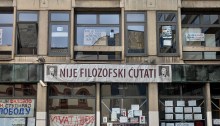
Awareness of the shifting landscape began on the second day of the conference. During the afternoon presentations, I heard the quick flight of fighter jets. Immediately, I got curious, but people around me seemed set on paying full mind to the research of their fellows. Outside the Faculty of Philosophy—the headquarters for the student protest movement—people walked languid, placidly up and down the streets of the city centre.
by Lloyd Cox
The 2025 Australian federal election will be remembered for both the scale of Labor’s victory and the implosion of the Liberal and National Party Coalition whose leader, Peter Dutton, lost his own seat. Together, they almost guarantee Labor at least another six years in power, while raising serious doubt about the long-term viability of an aging Liberal Party now at war with itself.
by Siniša Malešević
War is not an exception that suddenly interrupts normal social life. Nearly every aspect of social life including the governance structures, social hierarchies, gender and sexual relations, religious identities, class dynamics, ethno-racial stratification, educational practices, heath systems or the administrativeand administrative apparatuses have all been molded by legacies of specific wars. Whether we like it or not, warfare has historically been and remains a norm that constantly shapes our social order.
by Eric Ferris
Previously honoring Agnes Heller and George Markus, the conference was part of an ongoing, larger Chinese federal research project on aesthetics which, in part, is a canopy for critical theory and has to date resulted in serious scholarship on Eastern European Marxist thinkers by Chinese intellectuals. Co-sponsored by Thesis Eleven, The Research Center for Marxist Theory of Literature in the College of Literature and Journalism at Sichuan University in Chengdu, China, and the Marxist Aesthetics Committee of the Chinese Association of Aesthetics, the conference not only reflected Bauman’s global influence, it was also an example of how his influence continues to grow.
by Howard Prosser
This interview with Martin Jay took place in January 2025. The conversation focuses on the conceptual elements of his book Magical Nominalism: The Historical Event, Aesthetic Reenchantment, and the Photograph (2025). The discussion traces the place of nominalism within philosophy and in connection to Critical Theory, history, and art.
by Rex Butler and A.D.S. Donaldson
UnAustralian art is the art of our present, those missing years since 1970 in McLean’s book. But the real point – to say this for the last time and to conclude – is that we have always been like this. This history has been written for a long time, just not in the name of “Australia”. Those stories we tell of immigrants and expatriates from the past read as though they could have happened yesterday, and we can identify with them as if they were ours. We are all first of all non-national, non-Australian, So many of us, nearly all of us, are immigrants.
by Brendon O’Connor
The challenge ahead for the Democrats is the question of how the best aspects of the Harris campaign, with its multiracial openness and pro-women’s rights agenda, can be incorporated into a more Left-wing Democratic Party. The crushing defeat for Harris is an opportunity for the Democrats to develop policies that offer real solutions to America’s many social and economic problems.
by John Lechte
This year, 2024, marks the 50th anniversary of the original French edition Julia Kristeva’s epoch-making volume, La Révolution du langage poétique. L’avant-garde à la fin du XIXe siècle: Lautréamont et Mallarmé (1974) (Revolution in Poetic Language. The Avant-Garde at the End of the XIXth Century: Lauréamont and Mallarmé). The work was originally defended in 1973 in Paris as a doctorat d’état ès lettres. On the panel were Jean-Claude Chevalier (supervisor), Henri Lefèbvre, Pierre Albouy and Roland Barthes. The thesis was awarded the highest honour: mention très bien avec félicitations du jury.
by Howard Prosser
This is a tale of friendship. Or, more accurately, it’s a reflection on how a friendship based on a few meetings can amount to a lot. I am sure many of us have had a version of this experience. The friendships made during a stint living elsewhere. Or those incidental meetings and interactions with someone at infrequent events which, though it never quite blossoms into something more, we can still define as friendship.