Fathers and Sons: Nikos Papastergiadis on John Berger

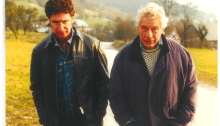
I once met Edward Said early on in my Phd candidature. I told him about my research and he extolled the virtues of John Berger, but then added: “Whatever you do, just don’t go to visit him there. There are pigs and shit everywhere.” I said, “it sounds like my father’s village.” It was not a turn off to me. Once I got there, I didn’t see any pigs. The pig sty was empty. It later became a storeroom for all the books that John published. John, himself did not even keep copies of his books.

“Peter’s House of Theory” – A Postcard to Peter

by Margaret Somers

I fell in love with Peter the first time I met him, at an American Sociological Meeting, sometime in the late 1980s, I think. This was, of course, love Beilharzian-style – not the amorous variety but an intimacy of shared political intellectual practice. The ASA was a fitting place to meet as it was one of Peter’s most fertile sites for his Beilharzian love assignations.

Friendship’s Resonance: On Peter Beilharz’s Goodwill

by Howard Prosser

This is a tale of friendship. Or, more accurately, it’s a reflection on how a friendship based on a few meetings can amount to a lot. I am sure many of us have had a version of this experience. The friendships made during a stint living elsewhere. Or those incidental meetings and interactions with someone at infrequent events which, though it never quite blossoms into something more, we can still define as friendship.

Peter Beilharz and Modernity in Ruins

by George Steinmetz

I first met Peter, I believe, at the meetings of the American Sociological Association in Montréal in 2006. After the panel I struck up a conversation with Peter, went out for coffee with him, and discovered two amazing things. The first was that Peter was the beating heart of the journal Thesis Eleven, which I had been familiar with since graduate school.

Puzzling Australia

by Peter Murphy

I think that what happened to both of us separately but in unconscious tandem in the 1990s says a lot about the intellectual framing of Australian society and history. We both, unwittingly, without any preconception of this, moved away from a politicised interpretation of Australian society (typical of much of Australian historiography) toward a view that placed art and aesthetics at the centre of social analysis.

A Story of Friendship: An Homage to Peter Beilharz

by María Pía Lara

This reflection is tied up with the memoir written by my dear friend Peter Beilharz (2020), Intimacy in Postmodern Times: A Friendship with Zygmunt Bauman. Indeed, Peter’s process of understanding himself not only allows us to learn about him as a person and as an intellectual, but it also explores some important dimensions of his sociological thinking in connection with his friend.

Learning Through and From Peter Beilharz

by Eric Ferris

Peter, like my mentor and friend Chris and Bauman (from books), offered me versions of a relationship to teaching and learning – a relationship between teachers and learners – that I can, and will, carry and pass on. This is a ‘how’ and ‘why’ I met Peter, and a glimpse at part of the ‘what’ that underpins my respect for Peter.