By Matt Dawson (University of Glasgow, Scotland)
(This is a prepublication version of this review. You can find the published version in Thesis Eleven Journal, on the T11 Sage website)
2023 saw six new books by, and about Zygmunt Bauman published. 6 years after his death, these texts were part of an emerging body of literature we may call The Posthumous Bauman. I explore the key lessons this literature has offered and suggest there are four key themes: our increased knowledge of Bauman’s life and its link, or not, to his sociology; the role of the hinterland for the sociologist; the increased interest in Bauman’s lifelong sociological project before he came to Leeds; and the differing receptions of Bauman’s work. The continued value of Bauman’s sociological project expressed in these themes is a reflection of his rich and diverse sociological project, but also the commitment and achievements of a committed body of interpreters. This new era of The Posthumous Bauman promises exciting new insights and sources of dialogue.
Texts, Bauman argues, gain their meaning contextually. If texts only have one author, they have multiple interpreters since ‘the coexistence of many interpretations is not a derivative, a function, a dependent variable … a phenomenon that needs to be explained, indicating features particular to that context: it is the constituent of that context’ (Bauman, 1997: 152). Recognition of this removes the possibility of a final, definitive, interpretation, akin to an ‘impudent effort to seize the secrets of history, to look over its shoulder, to steal the memos from its desk before they are sent out’ (Bauman, 1997: 153).
This recognition that there are continually new interpretations that can be applied to a text applies equally to the writer of those words. Now that Bauman is, sadly, no longer with us, his readers find themselves interpreting his words in a context that was never his. If they are lucky, such is the fate for social theorists whose words get to outlive them. But, for these words to live on, these theorists need their interpreters – as Bauman (1992: 57) put it ‘Tomorrow’s immortals must first get hold of today’s archives’ – and here Bauman was lucky in not only having a group of committed interpreters but also in the richness and diversity of his sociological project which means that his texts are open to new, exciting interpretations and meanings. Consequently, we have now entered a new era of Bauman interpretations, the era of a Posthumous Bauman.
The year 2023 saw six new books by, and about, Bauman. In the rest of this essay, I will outline four key themes based around these texts, supplemented by references to other texts appearing in recent years. These concern Bauman’s biography, the role of ‘hinterlands’ for the sociologist, mapping continuities across Bauman’s intellectual project and finally the question of how Bauman is received. It is my argument that, taken together, these four suggest the emergence of a new Posthumous Bauman.
‘We Live Twice’: Bauman’s Life
My Life in Fragments is the latest edition to perhaps the most notable expansion of Posthumous Bauman literature, that concerning his biography. Expertly edited, introduced, annotated and translated by Izabela Wagner this text is a combination of three separate texts from which Wagner creates an autobiography focused on Bauman’s time in Poland and the aftermath of this.
Of course, Wagner is well equipped for this having previously published the magnificent biography Bauman: A Biography (Wagner, 2020, see Dawson, 2021a for a review). Readers of the earlier text will be familiar with the main elements of Bauman’s time in Poland contained in chapters 2-4, though the autobiographical reflections and framing are new. As Bauman puts it:
We live twice. Once, breaking and flattening; the second time, gathering the pieces and arranging them in patterns. First, living; second, narrating the experience. This second life, for whatever reason, seems more important than the first. It’s only in the second one that the ‘point’ appears … The first life passes. The second – the narrated one – lasts; and that existence is a ticket to eternity
Bauman, 2023a: 10
Bauman’s application for his ticket to eternity here concerns the relation of being Polish and Jewish. He begins by describing the events of his first, lived, life by, for example, telling how upon arriving at the Gymnasium he is ‘submerged in an avalanche of kicks and punches. Pushed and pulled from all sides’ until he was deposited on the ‘Jewish bench’ which was to be his and four other boys’ homes. Bauman notes poignantly that of those five, only one still lives in Poland, another perished in the Holocaust while the remaining three ‘myself included, left their country. At least, bodily they did’ (Bauman, 2023a: 69-70).
The account begins to shift as it turns to the war and its immediate aftermath. In moving from describing his lived first life to narrating his second life Bauman inevitably begins to frame his account in light of the antisemitism and nationalism which was used by others to explain his actions. As he puts it:
Half a century had to pass for me to learn from the newspapers of my native land that everything I was doing with my brothers in arms was done in the name of enslaving, and not liberating, the homeland. This slander hurt terribly, as it must (if one believes in life after death) have hurt the tens of thousands of Poles who paid for this liberation/enslavement with their lives.
Bauman, 2023a: 112
And, again, when discussing his connection to communism:
I admit: I ‘matured’ slowly. There was a stubborn hope that the ‘Party would understand’ and acknowledge its ‘errors’, would turn away from the wrong path and, to use the words that could be heard after the ‘Prague Spring’, ‘restore a human face to socialism’…the people who were drawn into the Party and wanted to serve it were doing so not despite its ‘errors’, but because what others considered as errors, or even as the wickedness and crimes of the rulers, actually suited them.
Bauman, 2023a: 136
When reading this account of Bauman’s second life one is struck by two things. The first is the plausibility of his account of his ties to communism and the party. As is well known, Bauman’s time working for the Polish communism Internal Security Corps has been a matter of great controversy. Both here and in Wagner’s biography (2020: 102-132) this is convincingly explained as a set of circumstances of the time which led a young Polish Jew with belief – in retrospect mistaken, but understandable, belief – to end up in those circumstances.

The second thing one is struck by is the long arc of these events. The final three chapters of the book, in different ways, reflect on the nature of being Polish and Jewish after exile for Bauman. There is much here which is incredibly moving and which I would encourage the reader to explore. Notably, reflecting the pressures of the narrated second life, Bauman clearly felt a lifelong desire to not just defend his position as a Polish Jew, but to claim it proudly. Partly, he argues, this is a response to the bullying he faced as a child but it is also linked to politics of memory in Poland, with the (until very recently) governing Law and Justice party using memory as the way of ‘unmasking the devil’ for contemporary Poland, a devil who often happens to be Jewish (Bauman, 2023a: 183).
What can we take of a life lived like Bauman’s? This is the topic of the final chapter where Bauman reflects on what it is to mature. This, for him, involves acceptance of responsibility. However, we can lose something as we mature, namely ‘boldness and stubbornness, desire and the courage to say ‘no’, the inclination to refuse accepting things as they are just because they are … the audacity to spurn the carrot and the courage to ignore the stick’ (Bauman, 2023a: 193). Therefore, he argues we need to fight against this split. We should accept responsibility for our actions and face the world as it is but also see the possibility of alternatives. This can involve recognising that accepting responsibility can include the responsibility to resist. Reflecting his broader moral sociology Bauman ends his life story arguing that by transforming our fate into a calling, we ‘open the gates for our conscience to function, from now on, as our judge’ (Bauman, 2023a: 196).
The publication of My Life in Fragments along with other biographical texts such as Wagner’s and Beilharz’s (2020) account of a friendship Intimacy in Postmodern Times poses a new question for Bauman scholars: to what extent does Bauman’s biography explain or shape his sociology? Of course, it is impossible for a sociologist’s life not to have some impact on their work, so what we face here is a question of degree. In many ways, this is not a new question, with Smith (1999), Best (2013) and Rattansi (2017) previously seeking to use Bauman’s biography as a positive or negative source for his sociology. Therefore, what is new for the Posthumous Bauman is not the desire or trend to link his life and his sociology, but rather the amount of knowledge we now have available to us in doing so.
While there are valuable things to be gained from exploring this, I have a slight apprehension concerning any potential ‘biographical turn’ for the Posthumous Bauman. As discussed, for social theories to outlive the person who produced them, they need interpreters and adherents who, looking outward, seek to re-apply and reinterpret these theories in a world that was not the one of the theorist who wrote the original words. Rather than a biographical turn inwards, this should be a social turn outwards. One can complement the other (as Palmer (2023) does, see below) but this requires a commitment to relevancy. Interestingly, a 1997 diary reproduced in My Life in Fragments contains Bauman reflecting on this question of relevancy, specifically on how his work may be received by young people:
for me, postmodernity is primarily post-modernity – or, rather, post-modernity. But for them? It is not ‘post’ anything: we could just as well (or just as ineptly) call it the post-Alexandrian or post-Napoleonic epoch. That dusk, when my owl spread its wings, they did not experience, because they did not experience the day that preceded that dusk. For me, their world is, above all, what it is not: it is not all those things that constituted my world … They know better than (differently from) me what their world is; they know not as well (differently), what it is not. But to describe to them their world by referencing the past which I experienced is like explaining to them what water is, by hammering into their heads that it is not a hard substance.
Bauman, 2023a: 28-29
Here we see the intersection of biography and sociology, how Bauman’s experiences reflect what he had to say about society. But, reflecting his broader commitment to sociology speaking to social experiences, here we see it as a question for the writer focused on the reader: how can I usefully speak to their experiences when mine are so different? Rather than a question for the reader focused on the writer: how can we understand the sociology of Bauman via his biography? While this second question is important, the continued appeal of the Posthumous Bauman will depend on the convincingness of the answer to the first.
Bauman’s Hinterland: Photography and Literature
Writing of the history of sociologists who were also secret musicians, Les Back (2023) has argued that today too few sociologists have time for a ‘hinterland’, a craft or second profession, away from academia. Among the publications of the Posthumous Bauman we find a story of a hinterland in a time when they were perhaps more plausible for academics: photography.
Beilharz and Wolff’s (2023) edited collection The Photographs of Zygmunt Bauman is a beautifully presented text which combines Bauman’s photos with essays and short reflections. Bauman was a dedicated photographer, in the early 80s he began attending the Leeds Camera Club and converted parts of his house into a studio and darkroom. He took his camera with him on his travels and the volume contains photos of city streets, the Yorkshire countryside, portraits and candid shots of people going about their day. Bauman was quite accomplished, winning several certificates of merit, hosting exhibitions of his photos in both Leeds and Poland and even finishing 19th in the 1986 British Photographer of the Year competition.
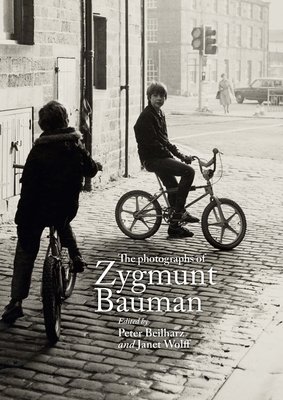
Such intense activity poses an obvious question: how did Bauman’s photography relate to his sociology? Contributors to this volume answer this in different ways. For Beilharz and Wolff the early/mid 80s was a period of ‘hiatus’ from sociology for Bauman, due to a mix of dissatisfaction with changes in University life and a lack of a clear audience for his work during which photography was a welcome diversion. Similar points are made in Wolff’s solo contribution where she notes the unusualness in a scholar who was comfortable discussing the arts spending so little time discussing the visual arts he practiced. A slightly different argument is offered by Palmer who argues that there is a connection between a photographical project which focused so much of capturing daily life and a sociology which sought to defamiliarize this same everyday life.
Palmer has a compelling case here, but as I read this collection a different answer crossed my mind. The most moving pieces in this collection are the essays from Bauman’s family, one which stuck out was by Bauman’s grandson, Alex Bauman-Lyons. Reflecting upon a photo Bauman took of a woman sitting outside her apartment block – curlers in, slippers on – Bauman-Lyons uses it to reflect on how Bauman framed the individual, seeing the ordinariness of the shot as a picture of everyday defiance, noting that ‘For all of the seriousness of his subject matters, [Bauman]was fundamentally an optimist. Anyone who ever met him will know he truly believed in the power of humanity’ (Bauman-Lyons, 2023: 123). In his own reflection on photography, compiled and published in the first posthumous volume of his essays, Culture and Art, Bauman argues that ‘I see now photography as a technique to create perfect images out of somewhat imperfect reality’ (Bauman, 1983-1985: 103). Reflecting on both these comments, I would suggest Bauman’s photographs are neither a continuation of his sociological project nor completely disconnected to it, instead they reflect his claims about what it is to be social. Namely, a process of bringing order to an imperfect reality and, in the ambivalent position of the modern actor, seeking to place your faith in people and the everyday against the macro and impersonal. His photographs may only imperfectly reflect Zygmunt Bauman the sociologist but they represent Zygmunt Bauman, an actor experiencing the claims the sociologist made, very well.
Back argues that hinterlands are important for sociologists since they provide ‘an interpretive device for reading social and cultural life’ and helps nourish the sociological imagination which, if restricted to the campus and the demands of contemporary academia ‘winnows’ (Back, 2023: 16, 18). While Bauman’s photography may not have provided such an interpretive device, the posthumous literature has shown us what cultural forms did. Beilharz and Wolff reproduce Keith Tester’s article concerning Bauman and Bergman which shows how film and a Bergmanian notion of vocation occur in his work. Meanwhile, Culture and Art shows the vastness of Bauman’s use of culture in his writings. In addition to photography this covers painting, the theatre, art exhibitions, sculpture and, of course, literature (Bauman, 2021). The last of these was a long-running presence in Bauman’s sociology and here we find his best reflection of the relation between literature and sociology. The latter:
loves clarity of image, harmony of shapes, transparency of compositions – beautifully grasped and cleaning up everything that threatens such clarity. Theory, not without reason, boasts of the ability to clarify things. Reality – aggravating as this aspect is, its habit of being intricate, blurred, chaotic and capricious – emerges from its processing by theory clear and fully visible, predictable, patted into place.
Bauman, 2010: 211
Meanwhile literature presents a different view:
The world of people … a world that is lived and experienced, is not divided into sociological, philosophical, economic and pedagogical squares. If one yearns – as I did, and attempted, though with only meagre results – to recreate this world of the creature called ‘homo sapiens’, and its being-within-it, in its indivisible totality … to whom, if not to novels should we turn for help in this undertaking? … In the modern world, abandoned by philosophy and divided into hundreds of academic specializations, the novel is for us the final observatory, from which we can perceive human life in its wholeness; the last one, from whose interior we can safely declare: ecce homo.
Bauman, 2010: 207-208
Both can, and must, live together for Bauman, but he is also clear on who takes the lead and, in so doing, returns us to the question of the sociologist’s hinterland:
the novel, are not, for the practitioner of humanities in academia (and sociology is part of the humanities, or it is not sociology), an activity reserved for ‘free time outside of work’, private pleasures of hobby horses; they are her companions-in-arms. Bah! They seem to be the vanguard of the army of the humanities – the division behind which countless platoons, companies, battalions, regiments and divisions of this army strive, usually with limited success, to keep up.
Bauman, 2010: 207
For Bauman, the sociological imagination is enriched through an interaction with literature. We cannot reach the heights of novels, but a sociology in which sociologists are too busy to read literature and cannot supplement the spirit of theory with the spirit of the novel is poorer. Therefore, pace Back, one thing we can take from the Posthumous Bauman is the need for sociologists to have a hinterland. This may enrich, reflect, or have nothing to do with one’s sociology, but as humans practicing the humanities, we are poorer without one.
Bauman’s Sociological Project: Continuity across Three Spaces
When Bauman arrived in Leeds he was 46. This meant that a significant amount of work, composed both in Poland and Israel, has been somewhat neglected in the secondary literature. His ‘Leeds period’ has become dominant and the work done in the other places has not been given the same attention. A notable theme for the Posthumous Bauman has been the efforts to correct this.
History and Politics (Bauman, 2023b), the second in three themed volumes of posthumously published essays, collects pieces from Bauman’s career, running from 1957 to 2016. The collection is edited, and introduced, by Mark Davis, Jack Palmer, Darius Brzeziński and Tom Campbell with translations of pieces previously published in Polish by Katarzyna Bartoszyńska. As Bartoszyńska notes in her translator’s note, translating Bauman, a man whose English prose was so distinct and well crafted, could potentially pose a number of issues, but she has excelled in doing so. The best compliment I can offer is when I read her translations, they read as if Bauman had originally composed them in English.

A reader of this text is invited to read these pieces, published over a period of nearly 60 years across Poland, Israel and England but now placed together, as part of a singular sociological project. This is a very welcome approach which encourages new readings. Take, for example, 1961’s ‘On the Political Mechanisms of Bourgeois Democracy’ and 2007’s ‘Britain after Blair, or Thatcherism Consolidated’. Read separately, these seem remarkably different pieces, the former is a somewhat orthodox socialist critique of ‘bourgeois democracy’ of its time which claims that the reality of such democracy, with its use of mass propaganda and control from the dominant class has ‘not much in common with the premises of theory’ (Bauman, 1961: 33). The latter explores how the reign of New Labour saw neoliberalism become consolidated with the ‘retreat of the state from the endorsement of social rights’ (Bauman, 2007: 172). Read together however, we can see a common concern with the closing down of alternatives, and reproduction of the status quo, in liberal democracy. In turn, each argues that in the language of the former ‘all possible human advantage and the totality of human acknowledgement are reserved precisely for those who have been successful – the clicking of a fat purse’ (Bauman, 1961: 35) and, in the words of the latter ‘the membership of the democratic body politic is on the way to becoming a privilege’ (Bauman, 2007: 169). In each case, we see the same Bauman, just in different contexts.
‘Britain After Blair’ is one of the most angry and normative pieces Bauman wrote and in this is united with a piece published here for the first time ‘At the Crossroad in a World of Crossroads’ (Bauman 1970) written during Bauman’s time in Israel. This engages in a critique of the notion of Israel being free from oppression due to the ignorance of non-national forms of oppression, particularly those based in class. Reading this piece in 2023, as in response to heinous attacks from Hamas the Israeli state engages in collective punishment against the Palestinian people, one cannot but be struck by Bauman’s call for what Israel should be:
The particular tragedy of our Jewish fates, the weight of the national fate on problems of class and other social problems often makes it more difficult to see this general human truth. The more painful that issues of state and nation become on a daily basis, the less we understand the point of class struggles and the all-encompassing meaning of the postulate of human freedom. We do not ponder who is actually interested in the ‘economic integration’ of occupied territories, and whose pockets it will line, and whose it will empty. We do not worry ourselves in the face of the next generation, growing up in the shadow of military occupation…The triumph of Israel is where we find the triumph of human freedom. We must not allow for the two sides of this equation to be separated. The problem of the world is our problem.
Bauman, 1970: 79
Reflecting the early politics of the Zionist movement, Bauman ends for a call for this to be linked to socialist politics since ‘the future world will be socialist. Or it will not be at all’ (Bauman, 1970: 79).
While this piece may share its anger and normativity with Britain after Blair, it also shares its desire to bear witness to the fate of Jewish politics with 1969’s ‘The End of Polish Jewry: A Sociological Review’ and 1988’s ‘Exit Visas and Entry Tickets: Paradoxes of Jewish Assimilation’. Each of these, in different ways, account for the historical fate of Jewry in Europe and the creation of distinct forms of socialism before being entangled with communism. In turn, these, with their focus on the specificity of Central and Eastern European share some themes with 1973’s ‘Between State and Society’, which critiques the desire to apply ‘Western’ models to Eastern Europe and 1981’s ‘On the Maturation of Socialism’ which highlights the specificity of the Solidarity campaign creating a Polish civil society different from the Western model. Finally, this critique of Western models can be found in 1957’s ‘Tractate on Bureaucracy’ which sees China and Britain as competing models for how to form socialist bureaucracy and in 2001’s ‘Names of Suffering, Names of Shame’ which uses the 9/11 attacks to critique the silence offered to atrocities beyond the West, such as Rwanda.
While in the above I have only covered some of the pieces in this excellent collection, I hope it is clear that one virtue of the volume is its ability to bring pieces from across Bauman’s career into debate with another encouraging us to see continuity in his thought1. It is perhaps therefore unsurprising that the secondary Posthumous Bauman literature has highlighted the same thing.
Palmer’s Zygmunt Bauman and the West: A Sociology of Intellectual Exile provides a reading of Bauman which challenges much of how sociology thinks of him. As the title gives away, this concerns, in Palmer’s words, ‘the ambivalence of Zygmunt Bauman’s social position and intellectual work vis-à-vis the West, situating him as a thinker who at various times and in various places has been cast as a stranger anta portas, in, but not of, the West’ (Palmer, 2023: 3). This position is seen as ‘exilic’ in Palmer’s telling, with Bauman continually positioned as an outsider. This is explored in the first chapter ‘The Exilic Position’ which explores Bauman two forms of exile from Poland, his alienation from state socialism then Israeli nationalism, ‘outsiderness’ in Britain and erasure in Poland. This constant position of the outsider not only shapes Bauman’s focus but is, for Palmer, the one which can produce the universal, critical perspective of a text such as Modernity and the Holocaust. In chapter 2, Palmer links this to Bauman’s desire to develop a form of ‘sociological essayism’ which, in its experimental and open-ended form, allows Bauman to ‘write the multiplicity of modernity’.
From here, Palmer discusses Bauman’s theorisation of the West across three themes. Chapter 3 explores decolonisation, placing Bauman into the context of the 60s and 70s where decolonization was being discussed via the international connections Bauman had developed. In turn, Palmer argues this influenced Bauman’s ‘activist’, rather than ‘managerial’ conception of culture which critiqued notions of Western cultural superiority. This then leads into later work concerning the link of the gardening state with colonialism or the ways postcolonialism removed a form of ‘waste disposal’ for the West. Chapter 4 then turns to the link between the Jewish experience and postmodernity, with Bauman providing an alternative, racially shaped, conception of modernity beginning with the expulsion of the Jews and ending with the Holocaust. Finally, in chapter 5, Palmer traces Bauman’s career-long writing on communism, arguing that here we can see a critique of both imperialism practiced against Eastern Europe and theories of Westernisation.
Palmer’s account of Bauman is groundbreaking and, as I will explore further below, speaks to Bauman’s reception today. Reflecting my earlier point, it is also notable how Palmer’s approach treats the West as a theme throughout Bauman’s whole sociological writing, combining the discussion of culture in the 1960s to his theorisation of his liquid modernity. It is reflective of the Posthumous Bauman who is no longer grounded simply in the ‘Leeds period’. It is also an excellent case study in how our increased knowledge of Bauman’s biography can be used productively to enrich his sociology.
A similar perspective can be found in Brzeziński’s Zygmunt Bauman and the Theory of Culture which is unique in the author’s tracing of the concept of culture across Bauman’s whole ouevre2. As discussed in chapter 1, Brzeziński sees change in Bauman’s conceptualisation of culture, from a quasi-positivist notion of culture as a social fact to a ‘repertoire’ model which emphasises the creative actor. He also highlights continuities, most notably in the commitment to a notion of structuration theory and Bauman’s ‘hyperbolizing’ tendency, namely, to make claims of drastic changes and stark dichotomies to encourage critique (Brzeziński, 2023: 12). Chapter 2, meanwhile, is probably the best overview available on Bauman’s ‘Polish period’ which, for Brzeziński, concerned Bauman’s desire to identify ‘alternative interpretations’ of a Marxist tradition he was rejecting in its more orthodox form (Brzeziński, 2023: 35). This alternative tradition, influenced mostly by Gramsci but taking influence from Camus’s notion of the culturally engaged rebel is then traced by Brzeziński into his later work, through the development of structuration theory in chapter 3 and then onto the theorisation of post and liquid modernity in chapters 4 and 5.
In Brzeziński’s work, the desire to look at the work of the Posthumous Bauman as a whole, running from his earliest to his latest texts reaches its apotheosis. An interesting question it raises in this regard, and reflecting a comment offered above concerning History and Politics, is the role of translation. As a Polish speaker, Brzeziński can draw upon a selection of texts hitherto unpublished in English. Given the largely mono-lingual nature of the British academia in which Bauman made his home, many of his commentators are likely to be unable to read these texts. This is a failing of Britain and its disregard of language learning, but it does shine a light on how little of the Polish work has been translated, with the collected essays beginning to make a dent in this.
It is perhaps fitting that after providing readers with the best account of Bauman’s early Polish period, Brzeziński’s contribution to Jacobsen’s edited Anthem Companion to Zygmunt Bauman3 focuses on his ‘last book’ Retrotopia as part of a broader ‘nostalgic turn’. While a concern with Bauman’s ‘late work’ marks out this text this is treated not as a separate part of Bauman’s thought, but rather as reflections of longer running trends. For example, Davis and Álvarez-Álvarez discuss how Bauman’s later ‘conversation’ books combine a late focus on dialogue with long-running themes such as modernity, the ambivalence of freedom and strangers. This later concept is then the focus of Best’s contribution which uses Bauman’s Strangers at our Door as a way to discuss the theorisation of strangers in his work going back to Modernity and the Holocaust. Beilharz traces a form of ‘Weberian Marxism’ across his work and Jacobsen also provides a particularly inventive approach to Bauman’s project by tracing the concept of ambivalence from his Polish period up to his last writings. Indeed, even Brzeziński’s discussion of Bauman’s ‘last book’ links this into his broader concern with utopianism.
As mentioned above, for any social theorist to live on, it requires the work of a committed number of interpreters who bring the work alive for the current day. The texts discussed in this section show a number of important attempts to do this by using a topic as an entry point into his broader sociology. The Posthumous Bauman is now not simply Leeds Bauman, but Bauman across Leeds, Poland and Israel, a Bauman with continuities in a rich sociological project which was, and can be, applied across different contexts.
Postcolonialism and Other Contexts: Bauman’s Reception
As indicated above, a key question for the Posthumous Bauman is how his work is now received. It is therefore unsurprising that this is a major element of the texts published in 2023.
Returning first to the Anthem Companion, notable here are texts which discuss Bauman’s reception in particular areas. Messina, picking up on some of the broader themes discussed in Palmer and Brzeziński’s (2022) edited volume on the topic, discusses the reception of Modernity and the Holocaust across sociology and history. When it comes to history a warm, albeit limited, reception increasingly gives way to criticism for underplaying antisemitism. Meanwhile in sociology the welcome is initially even more positive and extensive due to bringing the holocaust into sociology and the discussion of modernity. Overtime this becomes more critical, especially with the entry of postcolonial perspectives, but remains warm. Indeed, she notes that in the US, Bauman is seen to have invented holocaust sociology. The topic of the Bauman’s reception in the US is then the focus of a chapter by Meštrovic, Ohsfeldt and Hardy who discuss why Bauman, such a significant name in Europe/Latin America has so few followers in the US. A key factor for them is Bauman’s supposed pessimism or, in their words, ‘a kind of fatalism in Bauman’s work, and many other European works, that is simply incomprehensible to the American mind’ (Meštrovic, Ohsfeldt and Hardy, 2023: 88). They see this as reflective of a pragmatist approach in American sociology which is anathema to Bauman and the broader European tradition. Bauman scholars may wish to quibble with some of the claims made about his work in this chapter, but it is informative when read alongside Polhuijs’s (2022) text exploring not just how Bauman was influenced by Pope Francis but how the latter would draw upon some of Bauman’s concepts in his speeches. It is intriguing to ask why Bauman could have a welcome reception from an Argentinian Pope living in Europe, but not in American sociology?
Returning closer to home, perhaps the key question for Bauman’s reception in recent years has been in relation to the decolonial critique. Rattansi (2017) offered perhaps the most prominent attempt to argue that viewing Bauman from this perspective showed flaws in his sociology, most notably the occlusion of race and imperialism. Here, Palmer’s (2023) text is hugely significant. Reflecting a point Rattansi and myself previously debated on the pages of Thesis Eleven (Rattansi 2021a, Dawson 2021b), Bauman’s exilic position makes any claim of a clear link between social position, such as whiteness, and intellectual position, such as Eurocentrism, incredibly problematic:
Any attempt to pin down Bauman’s positionality into centred forms – ‘whiteness’, Jewishness, Polishness, and so on – fails on account of the essentially centreless positionality of exile, with consequences for any easy association between Bauman’s work and the charge of Eurocentrism
Palmer, 2023: 18
Here we see the question of biography and Bauman’s outsiderness returning again. As Palmer reminds us, these need to be used thoughtfully, rather than reduced to simplified categories from which clear outcomes can be drawn. Furthermore, as discussed above, questions of imperialism and race were in fact significant throughout Bauman’s oeuvre. This leads to Palmer’s reflections on Bauman’s value to debates on decoloniality:
In our hypothetical dialogue between Bauman and the sorts of postcolonial and decolonial thinkers referenced throughout this book, the risk is that their works and the histories to which they respond are appropriated in the attempt to pinpoint elements of Bauman’s sociological frame that are added post hoc … Conflation of historical trajectories, hasty analogy, and rough equation are not the solutions to their separation and hierarchical framing; each loses sight of the category of the specific. Perhaps, in disentangling these paths that run across Bauman’s oeuvre, it is precisely the identification of the specificity of the Jewish experience that is the best argument against Eurocentrism in his essayistic, multi-windowed account of the multiplicity of modernity.
Palmer, 2023: 138
Here, Bauman’s distinct postcolonial contribution concerns the specificity of Jewish experience within Europe, itself differentiated into its Western, Central and Eastern areas with unique experiences of imperialism and racial politics. For Palmer, rather than see Bauman as an object of critique for postcolonial scholars, we can, reflecting a theme Bauman would’ve appreciated, more fruitfully see this as a dialogue in which Bauman’s sociology ‘was much more attentive to colonial-imperialism and thus offers a far greater resource for decolonizing sociology than is commonly thought’ (Palmer, 2023: 86).
As discussed at the start of this essay, texts are always read in new contexts and in this section we have seen how the Posthumous Bauman exists within a sociological context marked by many factors, including the decolonial critique. This requires the type of ‘re-reading’ scholars such as Palmer have done. As Bauman argues, sociology as hermeneutics requires the recognition that understanding is not a straight linear process, but rather a circle in which we return to problems through new lenses (Bauman, 1997). The same is true for how the Posthumous Bauman will be received.
Conclusion: Where now for the Posthumous Bauman?
As Palmer puts it ‘Reading Bauman is conditioned by the conditions in which one reads him. The meanings of his works change depending on the direction from which the reader approaches them’ (Palmer, 2023: 166) and a reader in 2023 was provided with a number of new directions to follow for the Posthumous Bauman. As noted by both Palmer (2023: 15-16) and Brzeziński (2023: 142) the presence of an archive, The Papers of Janina and Zygmunt Bauman, held at the University of Leeds, promises even more new interpretations, including the new publications which helped make up My Life in Fragments, The Photography of Zygmunt Bauman and the collected essays.
In this essay I have highlighted how four key themes which mark out the early development of the Posthumous Bauman. Each of these promise new paths for his work. Firstly, we have the expansion of biographical material. While we should be careful not to go fully into a biographical turn, this material is not only an innately sociologically interesting account of a life lived through major social change and forms of oppression, but shows the varied contexts from which Bauman drew. Secondly, we saw the role of Bauman’s hinterland and the lessons sociologists can learn about the need for human experience to practice the humanities. Thirdly, we saw how a key element of the Posthumous Bauman has been the desire to see his work as a whole, rather than a collection of distinct stages. This has proved especially rich in encouraging us to look at his work in new ways, whether that be for common political themes, conceptions of culture or the role of the West. Finally, we saw how the Posthumous Bauman has a concern with reception, especially with the increased significance attached to the decolonial critique in sociology. Bauman should not be seen as an antagonist for these perspectives, but rather a source of dialogue.
To conclude, I would like to return to My Life in Fragements and Bauman’s, incredibly honest, reflections on how his sociology is read by a new generation. Here he argues that:
My writing is ‘for being chosen’. All of it is a mediation on the experience of life, and it will be of interest to those who experienced the world in a similar way, and who, turning the pages, will encounter experiences similar to their own…It is such a reader who is always before my eyes. If he ever existed, he exists now. If he was ever to be found, then he will not be lacking now. Expect that I have less and less to say to him. I have already shared with him my thoughts about what, in my experiences, could have grabbed him with its resonance or as a counter-point, similarity or difference. We used to walk side by side, we dealt with the same obstacles. Today, he has gone farther. I got stuck. My legs do not carry me, or do I not want to go? I am going deaf, or am I covering my ears? Either way – the world that he is living in now, I probably won’t enter, at this point. So, neither harmony, nor counter-point. One by one, the bridges are crumbling, the clearing where we met became overgrown with weeds. We wander different paths; or rather, he wanders along paths that I have never walked. If lions could speak, as Wittgenstein accurately observed, we would not understand them. I do not know who is the lion here, but I anticipate problems with translation
Bauman, 2023a: 25
While I would suggest this is an admirably reflexive consideration that all sociologists should ponder, in Bauman’s case, thankfully, his fears are misplaced. The record of the Posthumous Bauman shows us that due to a mix of the richness of his sociological project and the work of committed interpreters, his sociology will live on and continue to speak to our times. Whereas Bauman feared his legs didn’t carry him as far as his readers, I’d argue we’re still running to keep up with him.
Notes
- Culture and Art (Bauman, 2021) succeeds in this equally well with, for example, 1967’s ‘Notes Beyond Time’ sharing many similarities with 2010’s ‘A Few (Erratic) Thoughts on the Morganistic Liaison of Theory and Literature’ in their critique of the desire for sociology to provide simplified views of the world. This volume also benefits from Bartoszyńska’s excellent translations.
- I previously wrote a longer review of this text and would direct the reader there if they are interested in reading more (see Dawson, 2023).
- Full disclosure, I am one of the contributors to The Anthem Companion to Zygmunt Bauman. I will not discuss my contribution to the volume in what follows.
Bibliography
Back L (2023) What Sociologists Learn from Music: Identity, Music-Making, and The Sociological Imagination. Identities: Global Studies in Culture and Power, online first, DOI: 10.1080/1070289X.2023.2268969
Bauman Z (1961) On the Political Mechanisms of Bourgeois Democracy. In Bauman Z (2023) History and Politics: Selected Writings, Volume 2. Cambridge: Polity Press, pp. 21-37.
Bauman Z (1970) At the Crossroads in a World at the Crossroads. In Bauman Z (2023) History and Politics: Selected Writings, Volume 2. Cambridge: Polity Press, pp. 75-79.
Bauman Z (1983-1985) Thinking Photographically. In Bauman Z (2021) Culture and Art: Selected Writings, Volume 1. Cambridge: Polity Press, pp. 103-113.
Bauman Z (1992) Mortality, Immortality & Other Life Strategies. Cambridge: Polity Press.
Bauman Z (1997) Beyond the Limits of Interpretative Anarchy. In Bauman Z (2021) Culture and Art: Selected Writings, Volume 1. Cambridge: Polity Press, pp. 149-157.
Bauman Z (2007) Britain after Blair: Or, Thatcherism Consolidated. In Bauman Z (2023) History and Politics: Selected Writings, Volume 2. Cambridge: Polity Press, pp. 163-177.
Bauman Z (2010) A Few (Erratic) Thoughts on the Morganistic Liaison of Theory and Literature. In Bauman Z (2021) Culture and Art: Selected Writings, Volume 1. Cambridge: Polity Press, pp. 207-212.
Bauman Z (2021) Culture and Art: Selected Writings, Volume 1. Cambridge: Polity Press.
Bauman Z (2023a) My Life in Fragments. Cambridge: Polity Press.
Bauman Z (2023b) History and Politics: Selected Writings, Volume 2. Cambridge: Polity Press.
Bauman-Lyons A (2023) Photograph Essay. In Beilharz P and Wolff J (eds) The Photographs of Zygmunt Bauman. Manchester: Manchester University Press, p. 123
Beilharz P (2020) Intimacy in Postmodern Times: A Friendship with Zygmunt Bauman. Manchester: Manchester University Press.
Beilharz P and Wolff J (eds) (2023) The Photographs of Zygmunt Bauman. Manchester: Manchester University Press.
Best S (2013) Zygmunt Bauman: Why Good People do Bad Things? Farnham: Ashgate.
Brzeziński D (2023) Zygmunt Bauman and the Theory of Culture. London: McGill-Queen’s University Press.
Dawson M (2021a) ‘Bauman: A Biography’ by Izabela Wagner. European Journal of Social Theory, 24(4): 637-641.
Dawson M (2021b) Whiteness, Judaism and the Challenges of the Postcolonial Critique: A Response to Rattansi. Thesis Eleven, 167: 145-148.
Dawson M (2023) ‘Zygmunt Bauman and the Theory of Culture’ by Dariusz Brzeziński. European Journal of Social Theory, 26(4): 615-619.
Jacobsen MH (ed.) (2023) The Anthem Companion to Zygmunt Bauman. London: Anthem Press.
Meštrovic S, Ohsfeldt M and Hardy J (2023) Zygmunt Bauman and the Continental Divide in Social Theory. Jacobsen MH (ed.) Anthem Companion to Zygmunt Bauman London: Anthem Press, pp. 77-90.
Palmer J and Brzeziński D (eds) (2022) Rethinking Modernity and the Holocaust: Heritage, Dilemmas, Extensions. Oxon: Routledge.
Palmer J (2023) Zygmunt Bauman and the West: A Sociology of Intellectual Exile. Montreal: McGill-Queen’s University Press.
Polhuijs Z (2022) Zygmunt Bauman and Pope Francis in Dialogue: The Labyrinth of Liquid Modernity. London: Lexington Books.
Rattansi A (2017) Bauman and Contemporary Sociology: A Critical Analysis. Manchester: Manchester University Press.
Rattansi A (2021) A Postcolonial/Decolonising Critique of Zygmunt Bauman: A Response to Dawson. Thesis Eleven, 167: 141-144.
Smith D (1999) Zygmunt Bauman: Prophet of Postmodernity. Cambridge: Polity Press.
Wagner I (2020) Bauman: A Biography. Cambridge: Polity Press.
Author Biography
Matt Dawson is Professor of Sociology at the University of Glasgow. He was inspired into sociology by Zygmunt Bauman and remains inspired by his work. He has research interests in social theory and the history of sociology and is the author of The Political Durkheim: Sociology, Socialism, Legacies (2023, Routledge); Social Theory for Alternative Societies (2016, Palgrave Macmillan) and Late Modernity, Individualization and Socialism: An Associational Critique of Neoliberalism (2013, Palgrave Macmillan). Matt is currently working on a book provisionally entitled G.D.H. Cole and British Sociology: A Study in Semi-Alienation.


