
This post is a part of the online special edition Peter Beilharz: The Life of the Mind, Friendship, and Cultural Traffic in Postmodern Times
by Margaret Somers
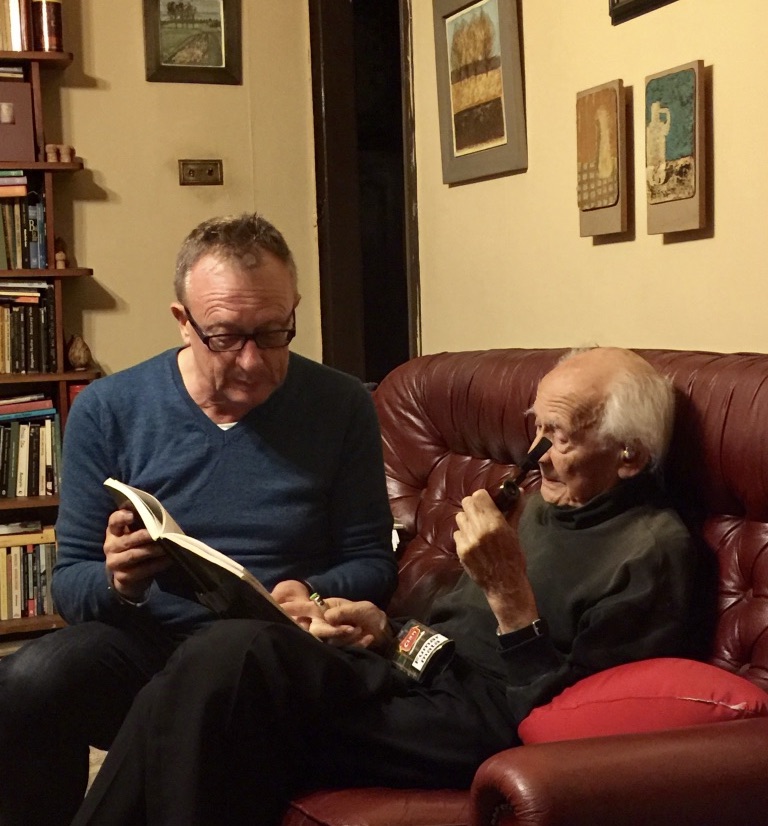
I fell in love with Peter the first time I met him, at an American Sociological Association Meeting, sometime in the late 1980s. This was, love Beilharzian-style – not the amorous variety but an intimacy of shared political intellectual passions. The ASA was a fitting place to meet as it was one of Peter’s most fertile sites for his Beilharzian love assignations. Like most professional conventions, its traffic in random encounters, in novel exposures to new thinking, and in reconnecting with meaningful comradeships embodies and cultivates the opportunity to nurture friendship and sociability through the prism of a vibrant knowledge culture. It didn’t take long to determine that these are the organizing commitments of Peter’s life – friendship, kindness, sociability, trust are at the foundation of his passion for socialism, democracy, sociology. There’s a Freudian shorthand for that – what matters in life is building a culture of love and work, work and love – and this seems to be the motivating font of Peter’s remarkable energy and brilliance.
Over time, through conversation and reading his work, I realized that Peter’s work of mind and heart entails even more. It is an epistemic magic by which he builds and constantly renovates what Iris Murdoch dubbed, in her 1958 rallying cry to the American and British New Left, a necessary House of Theory. Tom Hayden, in the 1962 Port Huron Statement – the nominal moment of the birth of the American New Left – picked up on Murdoch’s injunction, as did Stuart Hall and others at New Left Review. The House of Theory is an aspirational blueprint for a democratic vision of ethical intellectual practice – and somehow, across the ponds to the Antipodes, Peter heard the call and began building. He had so many co-architects in the always unfinished abode, too many to name them all – Castoriadis, the Budapest School in exile, Davidson, Bernard Smith, and above all Zygmunt Bauman. Today they are persistent ghosts, insistent presences, dogged voices. We’re grateful for their refusal to be silent as they continue to dwell in Peter’s House of Theory.
Peter’s House of Theory is built for real embodied frail humans to inhabit with all their (our?) unfinished efforts at theory-building. But it is also unworldly, in that it has no firm boundaries or exclusionary walls. Dare I say it is ‘liquid’ in its architectural flexibility and poetic innovations? At the same time, Peter’s House of Theory has a scaffolding foundation that is rock-solidly reliable, unmovable, trustworthy – it is comprised of an unflinching democratic ethos. The multiple rooms, the nooks and crannies and secret cabinets and backstairs, are filled with the intellectual output that springs from this ethos, which compels him to create knowledge by means of a method at once egalitarian, inclusive, merciful of inconsistencies, empathic, transnational, participatory – and deeply intimate. There are rooms for teaching, where students are treated as equals, and rooms for laughing, debating, and arguing all at once – Monty Python style. And there are especially warm and comforting rooms for crying – crying with the exquisite pain of recognition, such as Peter models for us in his remarkable introduction (2013) to Alex Miller’s Lovesong. And it is, of course, utopian.

What makes Peter’s writing and speaking and thinking and conversing and his Theory House-building so compelling is that it is clearly driven by an ethical symmetry between his moral core and his theoretical/socialist/sociological commitments. There are intimations of this through all his books, but with his stunningly brilliant, beautiful and moving memoir, Intimacy in Postmodern Times: A Friendship with Zygmunt Bauman (Beilharz 2020), this symmetry is revealed in full depth and color. It is profoundly performed, in the best sense of that term. In this book Peter fearlessly, vulnerably, and with a stunning generosity opens up a space most of us desperately strive to keep private – our ‘backstage’, in Goffman’s felicitous metaphor – and reveals what Jeff Alexander so appropriately calls ‘the emotional matrix within which social theory is made’ (Beilharz 2020: book jacket).
Both words are key: it is an emotional matrix because Peter openly lays bare what, again, most of us are keen to deny – that there is as much heart and soul and love and angst as there is mind and logic that motivates the truly difficult work of thinking theoretically. But it is equally a matrix, because for Peter the exercise of heart and soul and love are always embedded within his greatest of talents – the complex art of friendship and interlocutorship. Peter never thinks monadically, always at minimum dialogically. These are dialogs built on trust and good faith – even with those he may never have met. His production of knowledge always takes place in a matrix – a knowledge culture, populated by multitudes.
Sharing the raw insides of his knowledge culture, as Peter does in his memoir of Bauman, is such a rare act of generosity that reading it often conduces to tears – of recognition, of gratitude, of solidarity. Congratulations to Peter on his 70th birthday, for his decades of work on and in his House of Theory, and on the remarkable accomplishment of Thesis Eleven, which continues to be a beacon, a lovingly curated resource, and an aspirational model for all our Houses of Theory.
References
Beilharz P (2020) Intimacy in Postmodern Times: A Friendship with Zygmunt Bauman. Manchester: Manchester University Press.
Beilharz P (2013) The launch of Alex Miller’s Lovesong. The Monthly (April 9).
Miller A (2009) Lovesong. Crows Nest, N.S.W.: Allen & Unwin.
Murdoch I (1958) A House of Theory. In Mckenzie N (ed) Conviction. London: MacGibbon and Kee, pp. 171–186.
Biographic Information
Margaret Somers, Professor Emerita of Sociology and History, University of Michigan, is a social theorist and economic sociologist who specializes in political economy and the work of Karl Polanyi, as well as the comparative historical political economy of citizenship rights. Her first book, Genealogies of Citizenship: Markets, Statelessness, and the Right to have Rights (2008) explains how market governance and neoliberalism transformed citizenship into a market relationship, creating the condition of internal statelessness for poor and marginalized populations. The Power of Market Fundamentalism: Karl Polanyi’s Critique (2014) – co-authored with Fred Block – examines the work of Karl Polanyi and explores its application to historical and contemporary forms of social exclusion. She is currently working on a book explaining how the alchemy of the idea of the “free” market obscures how state- and law-driven ‘predistribution’ drives inequality and accelerates dedemocratization.


 thesis eleven