by Alonso Casanueva Baptista (Monash University)
‘Are you safe?’, Jessica asked me. ‘Definitely’, I responded, considering the material circumstances. I was probably in the most secure place around and it did not matter that I was walking at two in the morning. The only cumbersome aspect of the situation was having to take a detour to get back to the guesthouse.
Before arriving in Belgrade, I had looked for apartments near the buildings where the conference was to take place, somewhere in the Old City. As I scrolled through pictures and descriptions on a website, I thought to myself that Serbians did not have a particularly fine-tuned sense of aesthetics. Every affordable apartment had a sofa that worked as a bed, posters that read ‘New York’ or ‘live, love, laugh’, coloured neon lights on the ceiling and more often than not received negative reviews regarding strange stenches and non-working elevators. So, it came as a surprise that I could book a cheap bedroom in what looked like a traditional floating guesthouse anchored on the Danube River just minutes away from its juncture with the Sava. Having calculated that transport would take approximately half an hour to the conference, the same amount of time that it usually takes me to get from my home to Melbourne’s central business district, it was a no-brainer to experience the luxury of this rustic gem.

Upon arrival, I made my way from the bus station (I had travelled from Budapest to Belgrade in the morning) to the accommodation. Soon, I realised that the floating house was located behind the government headquarters, the Palata Srbija, and a park that extended from the Old city’s waterfront all the way to the town of Zemu and beyond. My first impressions already differed from what other conference presenters would tell me about the Serbian capital throughout the week of proceedings. A walk right of the Palata exposed a group of newly built shiny glass buildings, one with the Microsoft logo on it, another advertising a cinema and a variety of stores, similar to any other commercial centre in other cities around the globe. At the park stood a very small, sad even, town fair with few stalls and games standing over dry grasslands. Then there was the Danube, adorned by a line of trees and weeds that made me think of swamplands. The river stood calm and I could even distinguish some kayakers paddling away at the opposite end of the waterflows, next to what was later described to me as a ‘tourist island’.
I could not have anticipated (mostly due to my complete lack of knowledge of the country) that this calm and visually contrasting space would turn a few days later into an enclosed military perimeter where tanks, rocket launchers, trucks and soldiers would be concentrated. I had seen soldiers in groups of three smoking cigarettes in a street corner, but thought little of it. After all, next to the river was also a small military post, nothing to boast about.
Awareness of the shifting landscape began on the second day of the conference. During the afternoon presentations, I heard the quick flight of fighter jets. Immediately, I got curious, but people around me seemed set on paying full mind to the research of their fellows. Outside the Faculty of Philosophy—the headquarters for the student protest movement—people walked languid, placidly up and down the streets of the city centre. Smokers here, street vendors there, anxious academics sprinting to and fro, expensive suits and skirts sitting at restaurants ordering drinks, an actor dressed as a soldier from bygone times gifting flowers and crowns to passersby in exchange for golden coins—nobody seemed to mind the whirring of the planes.
When I returned to my floating room that night, I was informed by the host of the premises that something strange was happening. He had gone out on his bicycle and when trying to return using the same route, the soldiers stopped him and asked that he use the longer way around. Mildly upset, he complied. I had not experienced the same deal: when walking, the soldier closest to me stared for a few seconds before continuing his phone call. So, we downplayed it and conversed instead about the protests.

My friend and fellow editor James had asked me (in so many words) to bring back news about the students in Belgrade. His wife is Serbian and was keen to learn more about any recent developments. I thought it would be easy to chronicle these if anything was to happen. I had already learnt on my way there about the train station roof collapse in Novi Sad, the trigger for the protests nationwide. In fact, my bus had stopped at the entrance of the train station, and I could see in the distance the spot where a roof once was, now only a trace meaningful to those who knew about the tragedy. Sixteen people lost and no one held accountable. Almost one year later and no repairs, the train line between Novi Sad and Belgrade has not been active since; and the protests have continued.
Emir, the house owner and manager, helped me make more sense of what was happening. His view was that the protests were to do with government corruption, in particular the corrupt character of President Vucic. Emir held a particular hatred against this character. ‘He’s selling off everything! His government is destroying all the traditional buildings, leaving only the ugly communist-era brutalist apartments.’ According to him and others I met during the trip, Vucic had no sense of the historical imagination that made Serbia rich. Rather, he was making way for the investment of dubiously financed institutions, forward-looking, profit-oriented.
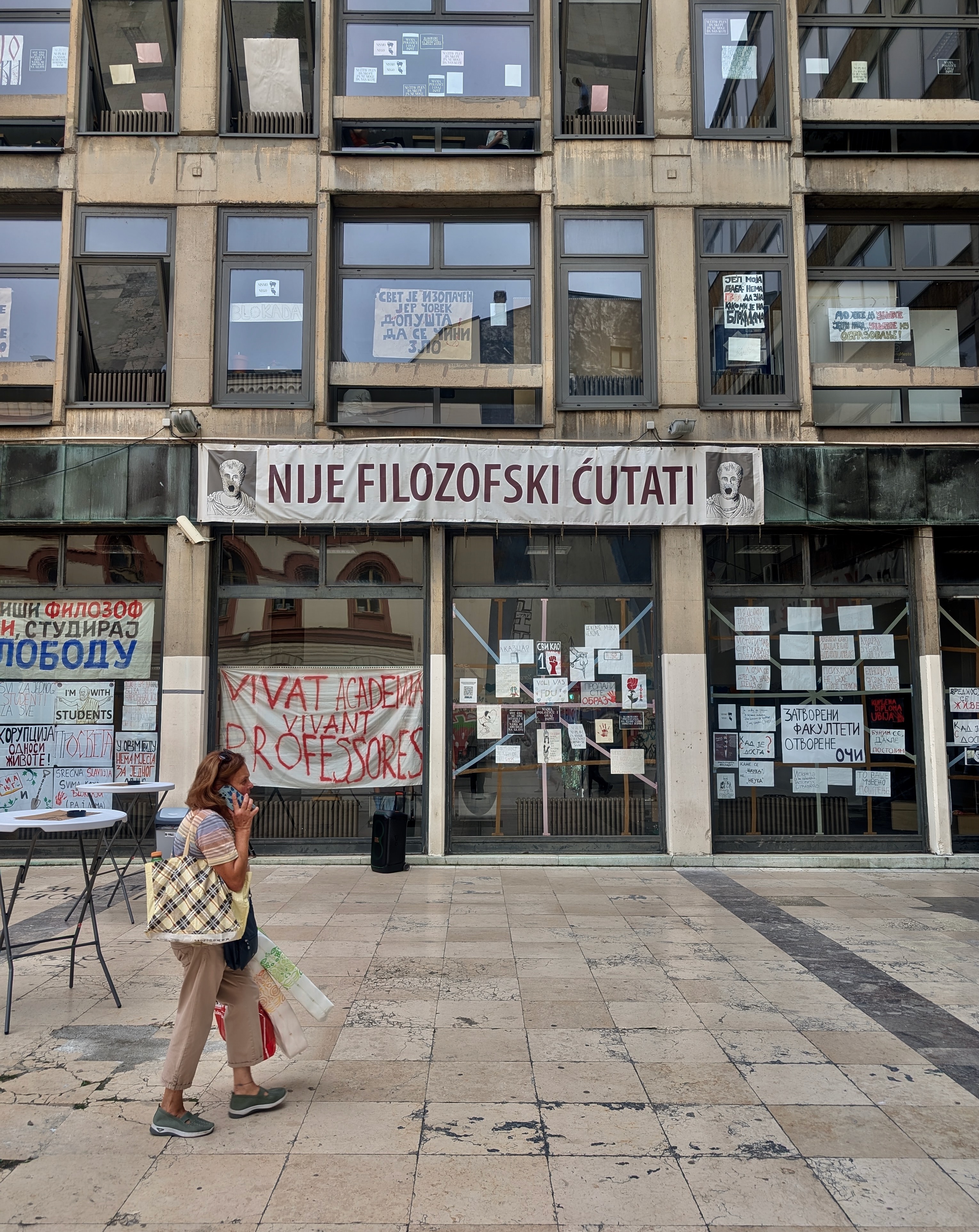
Beyond generalities, I was unable to uncover any new information regarding the protests. I only hold on to pictures and a few visual impressions. It was exciting to step onto the Faculty of Philosophy, which is currently dressed with a plethora of stencils, art projects, banners and placards all calling for the unity of the protest movement. The windows overlooking the statue of Njegoš (the nation’s historic ruler, prized poet and philosopher) on the plaza outside have been draped with numerous calls for praxis. One reads in large font ‘Nije Filozofski Cutati’, or it’s not philosophical to be silent. Without knowing the specifics, all these images protect the building as if symbolic shields using the power of the righteous demand for democratic action.
Local academics mentioned that the Humanities and Social Sciences (one third of the Faculty) were being ‘dismantled’, only leaving room for Education and Psychology to represent the umbrella term of Philosophy. I don’t know to what extent this is true, but it makes sense after being welcomed by staff who stood in unconditional solidarity with the student body, appreciative of the fact that we were allowed to use classrooms for purposes other than protesting.
Down the corridors of the faculty, classrooms and offices have been turned into bedrooms. On the sinks in the toilet rooms sit toothpastes and toothbrushes and, on the fourth floor, elements of the resistance move casually in conversation, perhaps plotting, perhaps discussing what music they are listening to at the moment.
What supposed a real shock was returning on the third day of the conference to the floating house and being told through gestures and maps that I had to find a roundabout way via the park if I wanted to reach my room. This time, a friendly and plump soldier (perhaps a sergeant, judging from his demeanour and treatment of a fellow trooper standing next to him) sketched a route with his finger on my Google map, and laughed at the sight of my widening eyes. With his hands, he led me to understand there was nothing he could do. A superior had given an order, most probably, to maintain the perimeter pest-free.

By the next morning, I woke up to the mechanical sounds of machinery. A flurry of camouflage now covered the entirety of the Nikola Tesla Boulevard. Buses filled with young soldiers were arriving, as trucks and tanks lined up and parked all through the street. The park was now fenced off in great part, separating my only access route from the Palata and the boulevard. Inside the guesthouse, Emir played ambient music and lit up incense candles to relax the guests. The contrast was heightened by the swaying of the property on the river waters when a group of military choppers began their rounds right above us.
So, I asked Emir once more what was happening. This time, he had the facts. On the 20th of September, Serbia was to celebrate its day of unity and freedom, usually held on the 15th. In preparation for a grand military parade, the government had called upon its forces to prepare and practice. ‘Of course’, Emir added, ‘people are not happy about this. I just saw a few arguing with the soldiers about why we need such display. Some even said, ‘if you want to use force, why not go to Kosovo?’’.
As soon as I stepped out of the house, I saw the preparations in full throttle. The tanks were on, heating up their motors. On them, soldiers wearing rugby hats sat patiently. The vehicles were of a great variety, some modern, others clearly outdated. They waited in pairs along the boulevard for the indication to advance over the prepared route. As I walked to the bus stop, I got to witness the tanks in movement. Later, I would show the video to the conference attendants who would look in shock and incredulity at the sight, given that the city centre was not exposed to this vision. Burning diesel, breaking pavement, children watching in amazement, brutalist buildings around the block—it was the sight of war, and yet it wasn’t.
When Jessica asked me if I was safe, I thought of the ways in which I could be targeted. There were none really. In a café, a woman asked where I was from and when I responded “Mexico”, she joyfully yelled ‘our brother country!’. The military had been mostly indifferent to my presence and, as a presenter at a nationally-vouched education research conference, nothing pointed to any real danger. All I could do was enjoy the show.
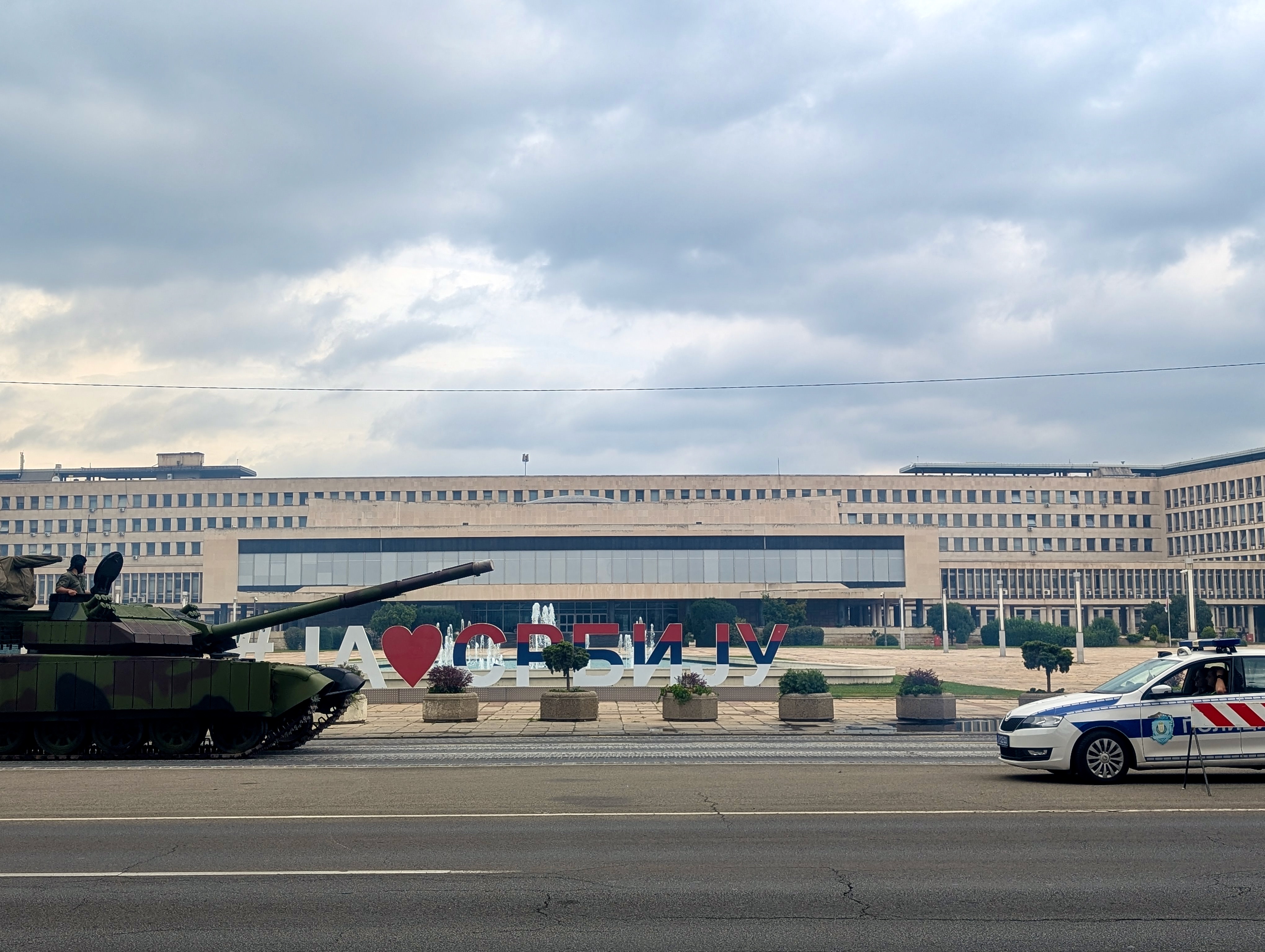
In the city centre, police presence increased, as did the number of hypotheses from foreign scholars. Some argued that it had to do with cracking down on the protests, but no sizeable manifestation was experienced throughout that week. Others claimed that, given the aggressive nature of Serbian fans, the prospective football match between the national team and the English required additional security measures. The most inventive suggestion came from a peer who stated that jets and helicopters were guarding airspace as the Polish had just taken down twenty Russian drones, but none of us knew where Serbia stood in connection to Putin. The truth was more protocolary, expansive and less improvised.
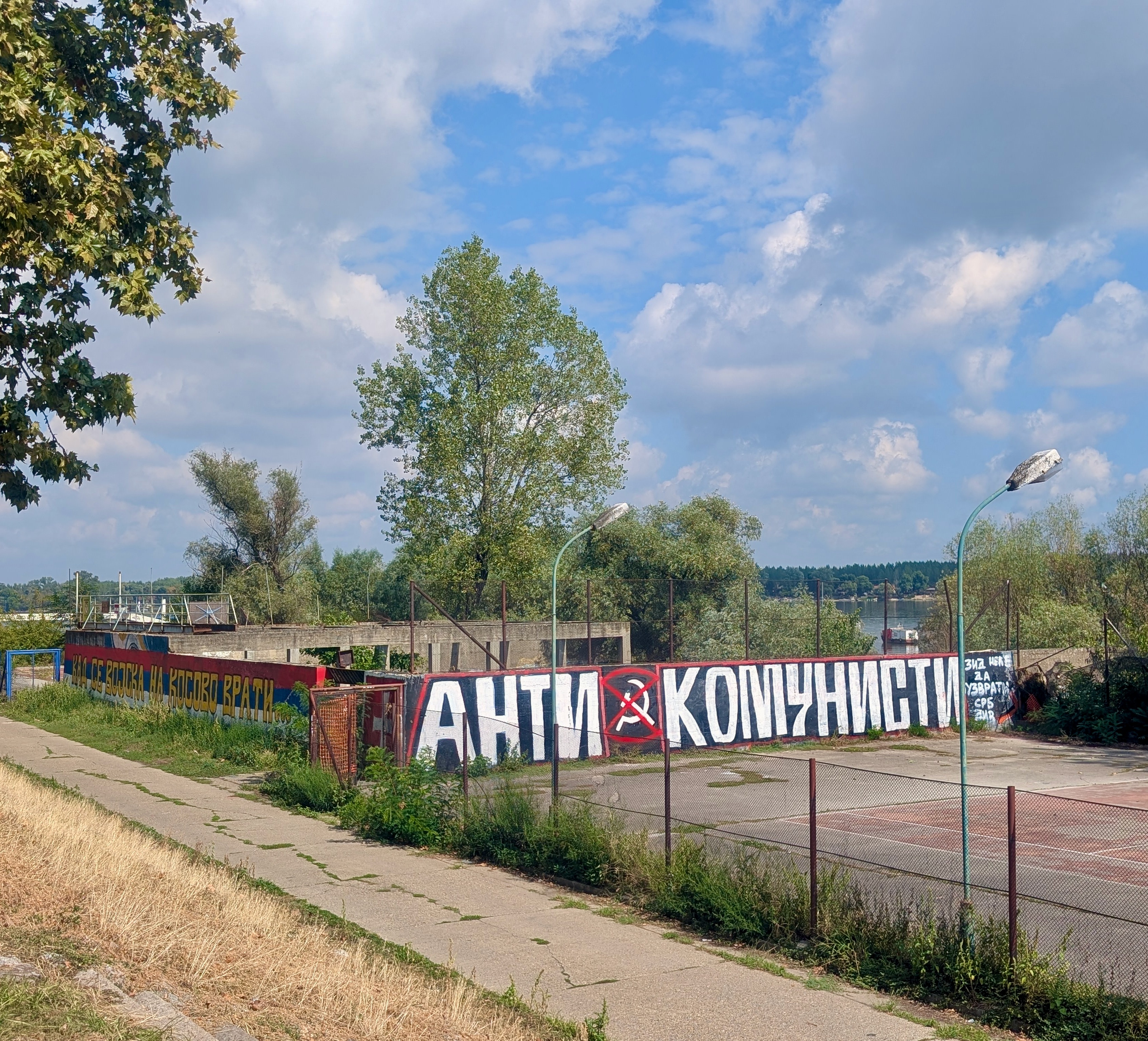
I got the impression that Serbians are very divided with what concerns Serbia’s past, the military, and its culture. New money is definitely flowing down the Danube and Sava rivers, but it hasn’t fixed the roof of Novi Sad station, nor has it contributed to the renovation of neo-classical buildings in the city centre. Tito’s Kuka Cveca (the House of Flowers that constitutes his mausoleum) is in pristine condition, despite the ideological difference between his rule and that of President Vucic. Simultaneously, the public (among them students and hotel hosts like Emir) is very concerned with the wave of privatisation that is turning the city into a mixture of styles that hold no cohesive foundation. Yet, it is not uncommon to see the long figures of women wearing designer brands parading around the Old City on their way to recently-inaugurated establishments, or the death of techno clubs that now close at 11 pm, following the times of COVID restrictions. On a walk from Belgrade to Zemu, I came across graffiti that clearly read (despite my lack of knowledge of the Cyrillic alphabet) ‘anti-communist’, next to an increasingly popular—and troubling—message of ‘When the army returns to Kosovo …’. In my mind, it resonates with the honking sound of cars encouraging tanks and trucks moving down the Mihaijla Pupina boulevard.
The night before leaving Belgrade, I followed my usual extended route to the guesthouse. The weather was humid and hot. Tens of people exercised under the moonlight in the bits of park that were still not off-limits. Ducks made brief, sudden moves by the riverbanks. I looked across the fenced park towards the government offices. Metallic stands blocked the view, probably reserved for the chosen few who would be saluting the military forces a few days later. At the foot of the stands, the rocket launchers slept, their pointy figures with the safety on, quiet and concerning at the same time. As I studied them from afar, my mind played back the gypsy music that accompanied me during dinner, which seemed to improvise life into existence, wrestling forms out of chaos.


 thesis eleven