Issue 194, June 2026
Including special section: The Philippine Condition: Threads of Critical, Decolonial, and Feminist Contentions
Guest editor: Kelly Louise Rexzy Agra
While the critique of Eurocentrism is noteworthy and important, it should not exhaust what it means to decolonize political theory. Our hope is to advance and pluralize the project of decolonizing political theory by suggesting ways of generating political theory from and for the non-European world, that is, by imagining political theory of a truly global reach.
Adom Getachew and Karuna Mantena (2021: 361) [emphasis added]
Editorial
A decolonial feminist critical social theory [open access]
Kelly Louise Rexzy Agra and Maria Lovelyn C Paclibar
This special issue on ‘The Philippine Condition: Threads of Critical, Decolonial and Feminist Contentions’ brings together articles by Filipino women critical theorists, that reflect on the social condition of contemporary Philippines through the lenses of critical social theory, that are intersectionally decolonial and feminist in their critical and emancipatory orientations. The intellectual formation of the authors in this issue is shaped by the tradition of critical social theory which began in the Frankfurt School as emancipatory social critique (Horkheimer, 1972), but builds on contemporary challenges to the Frankfurt School critical theory’s patriarchal limitations (Benhabib, 1992; Fraser, 1985; Young, 1990; McNay, 2022) and criticisms against its underwritten script of coloniality and racism within the discourse of modernity (Allen, 2016; Dussel, 1996; Mendieta, 2007; Mills, 2017; Bhambra, 2021). The Filipino women authors of this issue stand within this tradition and its continued contestation as their lived experiences push them to interrogate critical social theory’s shortcomings. The articles gathered here were first presented in the Philosophy and Social Science (Critical Theory) conference in Prague in May 2023, an annual conference that Jürgen Habermas helped found, and which Eduardo Mendieta along with other prominent figures of critical social theory continued and expanded. We honour both thinkers here, with gratitude and grief as their recent passing inspires us to continue the work they set in motion, and to insist that it remains unfinished.
Articles
Can dead bodies do politics? Decolonising Rancière through the Philippine drug war [open access]
This paper challenges conventional understandings of political subjectivity by examining dead bodies produced through violent state policies rooted in colonial histories, with particular attention to the drug war. It opens critical conversations about the intersections of violence, colonialism and political agency, which remain underexplored in mainstream political theory. I substantiate my argument on the subjectivity of dead bodies by using Rancière’s notion of political subjectivity and, at the same time, go beyond Rancière by claiming that his notion of political subjectivity highlights the role of bodies in politics, but the way that he does so is dismissive of the effects of colonial violence on specific subjects. By engaging with Rancière’s influential concept of political subjectivity while exposing its limitations in accounting for colonial violence, the paper contributes to both expanding and decolonising political theory.
(Mis)educating the empire: Non-recognition, colonial ignorance, and epistemic paralysis [open access]
Kelly Louise Rexzy Pascua Agra
In her talk ‘Disappearance, Erasure, and the Void’, Rocío Zambrana (2023) argued against the classification of colonialism as a ‘historical event of the past’. For Zambrana, colonialism is ‘a past that survives in the present’ through the ‘coloniality’ of knowledge and power (2021). Taking Zambrana’s cue, I unpack in this work the ways in which coloniality survives in Philippine education and continues to structure Philippine consciousness, social relations, government policies, and political arrangements. In my discussion, I recount how colonial educational institutions in the Philippines, during its Spanish and American occupation, betrayed their respective promise of ‘spiritual salvation’ and ‘self-governance’ to the Philippines. They instead entrenched structures that facilitated political and epistemic subservience to Anglo-European authority, dependence on former imperial economies, and colonial forms of repression and extraction. Through the Philippine example, I develop a concept of (mis)education that is generative of what I call, pernicious epistemic paralysis.
Agency, global capitalism, and postcolonial patronage: Provocations on structural injustice through the system of smallholder corn farming in the Upper Pulangi [open access]
Pamela Joy (PJ) Mariano Capistrano
In this paper, I take rural Philippines as the centre of my analysis to articulate structural injustice in a postcolonial rural context, inspired by Getachew and Mantena’s suggestion of conceptual reanimation as a decolonial practice. I show how smallholder corn farmers in the southern Philippine province of Bukidnon articulate a loss of agency, perpetuated not only by local economic-political elites but also by multinational seed corporations, building on colonial structures of power. This demonstrates Young’s and Haslanger’s assertion that material conditions and social-cultural structures are mutually sustaining, but also shows how structures of global capitalism intertwine with colonial relationships of patronage and the marginalization of rural and indigenous peoples. This decolonial approach to structural injustice is needed because much of the conceptual discussion of structural injustice, as well as practices of global capitalism, originate from the Global North; without contextual awareness, critical theory from the Global North can reproduce structural injustice in the Global South.
Kwentuhan as the active weaving of kapwa relations: Notes towards a decolonizing practice in Philippine education [open access]
This paper introduces kwentuhan as a practice for decolonization in Philippine education. Kwentuhan, commonly translated as storytelling or conversation, actively weaves kapwa relations, which are relations of reciprocity at the core of Filipino self-understanding. Decolonization entails challenging the absence of formal recognition of kwentuhan as a mode of discourse for learning and teaching in the classroom. I attribute this lack to colonial logics embedded in the Philippine educational system, modeled after western education during American colonization. Despite this dominance of the western model, kwentuhan remains ubiquitous, albeit marginalized in formal schooling. I describe kwentuhan as an active practice that resists the erasure of kapwa self-understanding. I argue for a formal inclusion of kwentuhan as a mode of discourse for learning and teaching in the classroom. This inclusion opens space for epistemological pluralism through reflexivity and articulation, making it a powerful decolonizing tool in Philippine education.
Filipino feminism from the margins [open access]
This work engages with the tradition of “critical theory at the margins,” a developing tradition that comprises works from scholars reflecting on Philippine marginality through the framework of the Frankfurt School critical theorists. They claim that there are normative sources of emancipation in the practices of local communities, and these practices are the “best alternatives” against capitalism in the Philippines. I argue that although resources for resistance can be found within the practices of communities, the idealization of indigenous values obscures rather than articulates forms of oppression. Instead, I stress that it is necessary to examine particular material realities that provide grounding for varied forms of oppressions and forms of emancipation. With urban poor Filipina women as the focus of my analysis, I narrate experiences of marginalization through the works of development scholars and highlight how intersectionality enables us to think with and from the margins.
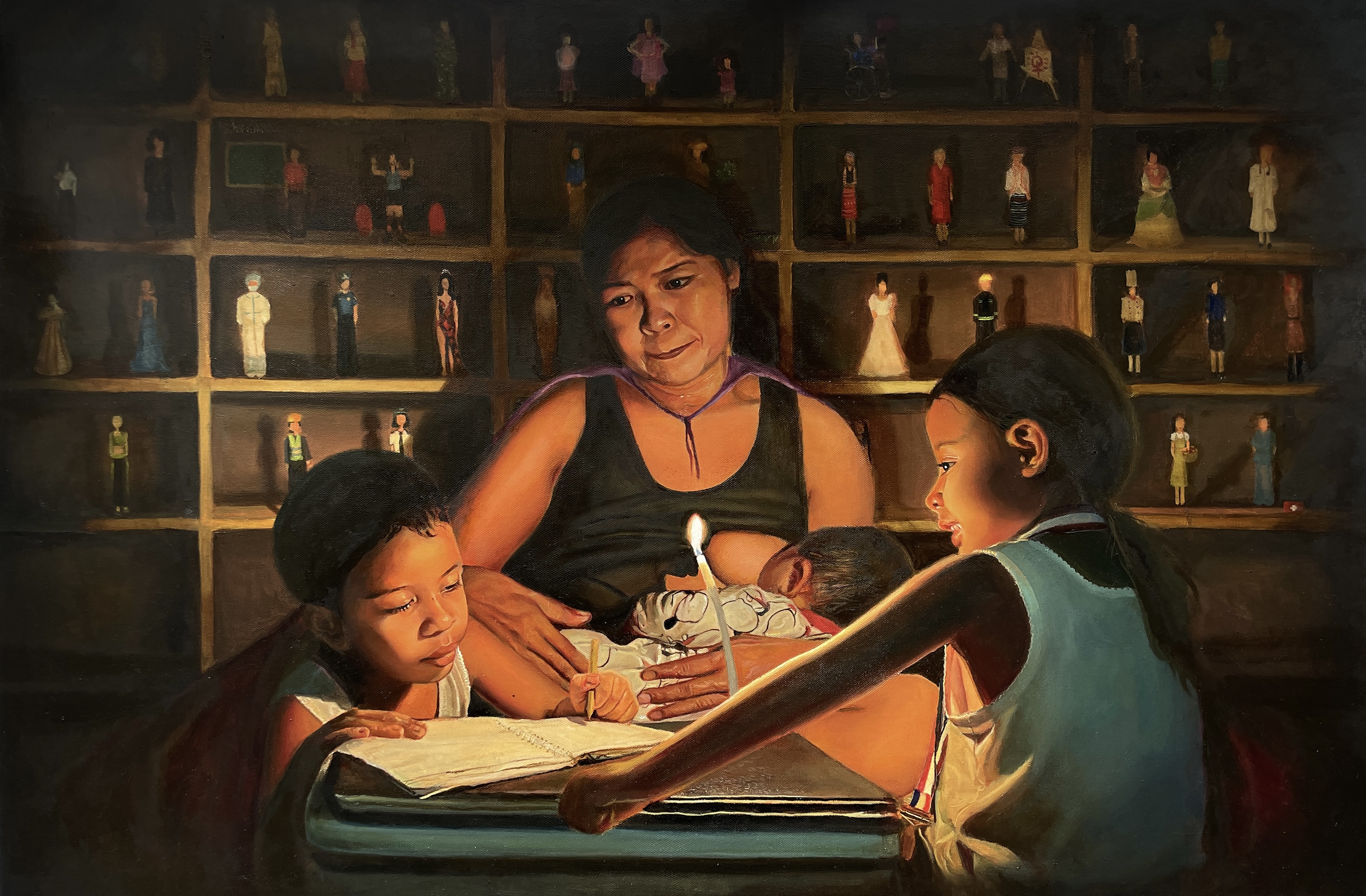
Addressing the mother gap: Why Filipino feminism needs motherhood studies [open access]
Krissah Marga B Taganas
Despite the Global North’s status on motherhood scholarship, the Global South continues to dub motherhood as feminism’s ‘unfinished business.’ One thing remains: motherhood continues to be a gendered identity that shapes and influences women’s subjective experience. Building on the works of mother scholars and feminist philosophers, I defend the inclusion of motherhood scholarship in Filipino feminist theorizing. I argue that its absence in the Philippine feminist scholarship contributes to the decontextualization and exclusion of motherhood dialogue from Filipino feminism. To do this, I map the women’s movement in the Philippines to show the evolution of the woman question in Filipino feminism. Then, I examine the Filipino construction of motherhood, position these debates within feminism, and argue for activism rooted in motherhood discourses. Through this conversation, feminist theorizing on motherhood enables us to examine the ways that motherhood and mothering serve as sites of both oppression and liberation for Filipino women.
Issue 194, June 2026
Articles
Rhythmanalysis and social critique
This paper draws on critical rhythmanalysis to address temporal pathologies manifested by the increase of acceleration and the decline of progress narratives. It traces the historical and philosophical evolution of rhythm from ancient Greece to Marx’s materialist analysis, then scrutinizes how modern algorithms reduce experience and contribute to the temporal alienation of flattened time. To counter the exhaustion of temporality rooted in the Western tradition an integration of insights from Chinese philosophy of rhythmic patterns, particularly Daoism and Yin-Yang thinking, is being proposed. Concepts such as natural freedom, ziran 自然, serve as an alternative to autonomy and provide a transcultural corrective to the unnatural and alienating rhythms of digital capitalism. Ultimately, the paper advocates for an intercultural rhythmanalysis that fosters temporal emancipation, enabling spiritual flourishing and the development of vital rhythms.
Capitalism in the classroom: A historical review of propaganda in United States schools
United States schools have long served corporate, industry and business interests by sustaining a spirit of capitalism through discourses and practices in classrooms. As a literature review and discourse analysis, this paper traces the history of free enterprise and capitalist propaganda in United States schools to demonstrate how the sociological concept of a spirit functions through curriculum and pedagogy, thereby contributing to the naturalization of capitalism. Though cultural justifications for capitalism have changed over time since Max Weber first conceived of a spirit of capitalism, the viability of the system still relies on cultural legitimization. Contemporary capitalism depends on and promotes an imprudent culture and spirit of waste. Capitalist-driven global warming and climate changes threaten the justifications offered in prior spirits of capitalism, and it will take more than a new iteration to overcome the material conditions of ecological annihilation.
Rethinking taxes as the gift: Maussian interventions and radical fiscal imaginaries
The ubiquity of the neoliberal counter-revolution, crystallized in the relentless drive to transform the welfare state into an austerity-driven state, has produced a series of paradoxes. As the welfare state sinks deeper into deadlock, tax resistance intensifies. Governments, however, in times of broken social contract, still have to stage ever new forms of consent-manufacturing to make taxation once again acceptable. Rather than painting a pessimistic picture, this paper attempts to reimagine taxes within Maussian gift theory to rupture ‘normal’ fiscal imaginaries. In doing so, I move beyond merely affirming the functional necessity of taxes and plunge into the fractured ontology of fiscal obligation itself, exposing the coercive and unreciprocated nature of the modern fiscal gift while seeking pathways to reverse the alienated hau. Through two dialectical thought experiments, this paper reconceptualizes taxation, proposing two models of taxation-as-gift: one within the state and one beyond the state’s borders.
The liberal-democratic death drive: A political economy of affective compulsion
This article provides a psychoanalytic–materialist critique of liberal democracy. It argues that the failures of liberalism are structurally necessary, founded in property, ideology and affect. Liberalism survives through the ritualisation of deferral, where disappointment generates loyalty as dissatisfaction is domesticated through civic repetition. Deploying Freud’s death drive, psychoanalysis is presented as a diagnostic tool for tracing how institutions structure desire through failed performance. This libidinal economy, consolidated by ideological apparatuses of reproduction and possessive individualism, secures subjects in stable attachments through its management of disappointment. Participation is rearticulated as attachment to process rather than outcome; melancholia operates as modality of governance. Against reformist and agonistic theories, the article contends that liberalism is beyond reform and that the challenge to respond to its crisis must work outside its grammar. It calls for an unbinding of political desire from the apparatuses that displace and defuse failure into fidelity.
The rise of new economic class in China’s incorporation process (1780s–1890s)
The incorporation of China into the capitalist world-system required political, social and economic changes. Although existing studies on incorporation and comparative historical sociological research have provided numerous analyses of nineteenth-century Chinese social transformations, they lack a detailed, comprehensive account of the economic classes that emerged during the period of incorporation. This study categorizes the economic classes that emerged during China’s long nineteenth-century incorporation into the capitalist world-system into domestic and international levels and analyses their impact on China’s economic development. This study’s contributions are as follows: first, unlike existing studies on China’s incorporation or comparative historical research, this study considers the economic classes created by China’s incorporation into the capitalist world-system in the nineteenth century; and second, this study enables an actor-based (or class-based) approach to China’s economic changes and development path during and after its incorporation.
Beyond guilt and responsibility – The social phenomenology of late modern debt experience
Domonkos Sik
The article describes the late modern experience of debt by combining phenomenological and social theoretical analyses. From Nietzsche’s perspective, the lived experience of indebtedness is explained by guilt. From the perspectives of Levinas and Derrida, the debt experience is explained by the impossible moralities of ‘absolute responsibility’ and ‘unconditional hospitality.’ These moral phenomenologies are connected to anthropologies of gift and money economy. Reciprocal gifts maintained a perpetual sense of indebtedness, which served as the basis for a trust-based, integrative debt experience (Mauss). The rise of the money economy undermined these relationships and replaced them with quantifiable, ephemeral transactions, implying an exclusively guilt-based debt experience (Graeber). Furthermore, the money economy not only replaced the gift-chains but also compromised the trust-based and responsibility-based debt experiences. This hybrid experience is explored in the article, along with its existential−moral consequences and the possibility of salvaging it.


