Obituary: Harry Redner, Scholar
by David Roberts
by David Roberts
by Peter Beilharz
by Denis White
by Alistair Davidson

This special section is the result of a online workshop called ‘Living in Crisis’ hosted by the TASA Social Theory thematic group and Thesis Eleven in 2020. Attendees were invited to think about the relationship between social theory and crisis in two ways. First, how can social theory be utilised to unpack what is happening in the world today? Second, do social theorists offer legitimate ways of understanding and responding to this crisis?

Stuart Macintyre was an eminent figure within the world of Australian history scholarship for 45 years. This collection of essays and responses revisits and extends this extraordinary life of achievement and engagement. Leading scholars write here of Macintyre’s contribution to understanding radicalism and communism, postwar reconstruction, education and civics, universities, liberalism, historiography and the history wars. They also tell us about collegiality and friendship.

The essays in this thematic issue reflect on late 20th- and 21st-century figurations of ‘upheaval’ to measure the affective and emotional dimensions of some of the most complex challenges of our times. In exploring the discursive potency of the term ‘upheaval’ itself they attend collectively to an ‘optics’ of upheaval – that is, to the ways in which upheaval’s forms are rendered visible or invisible in a variety of contexts.
Contributors: Peter Baehr, Jim Berryman, Christopher Houston, Anthony Lloyd, Mark Horsley, Henry Maher, Silvia Pierosara, Alice Bloch
Reviews: Zak Kizer, Shannon Brincat, Franciszek Chwałczyk, Nico Buitendag

by Matthew Barker
Alfonso Lingis asks the reader in the opening paragraph of Bodies That Touch Us: “are the bodies we touch really the bodies described by phenomenology?” (p.159). His question probes the limits of the possibilities of description vis a vis the actual body described. To answer the question, Lingis wanders through selected phenomenological texts and writers, pulling attention to moments of significance. His approach is meditative rather than calculative (see Heidegger, 1966) and his overture to Maurice Merleau-Ponty is as noticeable as his silence on Emmanuel Levinas.
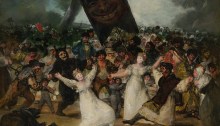
by Howard Prosser
“Carnivals in History” (1981) is the only article Emmanuel Le Roy Ladurie published in Thesis Eleven. The piece’s appearance, then and now, arguably says more about the journal than it does the esteemed historian. Having him appear in its early pages was a coup for the new publication. Other big names followed. And, mercifully, some lesser ones. To include his piece in the Top 40 offers a marker of the journal’s prestige as well as the persistence of critical thought among its many pages.
 thesis eleven