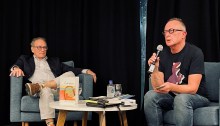
Three Lectures: Travel notes, Bendigo, October 2014

by Ivan Vladislavić

It was more of a performance than a ‘lecture’. Peter played Marx and one of his colleagues played Weber, and they argued about class and other things. A young woman took issue with their focus on the classic texts. Why bother to read them? You can learn the same stuff by watching The Sopranos – and it’s more entertaining. She was very stubborn about this, which they enjoyed.

A Story of Friendship: An Homage to Peter Beilharz

by María Pía Lara

This reflection is tied up with the memoir written by my dear friend Peter Beilharz (2020), Intimacy in Postmodern Times: A Friendship with Zygmunt Bauman. Indeed, Peter’s process of understanding himself not only allows us to learn about him as a person and as an intellectual, but it also explores some important dimensions of his sociological thinking in connection with his friend.

Learning Through and From Peter Beilharz

by Eric Ferris

Peter, like my mentor and friend Chris and Bauman (from books), offered me versions of a relationship to teaching and learning – a relationship between teachers and learners – that I can, and will, carry and pass on. This is a ‘how’ and ‘why’ I met Peter, and a glimpse at part of the ‘what’ that underpins my respect for Peter.

Article: The Negative Commonwealth: Australia as ‘Laboratory’, Then and Now

by Lorenzo Veracini and Dan Tout

Federated Australia was seen for a long time as a significant social ‘laboratory’. The Commonwealth itself was seen as an ‘experiment’. This widespread metaphor relied on a particular pattern of perception: the country was ‘new’ (it was not), and the country was allegedly isolated (it was not, at least not completely). Many believed that its social environment could be controlled, like that of a scientific laboratory. A laboratory is designed to shut all disturbances out – the value of the data and experiments depends on it.

Article: Beautiful Detritus

by Georgia Lockie

Once abundant and collective, utopian dreams had, by the turn of the millennium, largely receded from the social world, leaving a void to be increasingly filled by new dystopias—climate destabilisation; resurgent right-wing authoritarianism; technological domination; plague—the future becoming a prospect less of collective hope or aspiration than dread.

Article: “You all ok?” The Impossibility of Being Alright amid Mass Violence

by Christopher G. Robbins

In response to the 17th mass shooting in only 14 days of February 2023, or the 71st mass shooting in 45 days of 2023 in the U.S, this time at Michigan State University, my friend who lives a world away in Australia wrote a short, caring message, “You all ok? Re Lansing?” I live approximately 60 miles away from Lansing and have colleagues who work there and close friends whose children attend school there.

Article: Where are we home? Revisited

by Katie Terezakis

Home is a loaded idea. Call to mind the common sayings: home is where the heart is, you can never go home again, etc. The abundance of mottoes doesn’t dampen the sentiment; the idea of home remains charged with longing for a place we knew or hope to create.

Article: My Own Private Utopia

by Peter Beilharz

Utopia has always been part of my world, ever since I started thinking about it. Was this 1968? A little after, later in high school. Utopia seemed ubiquitous; the possibilities of new worlds abundant