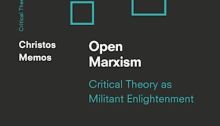
New Book: Open Marxism

Bringing together the various heterodox traditions, groups and scholars that came under the heading of Open Marxism for the first time, this book assesses the evolution of Open Marxism from the initial usage of the term by Kostas Axelos in France in the 1950s and the journal, Arguments, principally the ‘anarchist Marx’ of Maximilien Rubel and the ‘Libertarian Marxism’ of Daniel Guérin, through Open Marxism as it was developed in Eastern Europe, especially in the scholarly work of Karel Kosik in Czechoslovakia, the work of the Polish Open Marxists and the Praxis group in Yugoslavia …


New Book: The Socialist Side of World Literature

The Socialist Side of World Literature explores Socialist Realism in English-language publications since 1935. While many studies have focused mainly on the Soviet Union and Europe, often overlooking significant figures from Asia, Africa, the Caribbean, and marginalized groups in the First and Second Worlds, this book looks at the many crucial questions that have remained unanswered, including why the emergence of Socialist Realism in Eastern Europe constituted a pivotal cultural event for Russia.

New book – The Work of History: Writing for Stuart Macintyre

Stuart Macintyre was an eminent figure within the world of Australian history scholarship for 45 years. This collection of essays and responses revisits and extends this extraordinary life of achievement and engagement. Leading scholars write here of Macintyre’s contribution to understanding radicalism and communism, postwar reconstruction, education and civics, universities, liberalism, historiography and the history wars. They also tell us about collegiality and friendship.

New book: The barber who read history

scholars to look outside the universities for their field of writing/publication/action; they define radical history and discuss the work of some of its past and present practitioners; they show that labour history grew out of intellectuals within the labour movement, and argue that labour history should re-invent itself as working class history; and they provide examples of their recent ‘radical history’ work