Article: The Unaustralian: Doubling Double Nation

by Rex Butler and A.D.S. Donaldson

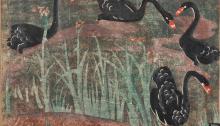
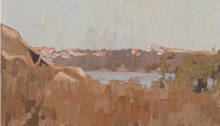
UnAustralian art is the art of our present, those missing years since 1970 in McLean’s book. But the real point – to say this for the last time and to conclude – is that we have always been like this. This history has been written for a long time, just not in the name of “Australia”. Those stories we tell of immigrants and expatriates from the past read as though they could have happened yesterday, and we can identify with them as if they were ours. We are all first of all non-national, non-Australian, So many of us, nearly all of us, are immigrants.

Article: Time for the return of the Sanders Movement?

by Brendon O’Connor

The challenge ahead for the Democrats is the question of how the best aspects of the Harris campaign, with its multiracial openness and pro-women’s rights agenda, can be incorporated into a more Left-wing Democratic Party. The crushing defeat for Harris is an opportunity for the Democrats to develop policies that offer real solutions to America’s many social and economic problems.

Article: On the 50th Anniversary of La Révolution du langage poétique

by John Lechte

This year, 2024, marks the 50th anniversary of the original French edition Julia Kristeva’s epoch-making volume, La Révolution du langage poétique. L’avant-garde à la fin du XIXe siècle: Lautréamont et Mallarmé (1974) (Revolution in Poetic Language. The Avant-Garde at the End of the XIXth Century: Lauréamont and Mallarmé). The work was originally defended in 1973 in Paris as a doctorat d’état ès lettres. On the panel were Jean-Claude Chevalier (supervisor), Henri Lefèbvre, Pierre Albouy and Roland Barthes. The thesis was awarded the highest honour: mention très bien avec félicitations du jury.

Exceptionalism and Provincialism: Re-Thinking the Antipodes

by David Roberts

Peter Beilharz captures this ongoing process of exchange, fed by the flow of people, goods, capital and ideas between the old and the new worlds, between metropolitan centre and open frontier in terms of cultural traffic. Cultural traffic in turn can be understood both in the direct and wider sense as translation. As the act of relocation, transformation and recreation, translation epitomizes the idea of supplementarity and in turn the question of identity. In the following, I shall be thinking with and against Peter’s thinking of the Antipodes with the idea of translation in mind.

Reflecting on Peter the Teacher

by Julian Potter

Thirty years separate Peter and Zygmunt, another thirty separate myself and Peter. These are generational spans, time enough for considerable changes that challenge traditions. Through my story, I would like to suggest that the refounding of intellectual traditions on friendship, instead of, and sometimes in spite of institutions, or enframed goals such as politics, is one of Peter’s gifts to his postmodern students and those who have met him along the way. Another is the vital question for scholarly endeavour: ‘Is it interesting?’ And for me, the love of books.

“Peter’s House of Theory” – A Postcard to Peter

by Margaret Somers

I fell in love with Peter the first time I met him, at an American Sociological Meeting, sometime in the late 1980s, I think. This was, of course, love Beilharzian-style – not the amorous variety but an intimacy of shared political intellectual practice. The ASA was a fitting place to meet as it was one of Peter’s most fertile sites for his Beilharzian love assignations.

Friendship’s Resonance: On Peter Beilharz’s Goodwill

by Howard Prosser

This is a tale of friendship. Or, more accurately, it’s a reflection on how a friendship based on a few meetings can amount to a lot. I am sure many of us have had a version of this experience. The friendships made during a stint living elsewhere. Or those incidental meetings and interactions with someone at infrequent events which, though it never quite blossoms into something more, we can still define as friendship.

Peter Beilharz and Modernity in Ruins

by George Steinmetz

I first met Peter, I believe, at the meetings of the American Sociological Association in Montréal in 2006. After the panel I struck up a conversation with Peter, went out for coffee with him, and discovered two amazing things. The first was that Peter was the beating heart of the journal Thesis Eleven, which I had been familiar with since graduate school.

Article: The Negative Commonwealth: Australia as ‘Laboratory’, Then and Now

by Lorenzo Veracini and Dan Tout

Federated Australia was seen for a long time as a significant social ‘laboratory’. The Commonwealth itself was seen as an ‘experiment’. This widespread metaphor relied on a particular pattern of perception: the country was ‘new’ (it was not), and the country was allegedly isolated (it was not, at least not completely). Many believed that its social environment could be controlled, like that of a scientific laboratory. A laboratory is designed to shut all disturbances out – the value of the data and experiments depends on it.

Article: Beautiful Detritus

by Georgia Lockie

Once abundant and collective, utopian dreams had, by the turn of the millennium, largely receded from the social world, leaving a void to be increasingly filled by new dystopias—climate destabilisation; resurgent right-wing authoritarianism; technological domination; plague—the future becoming a prospect less of collective hope or aspiration than dread.