Three Lectures: Travel notes, Bendigo, October 2014

by Ivan Vladislavić

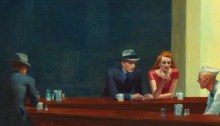
It was more of a performance than a ‘lecture’. Peter played Marx and one of his colleagues played Weber, and they argued about class and other things. A young woman took issue with their focus on the classic texts. Why bother to read them? You can learn the same stuff by watching The Sopranos – and it’s more entertaining. She was very stubborn about this, which they enjoyed.

Reflections on Friendship and Gratitude for Peter Beilharz on the Occasion of His ‘Revolution #70’

by Christopher G Robbins and Eric Ferris with Sian Supski

To describe this project as a festschrift seems fitting. It is, indeed, a collection of writings gathered together to honour, or pay tribute to, Peter as a scholar. The metrics describing Peter’s scholarship – his contributions to sociology, historical sociology, and social and cultural theory – reflect both its volume and quality and make him fitting of such a tribute.

Ted Snell, Born Sandy Devotional, 1949–2023

by Darren Jorgensen

It was devastating to hear of Ted Snell’s death for those of us who were touched by his unflinching support of the visual arts. Snell pursued a selfless career sitting on national arts boards, curating shows and managing galleries while always and endlessly advocating for art and ideas.

Article: The Negative Commonwealth: Australia as ‘Laboratory’, Then and Now

by Lorenzo Veracini and Dan Tout

Federated Australia was seen for a long time as a significant social ‘laboratory’. The Commonwealth itself was seen as an ‘experiment’. This widespread metaphor relied on a particular pattern of perception: the country was ‘new’ (it was not), and the country was allegedly isolated (it was not, at least not completely). Many believed that its social environment could be controlled, like that of a scientific laboratory. A laboratory is designed to shut all disturbances out – the value of the data and experiments depends on it.

Issue 177, August 2023 – Reflections on the Pandemic

This special issue revisits the Thesis Eleven online project: Living and Thinking Crisis. The original project published close to fifty contributions; a multimedia presentation that included postcards, words, poems and music responding to the pandemic in the real-time of its making. This issue of the journal brings a selection of these to publication and reflects on this moment of global upheaval and transformation.

Article: Beautiful Detritus

by Georgia Lockie

Once abundant and collective, utopian dreams had, by the turn of the millennium, largely receded from the social world, leaving a void to be increasingly filled by new dystopias—climate destabilisation; resurgent right-wing authoritarianism; technological domination; plague—the future becoming a prospect less of collective hope or aspiration than dread.