by Darren Jorgensen and Tami Xiang (University of Western Australia)
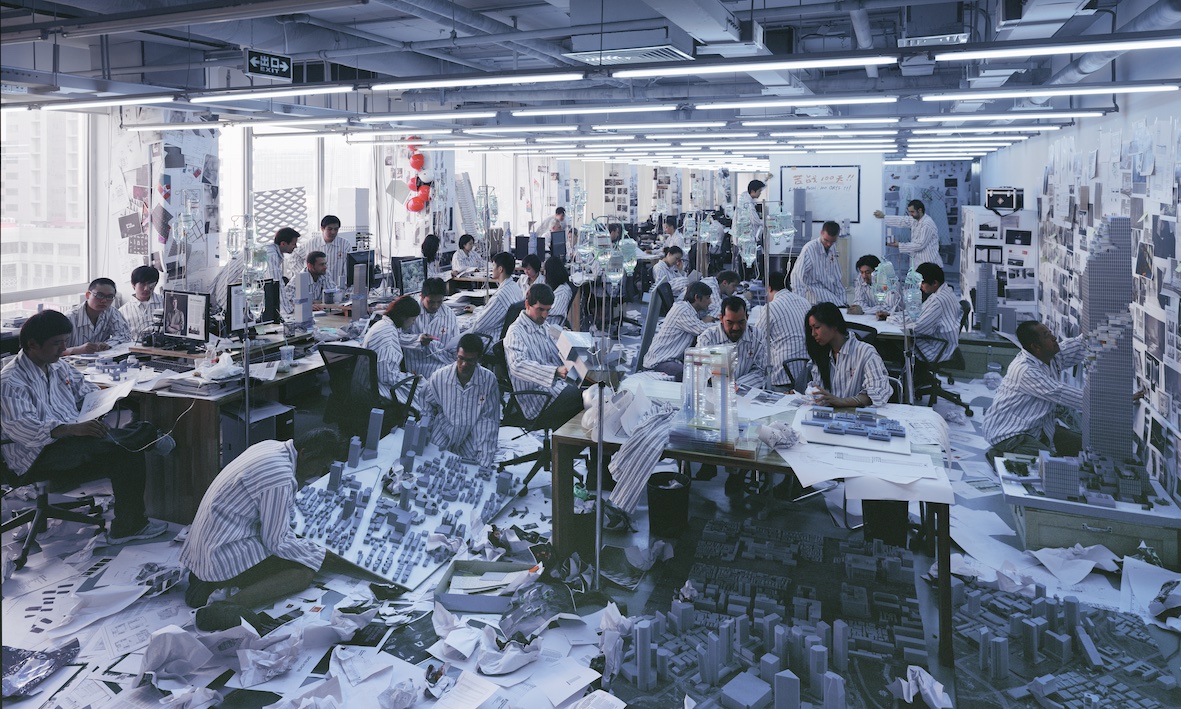
Wang Qingsong’s monumental photography unveils the deep structures of Chinese history and society. The title of the first survey of Wang’s work in Australia, exhibited at the Cullity Gallery in the School of Design at the University of Western Australia, is Everlasting Inscription. It attempts to describe Wang’s resistance to the forgetting of Chinese history, while illuminating the structural legacies by which life in China assumes its collective shape. With its constant upheavals, its massification and overbearing, bureaucratic governance, China is constantly engaged in rewriting its own history. The state is engaged in an ongoing struggle works to conceal and erase aspects of the past. In foregrounding aspects of this past, Wang reconstructs and stages processes of transformation, turning erasure into visibility. His images inscribe collective memory within fictionalized settings, preserving fragments even as they slip away. Yet each inscription signals its own incompletion: memory is always in loss, and inscription is always deferred.
Wang is best known for arranging expansive tableaux featuring workers, students, professionals and peasants performing themselves. As with any good picture maker, the joy of looking at Wang’s pictures lies in finding relationships between the smallest of their details to their overall composition. In this relationship of the small to the large, Wang mediates the historical memory of China. Born and growing up during the Cultural Revolution, being young during the optimism of Opening and Reform, and witnessing the rise of authoritarianism and capitalism during the last three decades, Wang has lived through China’s cataclysmic changes.
A tragic awareness of this history permeates the density of Wang’s works. They are not light-hearted satires of social reality but profound gazes into the weight of history, the absurdity of society, and the fragility of the individual. The more elaborate the stage, the more ritualized the gestures, the more forcefully the viewer perceives the inevitability of absence and futility behind the spectacle. One is simultaneously overwhelmed by the grandeur of the staging and haunted by the irreversible passage of time.
Wang thinks of himself as a documentarian, a journalist of Chinese life. The curators of this exhibition and authors of this text visited him in his studio in 2024, as part of a student tour of Chinese art studios and galleries. He told us that, “My work is not oppositional. I am a correspondent, a social correspondent recording society, not fighting against something.” The directness of photography, its ability to convey the truth of its subject, creates a sense of stillness amidst the country’s fast moving changes. He tells us that, “In China, you might move away and return to find your old home destroyed.”
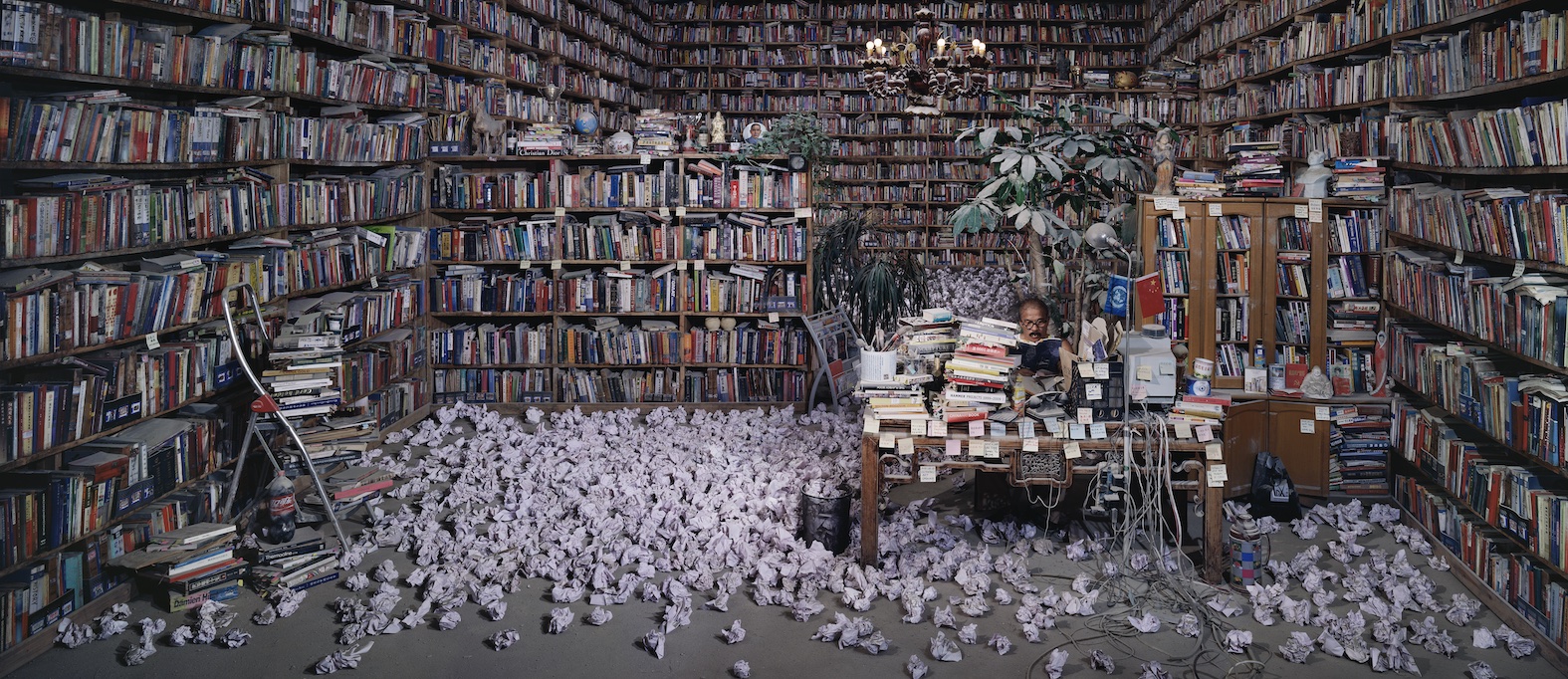
Guan Kan: Thinking with Contemporary Chinese Art is a student run journal that features three essays on and an interview with Wang, each describing the documentarian tendencies of his art. Sam Beard describes Chinese photography as offering a means for “oblique social criticism,” the artist playing a role that is not unlike that of a journalist, who witnesses, records and disseminates.[i] In Wang’s view, photography is not the construction of a fictional world, but a profound intervention into the context of reality. His images are consistently rooted in the social sphere, capturing and articulating the contradictions of the times, the predicaments of collectives, and the existential conditions of individuals. His staged compositions should not be seen as a departure from reality but as its refinement and re-manifestation. As he has said, “staged photography is more truthful than truth, as it explores how we actually experience the world.”[ii] The consciousness of the world is more true than the world itself, because in China the experience of this world has not been of a world outside the self, distant and absorbed in itself. Chinese life has instead consisted of an unmediated experience of history.
This Chineseness and historical consciousness distinguishes Wang’s pictures from the tableaux photography of Euro-American artists, that Michael Fried describes in terms of their absorption in their own composition, their autonomy from the cultural and political world. In Fried’s terms, Wang’s pictures are instead theatrical, because their actors pose in ways that show their awareness of being photographed. Fried’s preference for absorption comes from a particularly Euro-American conception of art, in which works assume a degree of autonomy from the world around them, ‘absorbed’ by relations that are internal both to themselves and to other artworks.[iii]
Instead, Wang’s work is immersed in and engaged with the collective drama of Chinese experience. In his most famous work, Follow Me (2003), featured in this first solo exhibition in Australia, Wang documents the drama and ritual of Chinese education. A teacher, played by Wang himself, looks directly at us, implicating us within the authoritarian and difficult hierarchies of the Chinese education system. Wang points to a blackboard with messages in different languages scrawled all over it, the mess of information overwhelming and difficult to comprehend. The image is about the trauma of Chinese education, its mass classrooms also represented in Follow You (2013), with students surrounded by slogans such as ‘Progress every day’ and ‘Study well’ along with existential questions, including ‘Why do we dream?’ and ‘Why do we die?’ This series of classroom works draws upon the trauma that lies in the memories of the hundreds of millions of people who endured it. They turn memories into history while revealing the melancholic sensibility that has hung over national life since the Cultural Revolution of the 1960s and 1970s.
Photography has played a key role in visualising the scale of China’s accelerated modernity, the pace of its transformation of villages into cities, its families torn apart as parents move to labour on construction sites, amidst unemployment, inequality, and an alienation from an increasingly consumerist culture. Think of the footage of Wuhan televised in 2020, as the first city to be locked down as the coronavirus spread. In a science fictional scene, the streets of a city of more than thirteen million people were empty. Here, as in so many other moments, China portended the world’s own future. Its mass surveillance systems are now being replicated in Europe and North America, while its massification, its reproduction of apartment cities, is a blueprint for urbanisation around the world.
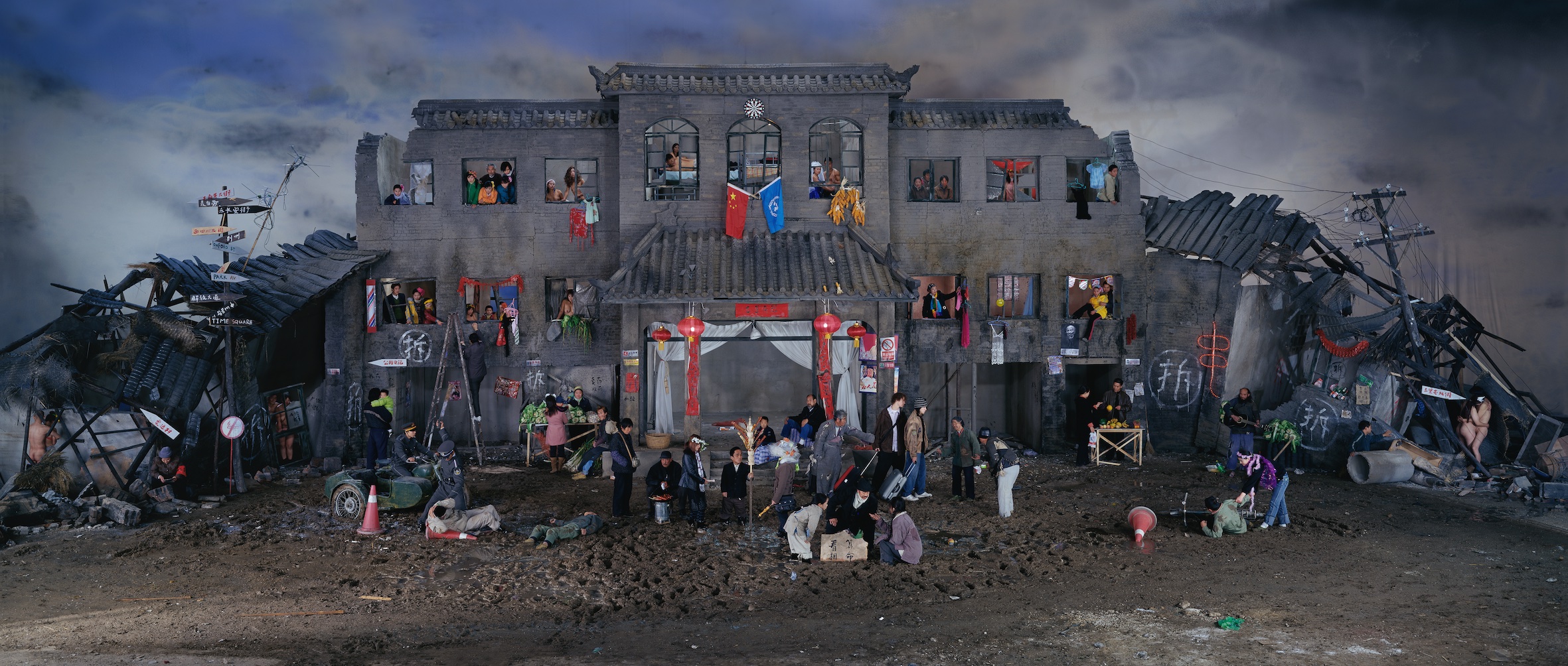
Wang’s use of the large scale, pictorial photograph is an attempt to partake of this scale, to reproduce the magnitude of China and its history. When he started making photographs in the 1990s, he was influenced by photographs taken of ‘model operas’ performed during the Cultural Revolution by travelling troupes, that played out scenes of ideal Maoist life for people across the Chinese countryside.[iv] Photographs used to promote these operas featured actors composed into vignettes that condensed the opera’s ideological message. As they face the camera and the viewer, Wang’s subjects recreate these tableaux while transforming them from ideology to allegory. As they face the viewer, his actors play out the social contradictions that ideology wants to conceal.
In this, Wang’s photographs do not represent an autonomous realm of art, but retain something of the ways in which art under communism illustrated the totality of its national circumstances. They are part of the postsocialist condition, in which art remains an expression of its national unconscious. While in the 1960s and 1970s socialist realism set out to complete the self-image of Maoist China, in the twenty-first century Wang’s photographs instead highlight the fragmentations and inconsistencies of this national ideal. Staging a historical unconscious, Wang brings our relationship with China into a relationship with its image.
As the Cultural Revolution of the 1970s gave way to the influence of Euro-America during the 1980s and the Opening and Reform policies of Deng Xiaoping, the model opera and socialist realism became anachronistic. Among scholars, books on postmodernism complicated China’s self-image, while foreign fashions and films made people aware of their place in the wider world. The title Follow Me comes from a state television program first aired in 1982 that introduced Wang and the nation to ‘the West’ and its ideas. The impact was not only cultural. The Chinese economy was also transformed through the 1990s and 2000s by foreign investment, including in Chinese contemporary art.
In communist state philosophy, whether Chinese or Soviet, human beings create the world, including its suffering. Consciousness is inextricably tied to this collective creation. For those who have lived through the late twentieth and twenty-first centuries, Wang’s photographs preserve this collective experience, while simulating their artificiality. The term ‘Everlasting’ in the title of this exhibition, derives from the classical Chinese idiom wei yang (未央), literally meaning ‘without end,’ signifying the ongoing extension of memory and history. Memories are inscribed, and yet these inscriptions are destined to remain unfinished, part of an endlessly unfolding series of tumultuous changes, of history deconstructed and created again.
The use of scale in Wang’s works are not displays of formal virtuosity, but strategies of condensing and dramatizing reality. The theatricality of his photographs visualise the absurdities and conflicts embedded in social structures. Just as journalistic reportage employs selective narration to highlight the essence of events, Wang’s photography, through staging and orchestration, makes visible the underlying structures of complex social phenomena and thereby penetrates to their essential dimension. In this respect, his practice extends the documentary function of photojournalism: his images attest to ‘what has been’ and reveal the socio-historical contexts of the present. By means of theatricalization and symbolic reworking, he transforms reality into visual allegory, endowing it with greater historical density and cultural resonance.
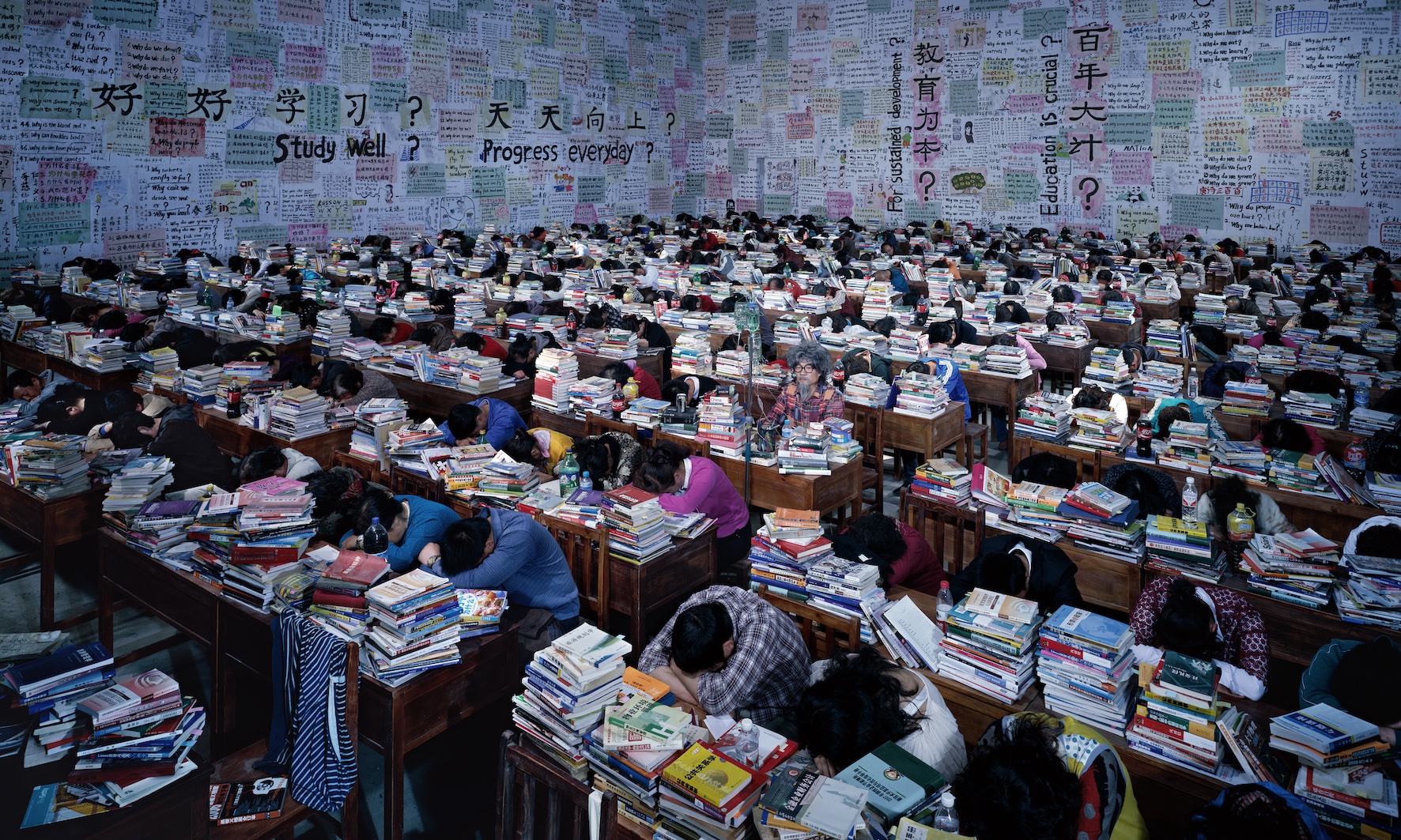
For this reason, Wang’s notion of himself as a ‘journalist’ cannot be understood simply as a professional designation, but rather as a deliberate artistic stance. Through photography, he continuously witnesses, refines, and inscribes reality, turning images into archives of collective memory. From this standpoint, his works are not only mirrors of the present but also the theatres of history. They point to the immediacy of the contemporary moment while simultaneously summoning a deeper cultural memory. This distinctive position allows Wang Qingsong’s photography to combine the incisiveness of reportage with the critical depth of art.
The allegorical function of Wang’s photography, its staging of collective memory in which individuals and landscapes act simultaneously as actors and symbols, relies upon the tension between the scarring of a collective population and mechanisms of collective forgetting. Gathering individuals to figure these tensions upon a photographic stage, their bodies and postures become vessels for the moulding and institutionalisation of Chinese national experience. His body of work is a counter-archive that illuminates social narratives that lie outside the propagandistic function of Chinese regimes of education, media and political life. Resisting the forgetting of collective experience, Wang’s photography acts as both a witness and an intervention.
In Wang’s staged scenes, memory is dynamic, participatory, and interpretive. Viewers are drawn into a temporal dialogue with the past, becoming co-participants in the construction of allegory. Every pose, gesture, and spatial arrangement within his photographs operates as a mnemonic device, both evoking history and generating new resonances for contemporary audiences. Each image is simultaneously an archive and an allegory, inviting the viewer into a space where memory is performed, history is interrogated, and human experience is inscribed in ways that endure. This exhibition underscores the essential role of art as both witness and custodian of collective memory, reminding us that in the face of temporal erasure, memory is constantly being recreated, the unconscious indelible in its resistance to the forgetting of history.
[i] Sam Beard, “Pictures and Perspectives: The contemporary photography of Wang Qingsong, Muchen and Shao Yinong,” Guan Kan: Thinking with Contemporary Chinese Art, 2 December, 2020, https://www.guankanjournal.art/journalessays/sams-essay?rq=qingsong
[ii] Quoted in James David Poborsa, Staging the Future: The Politics of Photographic
Representation in Postsocialist China, PhD thesis, Department of East Asian Studies, University of Toronto, 2018, pp. 229-230. The original quote is, “摆拍探索我们的⽣活经验,于真实好像⽐较真实性.”
[iii] Michael Fried, Why Photography Matters as Art as Never Before, Yale University Press, 2008.
[iv] These operas are memorably represented in Platform (2000), a film that follows the end of one of operas during the 1980s as China changes around them.


 thesis eleven