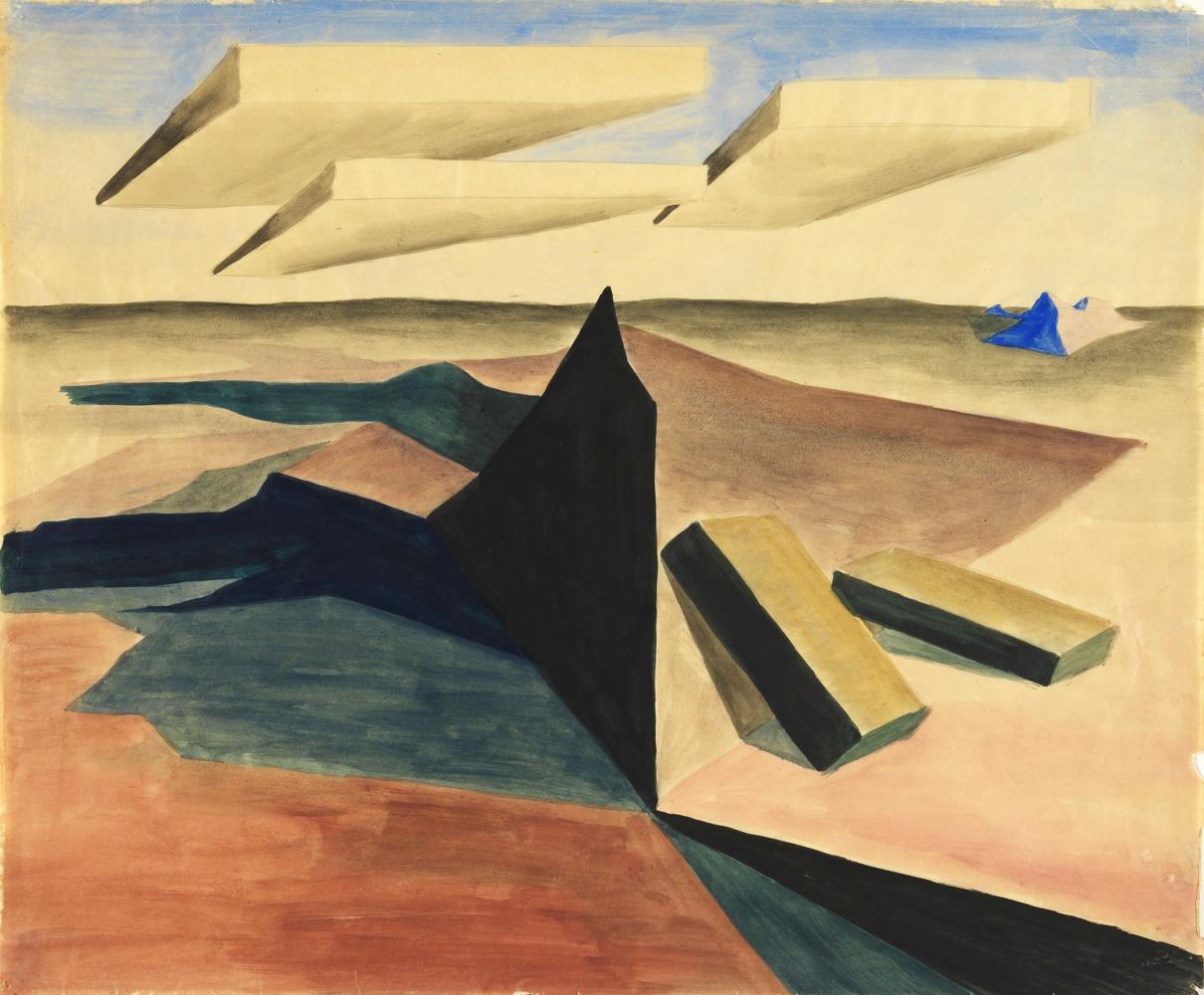
Issue 193, April 2026
Antipodean Accents: a special section in Australian social theory. Guest edited by Julian Potter
Articles
Foreclosure: Why Australian modernisms are implausible [open access]
This article appraises debates about modernism in 1930s and 1940s Australia in relation to the cultural and political traditions of settler colonialism. We theorise settler modernist and anti-modernist engagements as conditioned by a succession of negations constituting ‘Australia’ as what we have previously termed ‘the negative Commonwealth’. Both rejections and affirmations of European modernist traditions considered the imminent arrival in Australia of the ‘dangers’ of modernity. One response was the attempt to keep modernity and its contradictions ‘out’, and to maintain the supposed advantages of being an island continent. When isolation could no longer be maintained, attempts were made to leap over the implications of imminent reconnection by asserting that Australia was always already modern. Here, we survey settler cultural expressions and their embrace or rejection of ‘Old World’ traditions. Beyond complex engagements with these traditions, Australian modernist and anti-modernist experiments similarly struggled to establish their own indigenising settler nationalist traditions.
Antipodean dialogical solidarity, travel, and the agentic power of commemorative genre: Australia and Türkiye’s 75th battlefield remembrance of the Gallipoli campaign as an eventful moment [open access]
Utilizing Beilharz’s concept of the antipodean for developing social theory that reflects Australia’s unique place in the world, this article examines the origins of Australia and Türkiye’s current comprehension of the World War I Gallipoli campaign in its 75th anniversary remembrance. The article highlights the significance of travel as a ritual practice and cultural frame, both domestically and internationally, in shaping disenchantment and re-enchantment trajectories in how nations remember their past. Specifically, it is argued that this anniversary was an ‘eventful moment’ that allowed both Australia and Türkiye to redress a semiosis crisis in their national commemorative traditions through advancing relatively inclusive national memories. More recently the agentic power of travel, in this case connected to Australians’ commemorative exile from the battlefield, has afforded Türkiye’s move to an Ottoman-era focused national identity and Australia’s return to a more ethnonational remembrance of war history.
The art history and contemporaneity of Terry Smith [open access]
This essay surveys 50 years of essays and books by art historian Terry Smith, arguing that his encounters with conceptual art and Australian Aboriginal art inform a concept of contemporaneity that has emerged in his writing in the twenty-first century as a description of the historical zeitgeist. The rise of contemporary art since the 1990s enables a thinking about a state of contemporaneity that describes a coevality of difference across geographies and states of duration. These durations correspond to the vast inequalities and irreconcilabilities of global life, the ontological and material strata by which capital implicates human beings across nations, times and spaces. While modernity and postmodernity were periodising concepts that emerged from combinations of economics, literary studies, sociology and geography, contemporaneity arises from art history. The discipline’s phenomenal methods, its attention to sensual and visual experience, makes it ideal for thinking about the mediated experience of the twenty-first century
Social theorising as emplacement: Encounters with Antipodean sociology and place materialities [open access]
Eduardo de la Fuente
In this article, I consider the idea of academic work as ‘emplaced’ activity. I contextualise myself as social theorist and sociologist by considering two parallel processes: my responses over time to Antipodean sociology, and my evolving relationship to landscape, geology and place. I offer exegeses of Beilharz’s Imagining the Antipodes, Thinking the Antipodes, and the textbook Sociology: Place, Time and Division; as well as the writings of novelist Tim Winton and landscape scholar George Seddon. My reading emphasises the importance of personal experience, landscape sensory experience, and place as relational, in such writings. My own complex and uneven relationship to Antipodean sociology is used to reflect on overcoming my own placeless-ness in modes of theorising; and why the landscapes I migrated to decades ago, and the local geology, proved decisive in my grasping the significance of place experiences, memories and materialities within scholarly thinking and writing.
Issue 193
Articles
Why class discrimination is invisible
The article analyzes the reasons behind the persistent invisibility of class discrimination in social life and social science. Unlike gender and race, social class is not readily visible, clearly bounded and its boundaries agreed upon; membership can change and is not officialized by the state; position is perceived as a flexible and meritocratic; plus the social sciences have failed to develop a properly analytic concept of discrimination. I illustrate my argument with field observation of a California criminal court in which bias based on class is pervasive and overt, yet unseen and affirmed by judges, prosecutors and defence attorneys.
Domination by nature: On an unresolved tension in the Frankfurt School [open access]
Since its publication, Max Horkheimer and Theodor W. Adorno’s Dialectic of Enlightenment has inspired a wide range of interpretations. In particular, its central claim – that active domination over nature ultimately leads to passive domination by nature – continues to provoke debate. Based on a novel ecological explanation of this reversal, the article identifies two contrasting perspectives in the discussions by Jürgen Habermas, Axel Honneth and Amy Allen, among others. Whereas some critical theorists understand the reversal into domination by nature as the result of human history in general, others regard it as a contingent outcome of specifically modern societies. Finally, the articles argues that both readings attempt to sway the Dialectic of Enlightenment toward a single perspective, while its authors leave the tension between the two unresolved.
On radical continuity: Realism and utopia in Lukács and Jameson
This paper explores the evolving relationship between utopia and realism in the works of György Lukács and Fredric Jameson, centering on four subsequent reconfigurations of these concepts in their writing. With respect to Lukács, the focus is on his transition from negative utopianism in his early theory of the novel to writing later about “immanent utopianism” in his theory of realism and the historical novel. Regarding Jameson, the article follows the development of his writing on utopia. Jameson’s thinking about utopian form reflects his development from the Lukácsian model of representation to an alternative model in which the utopia takes center stage. I argue that Jameson’s late theory of utopian representation, applied to utopia as well as contemporary historical novels, can be seen both as a gradual emancipation from Lukács’ framework and an attempt at a more radical methodological continuity in a changing historical situation.
Labour as teleological positing in Lukács’ Ontology οf Social Being and Hegel’s philosophical background: A critical reappraisal
The article examines the interconnection between Lukács’ analysis of labour as teleological positing in his late social ontology and his interpretation of Hegel’s philosophy. It argues that Lukács’ reading of Hegel’s Logic, particularly his emphasis on the doctrine of essence, prioritizes the goal and cognitive aspects of subjectivity in his analysis of labour. By reconstructing the core aspects of Lukács’ analysis of labour, the article highlights how this ontological priority of teleological positing stems from the modality of categorial relations in the doctrine of essence to which Lukács is committed. In doing so, it draws attention to both methodological inconsistencies in his analysis of labour and its crucial insights, while stressing the absence of a more speculative−dialectical presentation that could frame labour in more dynamic terms. The article thus underscores the great importance of the late Lukács’ unfinished social ontology for debates on the dialectical method and critical theory.
The revival of “resonance” in cultural sociology: Uses and abuses of a metaphor
This paper explores the concept of “resonance” in sociology, assessing its strengths and limitations across several theoretical traditions, including American pragmatism, Hartmut Rosa’s critical theory, and Jeffrey Alexander’s cultural sociology. It argues that the overreliance on resonance as the central metaphor for cultural reception reveals a lack of understanding of the interplay between morality and emotion in audience engagement with cultural objects and performances. Rather than discarding the concept, the paper proposes a more modest yet analytically precise reformulation: resonance as moral alignment, stripped of its emotional dimension. This pared-down version allows the concept to be situated within a broader, multidimensional framework of reception, offering sharper tools for analyzing the dynamics of cultural continuity and transformation.
Nietzsche’s causality: On the enchanted and the automatic [open access]
This paper studies the invention of causality as a case study, not as a metaphor or interpretation, but as an old and beautiful lie that has attained objective reality/being. Causality is real because it is real ‘for us’, because it contains the characteristics that we habitually tie to phenomenality – the traits that are the only possible attributes of reality. Causality was born out of prayer and is at least as vulnerable as was God before we killed him. We ought to learn from Nietzsche that all things, and even those that at some stage garner unquestionable belief, are capable of perishing. It has been posited that for Nietzsche, a will to absolute knowledge may destroy the seeker: it is a will to death. It has not yet been explored that the same may potentially imperil key elements of living being. Nietzsche’s defence of life against knowledge has never really been heard: left irrationalism – that is, poststructuralism – frequently claims Nietzsche as a founder of its project, but is a generalised denial of the importance of being (we study ‘discourse’, which by virtue of being discourse is presupposed to be something other than reality), and right irrationalism, though many today say it is Nietzschean, mostly appears as a politics of generalised ressentiment, which by definition cannot be Nietzschean. Nietzsche, in short, is used today to deny or resent being, and thus is primarily misused. This paper will show that Nietzsche, properly heard, is a defender of both being and life, and that there are interconnected benefits to engaging with his unique ontology and politics. In recent discussions of the ‘discovery’ of Nietzsche’s hatred of the left of politics, his equal and opposite hatred of the right has been somewhat muted, and ought to be heard as well. Nietzsche ultimately despised modernity, because it seemed to him that nobody knew how to be alive. As the fight between left and right becomes increasingly absurd in the 21st century (for Nietzsche, a fight between those who want Socratic undeath and those who want, like Socrates, just actual death), another look at Nietzsche’s ontology and politics is timely.
Foucault’s genealogical normative stance [open access]
This article explores Michel Foucault’s genealogical approach and its potential for grounding a normative stance. Criticisms and further developments on genealogy within critical theory denote that, despite counterarguments, Habermas’s critique of Foucault’s theory of power remains influential. By analyzing Foucault’s conceptual choices —such as the dispositif (apparatus)— and his historical critiques, the article demonstrates how power and freedom are intertwined; it proposes an immanent, performative normativity, where freedom is both a precondition for power relations and a dynamic criterion for critique. The normativity emerges through critical engagement with historical contingencies. Foucault’s works—from Madness and Civilization to The History of Sexuality—demonstrate this process, exposing how norms are historically constituted. Ultimately, Foucault’s genealogy offers a normative stance grounded on freedom as power’s counterpart and as a meta-normative standard.
The fear of uselessness: From the normalization to the enjoyment of ecological destructiveness [open access]
Protest against the mitigation of climate change has become a core issue for right-wing populism across the globe. Such politics can mobilize a widespread normalization of ecological destructiveness. Drawing on Frankfurt School critical theory and Lacanian psychoanalysis, this article argues that climate protection provokes such outrage because it appears to negate all the sacrifices that had to be made for the world of work. Thus, the normalization of destructiveness relates to a fear of uselessness common to the modern subject. This fear is taken up by the right-wing anti-climate protest and turned into something positive to be enjoyed. The phenomenon is illustrated by interviews with Swiss construction workers about their experiences with climate change.
Coming round to ourselves: Labour’s self-education in the disrupted Earth system [open access]
This paper develops an eco-Marxist interpretation of the discovery that Earth is an integrated system, a discovery we have made in grasping our own role in shaping it. It criticizes an idea pervasive among Earth system scientists that our disruption of Earth is a function of human power, while bringing out the truth in the thought from Paul Crutzen that our species has become a self-conscious manager of the Earth system. If labour encounters itself in the disrupted Earth system, it finds itself in an environment increasingly hostile to human life. Yet labour may still impart a lesson to itself, on its own domination and the disorder in our relation to nature this domination effects. To fully recognize ourselves in an Earth system we are actively reshaping would mean grasping our self-conscious relation with it as the form of our dependency on it.
Drive repression and modern apocalyptic cosmology: A meeting ground between psychoanalysis and anthropology
This study analyses and compares three strands of critical inquiry into the autonarrative of modern Western civilization: Freud’s theory of civilization; its reworkings by Marcuse and Brown; and Latour’s assessment of the crisis of cosmology. According to Freud, civilization is based on drive repression and evolves through an increasing sense of guilt. Brown and Marcuse emphasize how this Freudian mechanism constitutes the psychic premise of continued functioning of domination. Latour, from an anthropological perspective, highlights modernity’s epistemological rigidity − its inability to confront current crises due to a cosmology devoid of mediation between nature and culture. The current study argues that, despite following different approaches, Latour’s conception of modern man perceiving himself as living in a desacralized apocalypse can be aligned with that of Brown and Marcuse, who trace the psychological conditions of domination in the historical metamorphosis of the sense of guilt.
Unalignment: Reflecting on unscripted reflection in higher education [open access]
Adrian Jones
This article reflects on the meaning of ‘reflection’, and on enablers of ‘reflection’, in higher education. Irrespective of what university managers might want us to think, the key point is that student reflection cannot simply be seen as an intended learning outcome (ILO) of teaching. The author contends that reflection is better seen as the occasioning of a questing self-consciousness in students. The ‘self’ in the questing is key. Reflection in higher education is no mere outcome of teaching.
Review essay
Micha Knuth on Marcel Gauchet: Translation and critique
Daniel Sullivan
Marcel Gauchet is a leading sociologist and public intellectual in France, but his work has not been internationally received. His thought manifests a variation of “post-’68” French theory which in many ways is opposed to versions more popular in the Anglosphere (e.g., Foucault and Bourdieu). A social theorist of sweeping scope, Gauchet has attempted across his life’s work no less than a “transcendental anthroposociology”: a series of philosophical engagements with history and ethnography, in which he identifies certain pivotal events and forces which explain the current state of European societies (in particular, the rise of the state, the Axial Age, Christianity, and the neoliberal era). Emerging theorist Micha Knuth has written the first comprehensive study of Gauchet’s scholarly corpus outside its French-language reception. As Knuth’s work “The Silent Revolution” appears in German, the present essay reconstructs it in summary form, and offers a critical reception of Gauchet.
Book review
Book review: Sociability and Society: Literature and the Symposium
Neslihan Bilge


