by Angus Nicholls, University of Texas at Austin[i]
(This is a prepublication version of this article. You can find the published version in Thesis Eleven Journal, on the T11 Sage website)
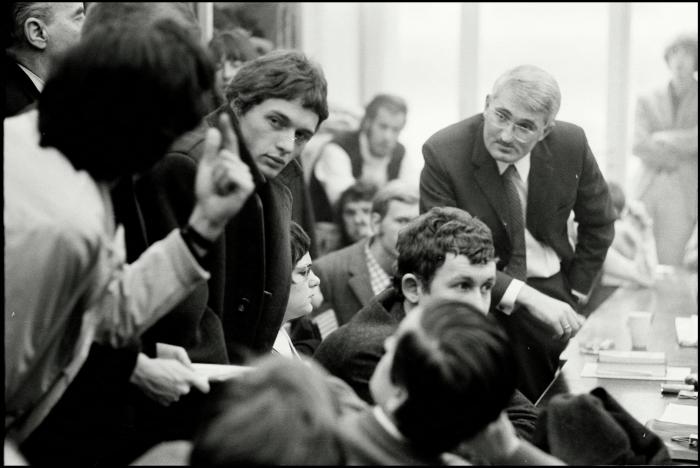
Jürgen Habermas (1929-2026): A Philosopher of the Twentieth Century, Re-Read Through the Early Writings
I: A Philosopher of the Twentieth Century
Jürgen Habermas – a philosopher of the twentieth century – is dead. This opening sentence has been carefully formulated, because other versions would have been possible. To judge from the obituaries in the German-language press, one could readily argue that Habermas was the philosopher of the twentieth century, at least for German-speaking Europe, and especially during its second half. The obituaries underline Habermas’s perceived centrality to the identity of post-war Germany: “the Hegel of the Bundesrepublik,” “the radical European,” “the secret king of philosophy in Germany,” “the defender of reason,” “the master […] who taught us to think and to debate,” “the thinker of democracy,” and the “world author” are just some of the superlatives that recur.[ii]
In an obituary appearing in Philosophie Magazin, Joseph Früchtl captures these sentiments when he observes of Habermas that “the history of the Federal Republic of Germany is more closely intertwined with him than with any other philosopher” (2026). As Früchtl notes, Habermas’s stature even led Joschka Fischer – foreign minister in Gerhard Schröder’s SPD-Green coalition government in the late 1990s and early 2000s, and a former attendee of lectures by both Theodor W. Adorno and Habermas in Frankfurt during the late 1960s – to remark that Habermas had become “almost the state philosopher of democratic Germany.” Fischer, who made this observation on German radio in 2019 to mark Habermas’s ninetieth birthday (see Fittkau, 2019), did so with a degree of irony, since ‘state philosopher’ is hardly a title the left-liberal Habermas would have welcomed, given the uncomfortable association with the role played by Hegel in Prussia.
If Habermas is rightly seen to have defined philosophical and political thought in German-speaking Europe during the second half of the twentieth century – a claim that will carefully be interrogated in what follows – then perhaps his death does indeed mark “the end of an epoch,” as Früchtl’s obituary contends (2026). It is certainly hard to imagine a single contemporary philosopher in, say, the Anglophone or Francophone worlds, who has equal importance to that held by Habermas for German speakers. As one obituary comments, Habermas was a “great provider of conceptual cues” who popularised terms – and here one thinks especially of both Lebenswelt (lifeworld) and Öffentlichkeit (public sphere) both to be examined below – that entered general political and sociological discourse in German (Später, 2026).
Looking back on Habermas’s career today – in an age of resurgent political populism, lightly regulated and ever more dominant digital media, and an increasingly precarious international order no longer unequivocally anchored by ‘the West’ – he appears, perhaps inevitably, as a thinker whose major works and central ideas belong to, and are best understood within, the historical conditions of the century that preceded our own. If not the philosopher of the twentieth century, then, Habermas is certainly a major philosopher of the twentieth century whose works have a lot to tell us about what has happened to what he called Öffentlichkeit during the last two to three decades in which his centrality and relevance have to some extent waned.
Accordingly, this essay makes three claims. First, Habermas, at least as we know him through his key works, should be understood primarily as a philosopher of the political problems of the second half of the twentieth century rather than as an interpreter of our own times. Second, Habermas’s intellectual formation becomes more clearly visible when we examine a group of early, untranslated and apparently ‘minor’ writings from the 1950s and 1960s. Third, rereading these neglected essays might also change our understanding of the better-known works on the public sphere and communicative action, especially in terms of their relevance to our current predicament, which Habermas also endeavours to address in two late works (Habermas, 2019/2023 and Habermas, 2022/2023). These three claims can only be fully developed if they are presented against the backdrop of Habermas’s early life during the immediate postwar period in Germany. Perhaps more than any other contemporary thinker, he requires deep historicization.
Although my purpose here is not to repeat all the basic facts of Habermas’s life – most major obituaries have done that, with the New York Times and especially The Guardian doing serviceable jobs in English – it is difficult to underestimate the extent to which the aftermath of National Socialism shaped his philosophical trajectory. As is recorded in the biography penned by Stefan Müller-Doohm – who, also on account of his Adorno biography, must now be regarded as the semi-official historian of the postwar philosophical culture partly created by Suhrkamp Verlag – Habermas, born in 1929, was both old enough to have strong memories of German fascism but young enough not to have had the opportunity actively to participate in or oppose its crimes as an adult.
Habermas’s father Ernst (1891-1972), born to a Protestant family, began his career as a school teacher and later earned a doctorate in industrial economics, eventually rising to a leadership position in the local chamber of industry and commerce in Bergisches Land (the region east of Cologne and Düsseldorf). Ernst joined the Nazi party in 1933 and became an economic adviser to the party in his local region, before voluntarily signing up for the Wehrmacht at the beginning of the war, going on to serve in leadership positions, mostly in France. After being taken as a prisoner of war in 1944, he was designated a Mitläufer (collaborator) by the denazification authorities, which in practice meant only a brief pause in his official role in the local chamber of commerce (Müller-Doohm, 2014: 28-33, 38).
In 1938, aged nine, Habermas probably witnessed an exhibition in his hometown of Gummersbach on the theme of Rassen, Volk, Familie im Oberbergischen (races, folk and the family in upper Bergisches Land). Aged ten, and unexceptionally for children of his generation, he joined the youth movement known as Das Deutsche Jungvolk (which later became the Hitler Youth), a decision that Müller-Doohm speculatively attributes to the opportunism of Habermas’s parents, and to growing legal and administrative pressure on all children and their families to demonstrate their loyalty to the fascist state. In the autumn of 1944, the fifteen-year-old Habermas was called upon to help defend the crisis-ridden Western Front, a fate which he narrowly avoided due to his not being at home when the Wehrmacht came knocking. A few months, later, in early 1945, the following happened, communicated here in Habermas’s idiomatic German: “dann kamen am 10. März, Gottseidank, die Amis” (“then, on the 10th of March, the Americans came, thank God”; for an overview of this period, see Müller-Doohm, 2014: 29-38).
A key theme in Müller-Doohm’s account of Habermas’s youth is his cleft palate, which necessitated numerous operations, affected his speech for his entire life, made him the subject of bullying at school, and is said to have informed a general boyhood scepticism concerning National Socialism. This experience of discrimination is also said to have made Habermas sensitive to the mechanisms of social exclusion and to have influenced his politics. It also alerted him to the importance of verbal communication for a sense of community and shared values (Gemeinsamkeit), a feature that would become important for his theories of the lifeworld and of communicative action (Müller-Doohm, 2014: 34-35).
To examine how the legacy of National Socialism influenced Habermas’s dealings with his academic colleagues would require a separate essay. His close collaborations and friendships spanned the full spectrum from victims and temporary exiles (Theodor W. Adorno, Max Horkheimer, Karl Löwith) to active collaborators (Erich Rothacker, Habermas’s PhD supervisor), to ‘liberal’ figures who partially accommodated the regime to get by and remain in Germany (Hans-Georg Gadamer, who signed the loyalty oath to Hitler, and who gave an infamously völkisch speech on Johann Gottfried Herder in occupied Paris in 1941).[iii]
Reflecting on how National Socialism would politicise Habermas for his entire career, Müller-Doohm invokes the concluding line from Bertolt Brecht’s Hitler satire from 1941, Der aufhaltsame Aufstieg des Arturo Ui (The Resistable Rise of Arturo Ui): “Der Schoß ist fruchtbar noch, aus dem das kroch” (the womb from which that thing crawled is still fertile; Müller-Doohm, 2014: 53). It is this understandable need constantly to be on the watch for any possible return of anti-Semitism and militaristic fascism in Germany which is a feature of Habermas’s intellectual generation, and which arguably informed the controversial positions that Habermas has recently taken on contemporary geopolitical questions: his call for negotiations with Russia with respect to the war in Ukraine (Habermas, 2023), and even more notably the “statement of solidarity” with Israel of November 2023, which has been described as a “reactionary” error of judgement by some commentators who are otherwise generally supportive of Habermas’s project, but has been more sympathetically contextualised by others.[iv]
When asked in 2024 by Stefan Müller-Doohm and Roman Yos to define the fundamental motivation behind all his thinking, Habermas answered in a way that deflated the grandiose metaphysical and post-metaphysical aims of German philosophers that preceded him (e.g. Kant, Hegel, Heidegger), and positioned him more modestly at the intersection between philosophy and sociology:
the motive of striving to make the world a tiny bit better, or merely contributing to warding off the constant threat of regression, is one that should not be scorned. So I’m quite content to be described as a ‘philosopher and sociologist’ […] What drives me is the problem of how a social coexistence that is fragile and has kept tearing apart until now can actually succeed.
Habermas, 2024/2026: 5-6
An important conviction of Habermas and others of his generation – here one thinks of the sociologist Ralf Dahrendorf, the novelist Christa Wolf, and the poet Hans Magnus Enzensberger, all of whom were born in the same year as Habermas – is that National Socialism was not an aberration, but a development that was native to German culture and which could therefore always return if left unchecked. As Habermas again commented to Müller-Doohm and Yos:
In 1949, my generation could look back at the end of the Second World War as a turning point, a time of historical transformation. By the time I began my studies, we had had four years to realize how profound a caesura the period of Nazi rule had been, and to understand what lay behind the everyday normality in which we had grown up and lived our lives. That was easier for us than for many of our seniors, because – through no achievement of our own – our age made us sensitive to the darkness behind the apparent normality that was now in the past […] It was an intuitive understanding that separated the critical part of our generation from the entrenched mentality all around us: the Nazis had not been a foreign body in the fabric of an ‘essentially healthy’ culture – not some horrible episode that was fortunately over now. Rather, they were able to draw on that darkest legacy of our culture that even great minds of the nation such as Thomas Mann had mobilized at the start of the First World War against the ‘spirit of 1789’.
Habermas, 2024/2026: 1-2
Habermas’s reference here is probably to Mann’s essay “Gedanken im Kriege” (“Thoughts in a Time of War,” written in 1914) in which Mann praises the purportedly apolitical depth and profundity of German Kultur, over and against French and British parliamentary Zivilisation, which Mann sees as a superficial political construction of the rationalist West. “The Germans,” he writes, are “not so in love with the word ‘civilisation’ as their Western neighbours […] they have always favoured ‘culture’ as a word and as a concept.” For Mann in 1914, the Germans, “this most inward of people, this people of metaphysics, of pedagogy, and of music, are not a politically oriented people but a morally oriented people.” For this reason, “the German soul is too deep for civilization to be a high concept, let alone the highest of concepts” (Mann, 1915: 20-21). Of significance here is the claim that Germany is not to be regarded as a ‘western’ nation but rather as an entirely unique and autochthonous cultural phenomenon.
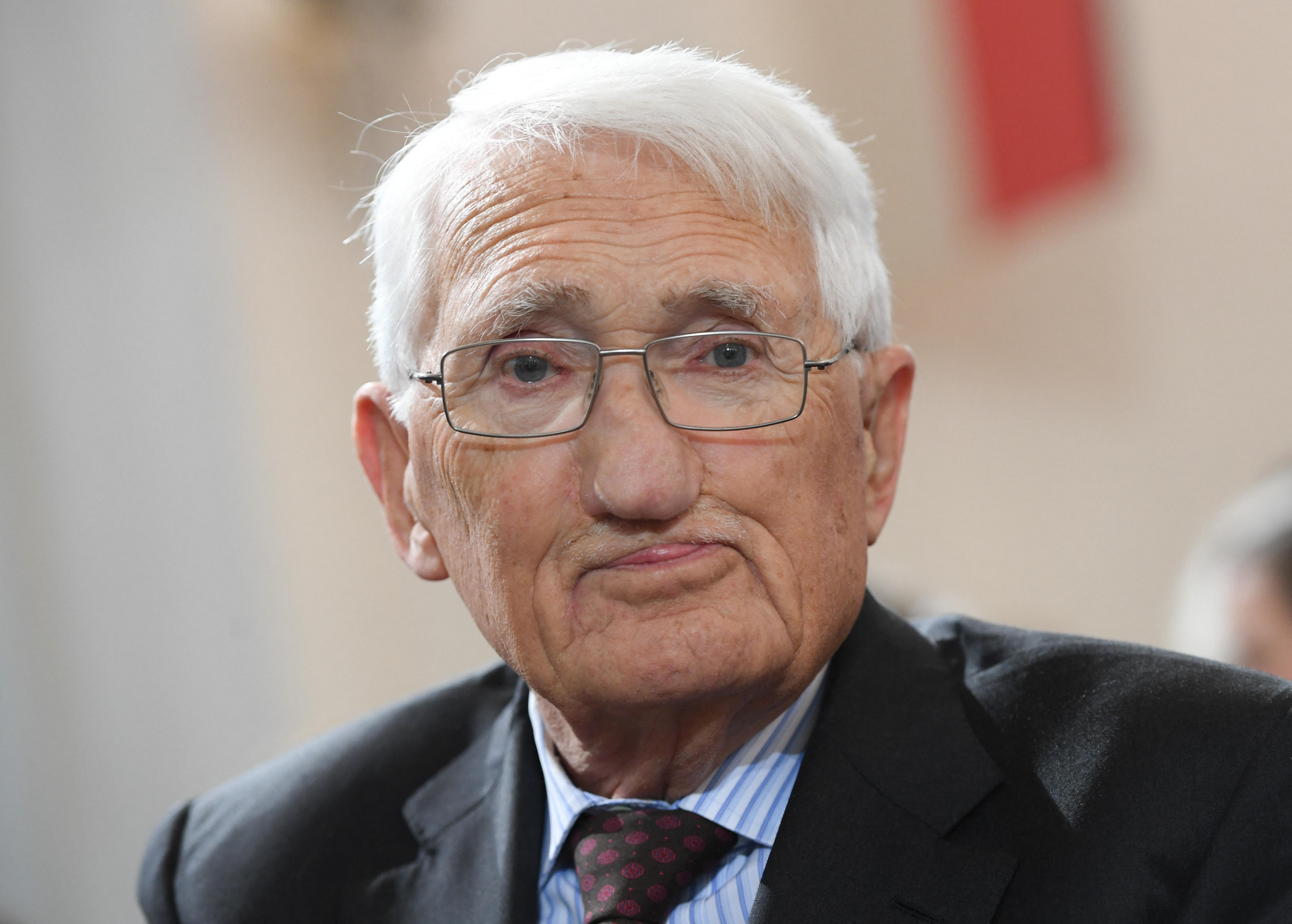
Although such sentiments might seem historically and politically distant from someone like Habermas, his own PhD supervisor, Erich Rothacker, made similar comments in a lecture delivered in 1938 at the Italian Institute for German Studies in a Rome then under the rule of Mussolini. German philosophy, he claims in this lecture, gains its depth from a “closeness to nature” (Naturnähe), which is a “primordial tendency of the German spirit” (Rothacker, 1938: 172). In an earlier essay written in the fateful year of 1933, Rothacker also implies that Jewish German artists (he mentions Heinrich Heine, for example) are not in a position to harness this alleged closeness to nature in the same way as their non-Jewish compatriots like Goethe and Schiller, and so tend to produce inferior art (Rothacker, 1933: 157).
After 1933, enthused by the new regime, Rothacker wanted to put these theories into action. During early 1933, he led the Volksbildung (people’s education) department of the Ministry for Education and Propaganda. And even after Joseph Goebbels fired him from this post in April 1933 for reasons that remain obscure, he acted as a mediator between Goebbels and the student organisers who instigated the National Socialist book burnings – known as the Aktion wider den undeutschen Geist (action against the un-German spirit) – in May of that year (Klee, 2013: 510; Stöwer, 2012: 13-17; 113-210; Sauder, 1983: 80).
While Rothacker was undoubtedly a Nazi, there is a complex debate in the secondary literature concerning the extent to which Rothacker’s thought as a whole can be characterised as National Socialist, with some seeing him as a consistent Nazi, and others as more of an occasional opportunist.[v] But how much of this would Habermas have known in the early 1950s? It is difficult to tell, based on his statements. In his interviews with Müller-Doohm and Yos, Habermas merely remarks that “Rothacker was certainly a well-known philosopher, though I only had a vague notion of his writings. And although he was a Nazi from the first – one only found out these things gradually” (Habermas, 2024/2026: 15). It is nevertheless notable that Rothacker is absent from Habermas’s book of profiles of his colleagues (Habermas, 1987).
In his early student years during the late 1940s and early 1950s, Habermas and his generation would frequently encounter people like Rothacker, who, having been briefly suspended from teaching during 1945-47 following a denazification inquiry, quickly resumed his position of power in German philosophy (Stöwer, 2012: 289-300). For someone like Habermas, Rothacker’s retrospective claims that “the terrible war gave little occasion for cheerful memories,” and that he was “a completely unpolitical person,” are very unlikely to have rung true (Rothacker, 1963: 52-53). Nonetheless, Müller-Doohm notes that Habermas dutifully contributed to Rothacker’s Festschrift, albeit with an essay that completely avoided the writings of his Doktorvater and instead focused on the concept of Freizeit in the writings of Marx and others (Müller-Doohm, 2014: 66).
Certainly, Rothacker is an ambivalent figure in Habermas’s academic development. Habermas’s claim – made in the volume of interviews edited by Müller-Doohm and Yos – that he “didn’t learn any philosophical theories from Rothacker,” is contradicted almost in the very next sentence, when he elaborates that Rothacker’s “lectures introduced me to the broad spectrum of the scholarly German historical school, and it was in his psychological seminars that I first heard about the rich empirical research on which the discussions in philosophical anthropology had been based since the twenties” (Habermas, 2024/2026: 15).
As much as one might agree, then, with some aspects of the mostly celebratory obituaries, Habermas’s legacy is better served by reading him closely and critically, and against the grain. Habermas is by now a thinker who is very familiar to Anglophone readers, especially readers of this journal. Nearly all of the key works, and many minor works, have been translated, though Habermas’s prose – which is often inelegant even in German due to the proliferation of conceptual vocabulary – is not easily rendered into idiomatic English. But sometimes we can know an author better, or at least in a slightly different way, when we shift our focus to ‘minor’ essays, which are not yet translated.
Habermas’s sensitive relation to Rothacker and to philosophical anthropology are a case in point. Here it is significant that the young Habermas wrote the article on “Anthropologie” for a philosophy lexicon published by Fischer Verlag in 1958, during the period when he served as Adorno’s assistant in Frankfurt (Habermas, 1958). This article contains, among other things, Habermas’s reckoning with philosophical anthropology’s conservative and neo-fascist manifestation in the wartime writings of Arnold Gehlen. Also of note is Habermas’s prominent and politically charged review of Reinhart Koselleck’s doctoral thesis – Kritik und Krise (Critique and Crisis, 1959) – written for the influential journal Merkur in 1960 (Koselleck, 1959/1988; Habermas, 1960). Here Koselleck is situated by Habermas alongside his unofficial mentor – the Nazi legal theorist Carl Schmitt – under the banner of the ‘new conservatism’ (neuer Konservatismus). And in 1954, the young Habermas wrote a piece engaging with Marx and the philosophy of technology (Habermas, 1954). This essay, which also appeared in Merkur, attracted the attention of someone who would soon become his colleague in Frankfurt two years later: Theodor W. Adorno.
II: Why Re-Read the Early Habermas? Notes on Method
Who was this early Habermas, what did he write about, and what positions did he take up with respect to Germany’s recent past? In part III of this essay, I will discuss the dramatic early stages of Habermas’s journalistic career by reconsidering his highly critical review of Martin Heidegger’s Einführung in die Metaphysik (Introduction to Metaphysics, 1953), a review which has long been translated and is widely discussed in the secondary literature. Following this, in parts IV, V, and VI, I shall read the aforementioned trio of less canonical early writings as a mosaic that has been assembled according to two criteria: first, they are not translated; second, they engage with intellectuals on both the left and right of politics, spanning from Marx to Gehlen to Carl Schmitt. In all of these writings, recent German history and its interpretation are at stake. The term mosaic is used here in the sense given to it by Walter Benjamin in the prologue to his Ursprung des deutschen Trauerspiels (The Origin of German Tragic Drama, 1928):
The value of fragments of thought is all the greater the less direct their relationship to the underlying idea, and the brilliance of the representation depends as much on this value as the brilliance of the mosaic does on the quality of glass paste. The relationship between the minute precision of the work and the proportions of the sculptural and intellectual whole demonstrates that truth-content is only to be grasped through immersion in the most minute details of subject-matter.
Benjamin, 1928/1998: 29
In the present case, the “underlying idea” or the “sculptural and intellectual whole” is the purported substance invoked by the proper name Habermas. The monumental genre of the obituary has the tendency to assume that the substantial identity of a person and their deeds can be identified in retrospect, chiefly through their big moments or greatest hits. Time and again, the Habermas obituaries refer to Strukturwandel der Öffentlichkeit (The Structural Transformation of the Public Sphere, 1962) and Die Theorie des kommunikativen Handelns (The Theory of Communicative Action, 1981) as his most significant and lasting achievements. While these judgements can be justified by the reception history, they can also cause smaller and less canonical texts to be passed over, especially when translation plays a role in an author’s international reception. The fragments of the present mosaic amount to moments during the 1950s and early 1960s when the now monumental Habermas was taking shape. The gaps between each piece of the mosaic will be just as important as the pieces themselves. Proceeding in this way, I will endeavour to glean some political coordinates from these early works through which we can then – finally in part VII – critically reassess the later and better-known major works.
One benefit of re-reading the early Habermas is clearly genealogical: the early works can be seen to set the stage for what the later works would go on to achieve. This genealogical task has been performed in a deeply philological way in Roman Yos’s recent study of the early Habermas, a work from which the present essay has benefitted immensely. In the introduction to this major study, Yos alludes to Habermas’s status as a classic (Klassiker), observing that it would be impossible to write an intellectual history of the Bundesrepublik without considering Habermas’s role in helping to conceptualise what is distinctive about postwar German democracy both before and after the fall of the Berlin wall (2019: 9-11).
In particular, The Structural Transformation of the Public Sphere is seen by Yos decisively to have shaped debates about democracy in Germany. The Theory of Communicative Action, by contrast, is viewed as having had less of an impact, partly because of the interdisciplinary knowledge that it demands from its readers (2019: 12). Yos then makes a surprising claim, which cannot be subjected to detailed evaluation here, but which seems intuitively correct: despite their classical status, Habermas’s works have not produced a secondary literature in which one can detect dominant schools or main lines of interpretation (2019: 13-14). This, he surmises, might partly be attributed to the sheer volume of Habermas’s publications, not to mention his productivity into old age, with his two-volume Auch eine Geschichte der Philosophie (Also a History of Philosophy, 2019) running to over 1,700 pages in the German edition. Yos’s exemplary method is to bracket out some of the categorisations and assumptions found in the secondary literature – for example, the idea that Habermas belongs to the second generation of the Frankfurt School – in order to analyse the early writings in their own right, in terms of their original historical contexts (2019: 28-29).
Yos’s study began as a genetic intellectual history of Habermas’s work leading up to and including his first and most successful book: The Structural Transformation of the Public Sphere. He soon found that the sheer breadth of material covered by the young Habermas – including at once philosophy, sociology, political theory, constitutional theory, and even literary and cultural criticism – required a larger focus on the entirety of Habermas’s production in the decade spanning 1952-1962, including work that did not directly lead into Structural Transformation (2019: 16). While the aim of Yos’s study is to offer an account of the formative stages in Habermas’s thought, he wisely avoids two methodological assumptions. The first of these is seeing Habermas’s work as undergoing a developmental process according to which theoretical ideas were gradually refined and improved. Such a method could overlook forgotten or discarded elements that might turn out – with the benefit of hindsight – to have provided genuine and lasting insights, while also revealing weaknesses in the later work. The second is that of offering a teleological intellectual history according to which the earlier materials are only read in terms of their contribution to later developments in Habermas’s thought (2019: 23-25).
The method adopted in this essay resembles that of Yos in some respects, while departing from it in others. Like Yos, I resist treating Habermas’s early writings merely as preliminary sketches superseded by the mature works. At the same time, I read them as documents against which the conceptual architecture of The Structural Transformation of the Public Sphere and The Theory of Communicative Action can be viewed in sharper historical relief. The aim is not to privilege the young Habermas over the mature one, but to recover possibilities that became obscured as his philosophy assumed its canonical – and now almost monumental – form. How might these early texts, written while the institutions of West German democracy were being reconstructed after catastrophe, help us to reread the later works? And conversely, how might the later works illuminate these earlier writings without simply absorbing them into a teleological narrative of intellectual development?
In 1932, while composing his Berliner Kindheit um 1900 (Berlin Childhood Around 1900, 1950), Walter Benjamin wrote the short fragment “Ausgraben und Erinnern” (“Excavation and Memory”). Although ostensibly concerned with the personal memories that would find their way into that work, the fragment can, particularly when read alongside the later “Über den Begriff der Geschichte” (“On the Concept of History,” 1940),[vi] be understood as sketching the outlines of an archaeological approach to intellectual history. Benjamin observes that “he who seeks to approach his own buried past must conduct himself like a man digging.” Such excavation requires the historian “to return again and again to the same matter; to scatter it as one scatters earth, to turn it over as one turns over soil” (1972/1999: 576).
Crucially, this method is concerned not only with what is recovered but also with the site of its recovery, for “the man who merely makes an inventory of his findings, while failing to establish the exact location of where in today’s ground the ancient treasures have been stored up, cheats himself of his richest prize.” Recovering fragments of the past therefore means more than assembling historical evidence; it also means revealing ideas and images that, “severed from all earlier associations, reside as treasures in the sober rooms of our later insights” (1972/1999: 576). This mode of looking back resembles Benjamin’s angel of history in “On the Concept of History,” who, while being blown towards the future by a furious storm, has his “face turned towards the past.” The storm that blows him is called progress (1974/2003: 392). For us, it might be called algorithmic digital capitalism or surveillance capitalism. Using the language of the Frankfurt School to which her work pays homage, Shoshana Zuboff, the scholar who coined the term surveillance capitalism, describes this development as the “origin of a new instrumentarian power that asserts dominance over society and presents startling challenges to market democracy” (2019: 2, 22).
If Benjamin’s archaeological metaphor is applied to today’s ground – to the political and technological conditions of the digital age as described by Zuboff and others – the canonical Habermas begins to appear particularly untimely. The bourgeois public sphere described in Structural Transformation, which later became the normative foundation of Habermas’s theory of deliberative democracy, no longer exists in the form presupposed by that work. Likewise, the assumption in The Theory of Communicative Action that communicative rationality is anchored in a shared lifeworld has itself been challenged by the algorithmic fragmentation of public communication and the marginalisation of the so-called ‘legacy’ media – printed newspapers, broadcast television, and radio – that once occupied a more central position in the public sphere. As Habermas himself has recently acknowledged, citing the work of Zuboff, digital platforms commodify the lifeworld by presenting different users with radically different versions of reality (Habermas 2022/2023: 47). Without agreement on basic external facts (for example: does climate change exist?) rational political dialogue becomes increasingly difficult. Yet these developments also suggest a different possibility. The young Habermas – particularly the author of the technologically inflected essays of the 1950s, written under the influence of Heidegger and philosophical anthropology – may offer resources for understanding precisely those transformations that place pressure on the assumptions of his later work.
During the 1950s, Habermas was preoccupied with situating his deeply provincial German lifeworld within the geopolitical landscape of the early Cold War. The claims advanced by the early Thomas Mann and, more obliquely, by Rothacker concerning German exceptionalism and the uniqueness of a supposedly ‘romantic’ German culture were to be overcome through a political and intellectual turn towards the West and the construction of a normalised liberal democracy in the Federal Republic. At the same time, Habermas remained convinced that this Western orientation should not entail an uncritical embrace of liberal capitalism; elements of the Marxist critique of society had to be retained, albeit in a distinctly Western and non-GDR form. This precarious balancing act rested upon assumptions about liberal democracy, capitalism, and the public sphere that can no longer be accepted today without significant qualification. The concluding section of this essay therefore returns to The Structural Transformation of the Public Sphere and The Theory of Communicative Action, asking what remains of their explanatory and normative force under the conditions of digital or surveillance capitalism.
III. A Dramatic Journalistic Debut: Habermas Reviews Heidegger
After completing his doctoral dissertation on the German idealist philosopher Friedrich Wilhelm Joseph Schelling under Rothacker’s supervision in Bonn, Habermas spent the years between 1952 and 1956 earning his living as a journalist.[vii] He wrote for newspapers including the Handelsblatt and the Frankfurter Allgemeine Zeitung (FAZ), as well as for public-facing intellectual journals, above all Merkur, founded in 1947 and still published today. Merkur – in which the two essays discussed below in parts V and VI first appeared – was particularly significant because its subtitle, deutsche Zeitschrift für europäisches Denken (German Journal for European Thought), announced the ambition to reconnect postwar West Germany with the wider intellectual culture of Europe.
Politically eclectic yet intellectually prestigious, the journal brought together major figures from across the ideological spectrum: on the conservative and nationalist right, Arnold Gehlen, Ernst Jünger and Carl Schmitt; among liberal and centrist intellectuals, Ernst Robert Curtius, José Ortega y Gasset and Hannah Arendt; on the liberal left, Theodor W. Adorno, Max Horkheimer, Hans Magnus Enzensberger and Habermas himself; and on the Marxist left, Ernst Bloch and Jean-Paul Sartre. Such a forum offered an unusual opportunity for genuine intellectual confrontation. When Habermas addressed thinkers with whom he profoundly disagreed – as he did, for example, in his critical review of Reinhart Koselleck’s dissertation – he could reasonably assume that both his opponents and their sympathisers formed part of Merkur’s readership.
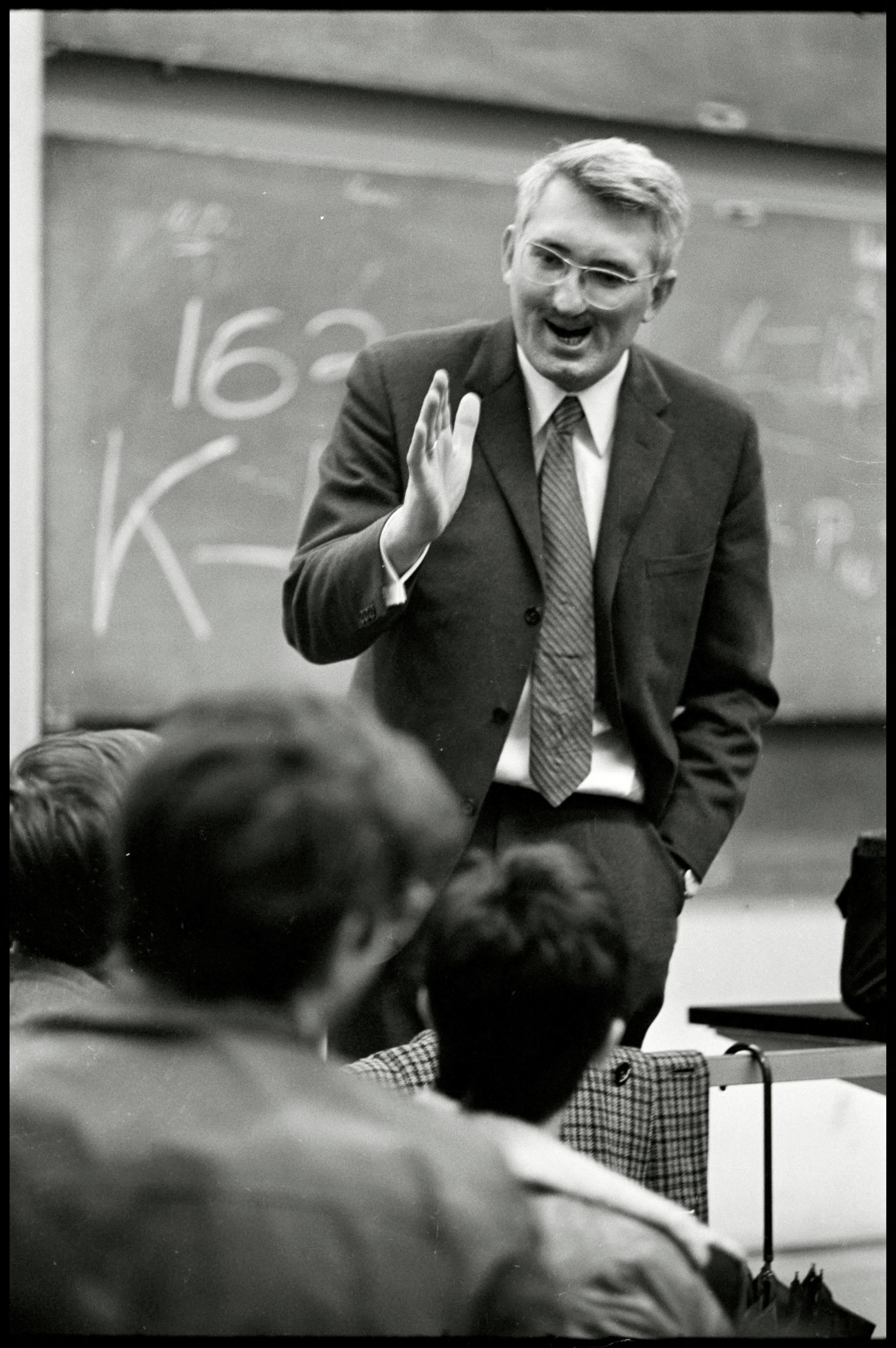
But Habermas’s dramatic entry into the world of journalism was mediated by the FAZ, in a text that has now become so famous that it even rates a mention in most of the German obituaries (the FAZ also reprinted it shortly after Habermas’s death). In “Mit Heidegger gegen Heidegger denken” (“Thinking with Heidegger Against Heidegger”) published on 25 July 1953 and long since translated, Habermas registers his shock that a book in which Heidegger invokes the “inner truth and greatness” of National Socialism could be published in 1953 without an explanatory comment (Heidegger, 1953/2000: 213). The book emerged from the manuscript of Heidegger’s 1935 lecture series, Introduction to Metaphysics. In parentheses probably added by Heidegger or his assistants in the 1950s,[viii] this “inner truth and greatness” is attributed to “the encounter between global technology and modern humanity” (1953/2000: 213).
Heidegger’s geopolitical observations in the earlier phases of this lecture series provide context for this remark: the two superpowers of Russia and the USA represent the “same hopeless frenzy of unchained technology” which is hastening the “spiritual decline of the earth.” Heidegger then claims that: “We lie in the pincers. Our people, as standing in the center, suffers the most intense pressure.” This “metaphysical people … must transpose itself – and with it the history of the West – from the center of their future happening into the originary realm of the powers of Being.” The people to whom Heidegger is referring are apparently the Germans. And in another version of the exceptionalism that we have already encountered in the writings of the young Thomas Mann and in Rothacker, it is the supposed spiritual profundity of this people that will inform the “great decision” regarding Europe’s future: immiseration via technology or retrieval of “our historical-spiritual Dasein” (1953/2000: 40-41).
Habermas’s critical review describes Heidegger as placing “in the hands of the German people a world-historical mission,” thereby “calling for a heroic existence in opposition to the insipid, deteriorated condition of ordinary life.” He then asks why, in 1953, one would wish to rehabilitate such sentiments: “can the planned murder of millions of human beings, which we all know about today, also be made understandable in terms of the history of Being as a fateful going astray?” (Habermas, 1953/1991: 192-193, 197).
The secondary literature on Habermas’s review of Heidegger and its aftermath is far too extensive to discuss here.[ix] But here a minor detail from interviews with Habermas conducted by one of his biographers is relevant. After reading Habermas’s review – and mindful of his own record of political accommodation during the Third Reich – Rothacker is said to have summoned his former student to his home and asked whether he would be the next target of Habermas’s criticisms (Wiggershaus, 2004: 32; Yos, 2021: 14). As recent research on the young Habermas has suggested, encounters with the lingering intellectual residues of National Socialism in postwar German philosophy may well have contributed to his decision, in 1956, to become Adorno’s assistant in Frankfurt after a two-year interlude as a journalist (Verovšek, 2024: 180). Yet Habermas did not simply abandon the intellectual concerns of his Bonn years when he moved to Frankfurt. Some of the conceptual materials he had encountered under Rothacker travelled there with him.
IV: The Lexicon Article on Philosophical Anthropology
This becomes evident in the entry on “Anthropologie” that Habermas wrote for the Fischer Lexikon Philosophie. There, he re-examines the tradition of philosophical anthropology that Rothacker had introduced him to, subjecting it to the critical perspective of the Frankfurt School, his new intellectual home. Habermas devotes only a few lines to what is traditionally understood as anthropology in the Anglophone world. He briefly discusses early physical anthropology, ethnography, theories of race, and the turn to cultural analysis in Levi-Strauss and in Boasians like Ruth Benedict, before turning to his real subject: the almost exclusively German strain of thought which seeks philosophically to describe the essence of the human being and to build a worldview based on that description. The basic story told by this “direction of thought” – its chief historian gives it only the meagre status of a Denkrichtung, not even a school or tradition – is an old one (Fischer, 2008: 14).
In Plato’s Protagoras (320c-323a), to name just one example, we are offered this origin-story for the human being: when the titan Epimetheus was distributing biological features to animals and humans, he gave non-human animals the equipment they needed to survive: fur, claws, sharp teeth, wings, horns and so on. Yet by focusing almost exclusively on the animal world, he forgot about the humans, who, upon inspection by Prometheus, were revealed to have been left naked and without any protection. Prometheus’s solution was to steal technical wisdom – often associated with the means to reproduce fire – to protect humans from nature. Later, when Zeus realises that technology alone would not be sufficient to protect humans from one another when living in communities, he has Hermes distribute to them the capacity for civic or political virtue (politikē aretē), which will enable them to engage in civilised political debate, and is underpinned by the art of rhetoric. The entire story is told to Socrates by Protagoras, himself a rhetorician or sophist, as a defence of his art, and of the notion that political virtue is teachable.
At the heart of this story lies the compensation theory of the human being that runs through all of philosophical anthropology, and which stands in some degree of tension with Darwinian natural selection: inadequately equipped by anatomical and instinctual adaptations, humans must survive via cultural or technological rather than by natural means. As Habermas’s article notes, this story begins to be retold by Johann Gottfried Herder in the late eighteenth century, when he claims that reason is to be regarded as a replacement for inadequate instinctual adaptions (Instinktersatz). The young Hegelians and especially Marx are said to then resist any fixed definitions of the human, because they see the human essence as the capacity for action and work, which unfolds dynamically throughout history. In Habermas’s account, it is only during the 1920s that a more formally biological anthropology begins to prepare the way for more fixed – and in his terms: uncritical – theories of the human being (1958: 21-22).
The foundational figures of this modern philosophical anthropology are Max Scheler and Helmuth Plessner. Drawing on the arguments of the biologist Johann Jakob von Uexküll,[x] Scheler proposes that unlike animals, human beings are not confined to a particular biological niche or environment (Umwelt). In being unspecialised, poorly adapted and even (in Scheler’s own words) krank or “sick,” humans are characterised by their openness to the world (Weltoffenheit), their capacity to adapt to a variety of environments (Habermas, 1958: 23; Scheler, 1915/1971-1997, vol. 3: 192). Ultimately, in Habermas’s account, the special status afforded to humans by Scheler is underpinned by the metaphysical category of Geist (mind/spirit).
Reacting against these metaphysical tendencies in Scheler, Helmuth Plessner attempts a new version of philosophical anthropology which is designed to resolve any lingering sense of Cartesian dualism. For Plessner, human exceptionalism is to be explained by upright gait, which frees the hands for the purposes of technological innovation, and opens up the human field of perception (Habermas, 1958: 23-24). Here speech (referred to by Plessner as Expressivität, the capacity for expression) becomes one of the main technologies used to describe and cope with this wider field of vision. Humans are therefore a paradox in that they are naturally artificial beings (Plessner, 1928/1975: 324, 309).
The real target of Habermas’s critique, however, is Arnold Gehlen, whose key contribution to philosophical anthropology – Der Mensch: Seine Natur und Stellung in der Welt (Man: His Nature and Place in the World) – appeared in 1940, after he had signed the loyalty oath to Hitler in 1933, as well as considering writing a philosophy of National Socialism during the 1930s (Thies, 2000: 12, 15-19; Klee, 2013: 176-177). Gehlen’s pessimistic anthropology defines the human being as a Mängelwesen (creature of deficiencies) which, lacking both a strict biological niche and a secure foundation of orienting adaptations and instincts, stands at risk of being overwhelmed by a plethora of external stimuli. A key mode of social organisation is therefore the development and maintenance of strong societal institutions that are effective at orienting behaviour and unburdening humans of the need to decide on courses of action in every new situation (Gehlen, 1950/1988: 24-31). Gehlen redacted and republished his key contribution to philosophical anthropology after the war, and the English translation is based on the third edition, published in 1950. But in the original German editions of the 1940s, institutions are tellingly referred to as “command systems” (Führungssysteme) that are an essential part of the state (Gehlen, 1940/1941: 448).
In his study of the philosophical foundations of postwar West Germany, Jens Hacke characterises Gehlen’s philosophy of institutions as providing a key point of reference for the “liberal conservative” school of philosophers that took shape around figures such as Joachim Ritter and Helmut Schelsky. In Hacke’s account, Gehlen’s vision of the human being is broadly speaking Hobbesian. But while Hobbes sees the solution to human passions and weaknesses as lying in the social contract made with an absolutist sovereign, Gehlen argues that institutions provide stability by channelling human affects and simplifying decision-making processes (Hacke, 2006: 135-174). Many viewed this philosophy of institutions as openly authoritarian. In a pointed remark in one of his own earliest engagements with philosophical anthropology, Hans Blumenberg, to name one example, refers to Gehlen’s thought as elaborating an “absolutism” of institutions (Blumenberg, 1971/1987: 439).
For his part, Habermas sees an affinity between Gehlen’s anthropology and Heidegger’s analysis of Dasein. Summarising Gehlen, he writes:
By nature unspecialised, the human being depends upon controlled movements that must remain flexibly adaptable to different situations and contexts; orientation in the world and the guidance of action are one and the same – the human being constructs for itself both its world and its being-in-the-world. On a phenomenological basis, Gehlen’s determinations find their point-by-point counterpart in Heidegger’s analytic of Dasein.
1958: 27
In his earlier writings around the time of the Davos disputation with Ernst Cassirer in 1929, Heidegger had himself condemned philosophical anthropology as offering only a “regional ontology” which answered only a limited question – What is the human being? – rather than the question of questions: What is the Being of beings? (Heidegger, 1929/1997: 146-153). Habermas offers a similar critique of philosophical anthropology, but one that is arguably more informed by a Marxist philosophy of history than by Heidegger’s analytic of Dasein.
Habermas’s attack on philosophical anthropology is full frontal and surprising for a lexicon article,[xi] a genre normally requiring an objective overview rather than a clear taking of sides. This might at least partially explain why the article was removed from a later edition of the Lexikon published in 1967.[xii] For Habermas, philosophical anthropology radically fails on two fronts. First, and in the language of the Frankfurt School, it is insufficiently critical (kritisch). Habermas points out that these philosophers who are defining the human being are themselves human beings. They are therefore unable to define the human essence objectively, from the outside, because they are themselves embedded within the human, and within particular historical and social contexts. “A critical anthropology,” according to Habermas, would not fall into the trap of repressing this self-reflexive dimension (1958: 19). Second, defining the human being would be just as reductive as defining the human language. Why? “Because human beings first make themselves into what they are, and they do this according to different conditions” (1958: 31). Here one is reminded of Adorno’s remark in Negative Dialectics: “We cannot say what man is […] To decipher the human essence by the way it is now would sabotage its possibility” (1966/2004: 124).
Of particular interest is the fact that, in 1958, Habermas presents Rothacker alongside the young Hegelians and Marx as offering the possibility of a critical, non-reductive and non-positivist philosophical anthropology. During the 1930s, Rothacker had enthusiastically embraced the biological theories of Uexküll, and it was this body of work that Habermas would have encountered during his years in Bonn (Rothacker, 1932: 173-174). In a publication from the early 1940s, Rothacker explains how Uexküll’s theory of Umwelten (environments) rests on the proposition that every animal is narrowly adapted to a particular biological niche. A tick’s access to nourishment, for example, depends upon highly specialised senses of smell and touch that guide it towards the skin of warm-blooded animals.[xiii] Only those features of the external world that are essential to its survival enter into its environment, which is always subjectively constituted (Rothacker, 1942: 159).
According to Rothacker, the decisive difference between the tick and the human being is this: what counts as relevant and significant (bedeutsam) for humans is not biologically fixed but culturally and historically conditioned. Human beings are Kulturwesen (cultural beings) whose interests (Interessen) are shaped by historically contingent Lebensstile or styles of life (1942: 157-178). These ideas lead directly to Habermas’s principal conclusion regarding philosophical anthropology, one that would have far-reaching implications for his later work. “Human beings live and act only within the concrete lifeworlds of their respective societies, never in ‘the’ world.” Consequently, “the human being has a history and becomes what it ‘is’ only historically. This is a disquieting fact for an anthropology concerned with the ‘nature’ of the human being, with what all human beings have in common at all times” (1958: 32).
Roman Yos observes that Habermas’s preference for Rothacker over Gehlen seems difficult to understand, since Rothacker had himself often been associated with biologically determined anthropology in the manner of Gehlen (2019: 317, 340-341). And recent research has also shown how easy it was for Rothacker to adapt his anthropology to the tendencies of National Socialism when it suited him (Fohrmann, 2023). All this notwithstanding, Rothacker’s idea that human lifeworlds and human perceptions of significance (Bedeutsamkeit) are contingent and historically conditioned was also positively received by other contemporaneous thinkers, most notably by Hans Blumenberg in Arbeit am Mythos (Work on Myth, 1979).[xiv]
Habermas’s lexicon article on philosophical anthropology matters for three reasons. First, this little-known text reveals that his sociologically inflected conception of the lifeworld emerged from sustained engagement with a philosophical tradition that he himself regarded as deeply compromised by the legacy of National Socialism. Second, and in direct contradiction to Habermas’s later claim that he “didn’t learn any philosophical theories” from his doctoral supervisor, Rothacker appears to have been a crucial, if largely unacknowledged, source for the concept of the lifeworld itself. This finding substantially complicates Habermas’s own account of the concept’s origins in his work. In The Theory of Communicative Action, Habermas identifies the later Husserl and Alfred Schutz as the principal influences on his understanding of the lifeworld, leaving Rothacker’s contribution entirely out of view (1981/1987: 119-135). And third: the article suggests that human lifeworlds are contingent, and therefore potentially fragile cultural constructions, an idea that we will return to in part VII.
V: Reviewing Koselleck’s Critique and Crisis
Habermas’s review of Reinhart Koselleck’s Kritik und Krise. Ein Beitrag zur Pathogenese der bürgerlichen Welt (Critique and Crisis: Enlightenment and the Pathogenesis of Modern Society, 1959) – widely regarded as one of the most influential and controversial doctoral dissertations written in postwar Germany – is equally revealing, though for different reasons. At stake are two concepts that would become foundational for Habermas’s mature philosophy: critique and the bourgeois Enlightenment. Both occupy a central place in The Structural Transformation of the Public Sphere, making Habermas’s early engagement with Koselleck an important point of departure for reconsidering some of the political assumptions on which that work was built.
As Stefan-Ludwig Hoffmann observes in his recent intellectual biography of Koselleck, Critique and Crisis is simultaneously a book about the eighteenth century and about the twentieth, especially the competing totalitarianisms of the political left and right (2023: 20). This was similar historical terrain to that on which the Frankfurt School had staked its own critique of modernity. Reviewing the book as Adorno’s assistant in Frankfurt, Habermas must immediately have recognised a striking affinity between Adorno and Horkheimer’s Dialektik der Aufklärung (Dialectic of Enlightenment, 1947) and Critique and Crisis. Although the former draws primarily on Marx and Freud, and the latter on Hobbes and Carl Schmitt, both offer fundamentally negative assessments of the Enlightenment, albeit for very different reasons.
For Adorno and Horkheimer, Enlightenment rationality culminates in the domination of nature and the alienation of human beings from both the natural world and from themselves, a historical process which – in their account – ultimately made fascism and the Shoah possible. In their words: “the fully enlightened earth radiates disaster triumphant” (1947/1997: 3). Koselleck, by contrast, identifies the Enlightenment – and its guiding concept of critique (Kritik) – as the source of a new philosophy of history that emerged during the eighteenth century. At its centre stood the bourgeois subject, conceived as “all mankind,” and destined to be “unified from its European centre and led peacefully towards a better future” (1959/1988: 6).
For Koselleck, the various utopian projects of the nineteenth and twentieth centuries, whether of the political left or the right, rested on the conviction – born of the French Revolution and accelerated by secularisation – that the traditional separation of politics and morality could be overcome through critique. Accordingly, Koselleck opens his study by invoking the “present tension between the two superpowers, the USA and the USSR,” interpreting both as rival universalist projects whose ultimate origins lie in the Enlightenment. In this perspective, the eighteenth century becomes “the antechamber to our present epoch,” whose political antagonisms have unfolded since the French Revolution (1959/1988: 5-6).
A further charge levelled by Koselleck at the Enlightenment is that it lacks political realism because it represses ‘the political’ per se. The newly emancipated bourgeois subject, equating ‘the political’ with the absolutism that led to the revolution in France, mistakenly believes that critique and planning will render politics obsolete by replacing it with morality. In Koselleck’s words: the idea that “politics is fate, and precisely not in the sense of blind fatality, this is what the enlighteners fail to understand. Their attempts to allow the philosophy of history to negate historical factuality, to ‘repress’ the political realm, are Utopian in origin and character” (1959/1988: 11-12, translation altered). While Hobbes, according to Koselleck, saw that rationality offered a way out of civil war via the development of the social contract, he was wise enough still to maintain a separation between private morality and the political. But once private morality was given this free and protected space by the social contract, it expanded, to the extent that “morality striving to become political would be the great theme of the eighteenth century” (1959/1988: 39).
The Enlightenment, in Koselleck’s account, accelerated when this “private interior expanded into the public domain” (1959/1988: 53). Of importance, however, to Koselleck’s argument, is his claim that this expansion was public only in a quite circumscribed sense, taking place in semi-public coffee houses and academies, and in secret societies in the form of Masonic lodges. It was thus “under the protection of the Absolutist State that the new society created its institutions,” but the outcome was “institutionalisation behind the scenes, one whose political strength could not unfold openly” (1959/1988: 66). The “concealment and intensification of this crisis” were, in Koselleck’s view, “part and parcel of the same process” (1959/1988: 185).
Once these new political actors did emerge from behind the scenes, they had effectively sublated private morality and public politics. This movement was paradoxical and even dialectical: on the one hand, the “new elite lived with the certainty of a moral law whose political significance lay in its antithesis to Absolutist politics,” but on the other “the dichotomy of morality and politics guided the pre-eminent criticism and legitimised the indirect taking of power” (1959/1988: 185). In this way, the negation of ‘politics’ by bourgeois morality led to a would-be ‘higher’ politics that ended in revolution. What ensued – according to Koselleck – were the political utopianisms of the left and the right that marked the first half of the twentieth century.
Koselleck (1923-2006), a crucial six years older than Habermas, had more direct experience of both these utopianisms. Having voluntarily joined the Hitler Youth in 1934, and the Wehrmacht in 1941, he participated in Operation Barbarossa, which, among its other atrocities, included the massacre at Babi Yar, an event of which Koselleck claimed to have been unaware. Later, from August 1945 until September 1946, he was interned as a prisoner of war in a Kazakhstan Gulag (for an overview, see Hoffmann 2023: 30-59).
In his review, Habermas almost immediately focuses on the dialectical dimension of Koselleck’s argument. Koselleck, he writes, “conceptualises the Enlightenment through a dialectic of politics and morality that is prefigured in the original position of the bourgeois intelligentsia in the absolutist state” (1960: 469). For Habermas, Koselleck’s book “polemicises against the critical process because he regards it as moving inexorably towards crisis.” The thesis that critique, “established as an indirect political power, by necessity causes crisis,” is regarded as unconvincing, and based on a “political anthropology that is half furtive and half concealed” (1960: 470-471).
Habermas’s review therefore becomes an exercise in intellectual genealogy. He seeks to uncover the assumptions that Koselleck leaves implicit. Koselleck’s notion of ‘the political’ – of an implied friend/enemy distinction that ultimately resists rationalist critique – is in Habermas’s opinion clearly derived from Carl Schmitt (whom Koselleck thanks as a mentor in the book’s acknowledgements). Meanwhile, Koselleck’s portrayal of the bourgeois intelligentsia as politically naïve, and as incapable of mastering affects that it mistakes for morality, is attributed to Gehlen’s philosophical anthropology (1960: 471). As we have seen, according to Gehlen, only strong institutions can provide human beings with the normative orientation they require.
One of the roles in which Habermas’s obituaries have cast him is as a defender of reason and therefore of the Enlightenment (Bopp, 2026). This claim is substantiated by the fact that, when looking back at Adorno’s and Horkheimer’s Dialectic of Enlightenment in 1982, Habermas describes it as the “blackest” and “most nihilistic” book produced by the Frankfurt School (1982, 13). The reduction of the Enlightenment and its philosophical and scientific achievements to a totally instrumentalised reason is one which “flattens out the view of modernity in […] an astonishing manner” and “does not do justice to the elements of reason in cultural modernity which are contained in what Marx and the Marxist tradition call the bourgeois ideals.” Adorno and Horkheimer offer “hardly any prospect of escape from the constraints of instrumental rationality,” not least because their own critique of instrumental reason is itself delivered using the resources of reason, leading to “a performative contradiction of which Adorno was well aware,” and which became the principal theme of Negative Dialectics (1982: 18, 22). There, in Habermas’s damning judgement, Adorno “abandoned any theoretical approach and practised ad hoc determinate negation” (1982: 29). At the beginning of this retrospective article, Habermas already makes his position on the image of reason presented by Adorno and Horkheimer clear: “We no longer share this attitude,” though who precisely ‘we’ is referring to is left undetermined (1982: 13).
Habermas’s critique of Adorno and Horkheimer was of course written twenty years after the work in which he had thematised the “bourgeois ideals” that he accuses his older Frankfurt School colleagues of having neglected. In Structural Transformation, Habermas focuses on precisely the same period and cultural phenomena that are the subject of Koselleck’s Critique and Crisis, with the difference being that Habermas now endows these phenomena with a positive rather than a negative valence. Even the element of secrecy focused on by Koselleck is remobilised by Habermas but viewed by him in a favourable light:
The coming together of private people into a public was […] anticipated in secret, as a public sphere still existing largely behind closed doors. The secret promulgation of enlightenment typical of the lodges but also widely practised by other associations and Tischgesellschaften had a dialectical character. Reason, which through public use of the rational faculty was to be realized in the rational communication of a public consisting of cultivated human beings, itself needed to be protected from becoming public because it was a threat to any and all relations of domination.
1962/1989: 35
There is an astonishing degree of correspondence between Habermas’s and Koselleck’s respective descriptions of how the European public sphere came into being during the eighteenth century. As has been noted in the secondary literature, it is almost as though Koselleck’s book functioned as a kind of negative image, which Habermas both used and inverted in Structural Transformation (Yos, 2019: 447-448).
This infuriated Koselleck, who, to make matters worse, later became Habermas’s colleague in Heidelberg during the early 1960s. As the archival work of Stefan-Ludwig Hoffmann shows, after Structural Transformation was published, the circle of friends around Koselleck even whispered allegations of plagiarism in Habermas’s direction (Hoffmann, 2023: 263). In a letter to Koselleck written in 1964, Habermas both denies these allegations and praises Critique and Crisis as offering a useful account of the emergent public sphere. Further to this, Habermas also explains that Koselleck’s hypothesis about the dialectic of morality and politics did not require further discussion in Structural Transformation, because he had already registered his objections to these ideas in his Merkur review (Hoffmann, 2023: 264-265).
More troubling to Koselleck than the rumours of plagiarism was what he regarded as Habermas’s duplicitous treatment of Critique and Crisis: politically tarnishing the book in Merkur by associating it with Schmitt and Gehlen on the one hand, while making extensive use of its description of the emergent eighteenth-century public sphere on the other. In a note that lay inside his copy of Structural Transformation, Koselleck vents these frustrations: “in his book he makes affirmative use of me in whole sections of his argument, yet at the same time cites the Merkur review.” In Koselleck’s (thankfully private) opinion, this method is “schizoid” (Hoffmann, 2023: 266). While this last charge is undoubtedly exaggerated, Habermas’s engagement with Critique and Crisis certainly reveals both his debt to Koselleck and his skilful use of forums like Merkur in order to shape the reception of competing sources, thereby creating space for his own arguments.
VI: The Dialectic of Rationalisation: The Young Habermas on Marx and Technology
Stefan Müller-Doohm speculates that the twenty-four-year-old Habermas would probably already have come to Adorno’s attention following the publication of Habermas’s Heidegger review in the FAZ. Shortly before that review appeared in 1953, Adorno had, in the winter semester of 1951-52, already devoted a seminar to Heidegger and the use of philosophical language. But it was Alfred Frisé, the editor of the Handelsblatt and also a producer of a radio programme for Hessischer Rundfunk known as Abendstudio, who offered to organise for Habermas an introduction to Adorno. Frisé’s work for Abendstudio had seen him collaborate with major names in German philosophy, including Adorno, Horkheimer and Gadamer (Müller-Doohm, 2014: 99).
On 14 December 1955, shortly after Habermas had taken Frisé up on this offer by writing to Adorno, he received a reply. In it, Adorno remarks that “long before the intervention of Herr Dr. Frisé, I had the intention of getting in contact with you […] You came to my attention by way of an essay in Merkur, and at the time I immediately informed the journal’s editors of the favourable impression it had made on me.” Adorno also invited Habermas to meet him in Frankfurt the following January, and in advance of that meeting, he expressed the hope that Habermas might join him as a colleague in Frankfurt.[xv]
The essay by Habermas that Adorno had read for Merkur is entitled “Die Dialektik der Rationalisierung. Vom Pauperismus in Produktion und Konsum” (“The Dialectic of Rationalisation: On Pauperism in Production and Consumption,” 1954). The title alone must have piqued the interest of the co-author of Dialectic of Enlightenment, and the essay’s contents also bear the influence of the early Frankfurt School on almost every page. Another clear influence is Heidegger’s philosophy of technology, and Heidegger’s essay “Die Frage nach der Technik” (“The Question Concerning Technology”) appeared in the same year as Habermas’s Merkur piece (Heidegger, 1954).
Habermas’s essay opens provocatively with the notion of Haßliebe: alluding to society’s love-hate relationship with technology. Immediately, four questions, which have certainly not lost their topicality for us today, and which I paraphrase here for brevity, are posed: Are there any civilized people left, even those without cars and phones, who are not in some way shaped by technology? Are there any remaining organic areas of life, including human nature itself, that have not in some way been transformed by history and by technology? Can an historical period only rescue itself through the use of its own technological achievements, rather than by turning its back on those achievements? With respect to the adoration (Anbetung) of technology, is it not the case that new developments legitimate themselves not only by virtue of their newness, but also on account of their style? (Habermas, 1954: 701).
Habermas then endeavours to answer these questions by turning to a concept that is given a classical definition by Marx and Engels: pauperism, meaning the impoverished reserve army of the proletariat that increases as a result of the proletariat’s expansion.[xvi]By endeavouring to answer the four questions listed above, Habermas seeks to provide a new definition of pauperism. This definition has little to do with material poverty and much more to do with a kind of societal and even spiritual poverty that is bound up with technological progress and rationalisation.
In Habermas’s account, as machines are optimised, they become increasingly independent from the human hands under which they were originally designed to operate, and more difficult for humans to understand: “the closeness of the working human being [to their work, AN] diminishes in proportion as the automatic machine replaces the tool” (1954: 703). Extending the classical Marxist idea of alienation (Entfremdung) to the epoch of mid-twentieth century automation, Habermas argues that such technological “alienation takes on universal proportions within a machine culture; our world is permeated by the rhythm of machines, all the more so the less conscious we are of this fact” (1954: 703). The political consequences arising from such automation are described as follows:
Furthermore – and this is the crucial issue at stake here – the machines with the maximal range of effect are at the same time those that remove human beings furthest from nature, from their fellow human beings, and ultimately from themselves.
1954: 703
Here “range of effect” (Wirkungsradius) also means the level of political influence exerted by particular machines, and Habermas thinks that the transparency of this influence decreases in proportion as a machine’s range of effect increases. He cites as examples the US nuclear laboratory at Los Alamos and the arm of Rand Corporation devoted to conducting research for the US air force (1954: 703).
Another feature of these machine-dynamics lies in the optimisation and rationalisation of the relation between workers and their machines. Here Habermas refers to Frederick Winslow Taylor’s Principles of Scientific Management (1911) and its focus on dividing up the production process into quantifiable stages, allowing the measurement of values such as effort, motivation and tiredness. The end goal is that “the human machine should adapt itself precisely to the mechanical machine”(1954: 705). Efficiency is increased and cost is reduced when machines are optimised more in terms of their ease of use rather than their speed. The theoretical limit of such a process would be a situation in which the integration between worker and machine is so seamless that the worker is no longer aware that they are even operating a machine. Taylor’s model is also one in which the overall production process is directed by management rather than by the workers. In Habermas’s analysis, this “separation of the Thinking Departments from production has removed the sense of common purpose from the worker’s field of vision,” leading to even deeper alienation (1954: 715).
The dialectical component of Habermas’s argument – and doubtless the move that would most have impressed Adorno – is the idea that there is no direct correlation between the rationalisation of production and increases in the quality of life. This is because rationalisation and optimisation extend themselves outside of the sphere of work, penetrating both domestic life and the private sphere of consumption. Just as at work, machines should become easier to use, so too at home is there a “matter-of-factness with which we turn radio knobs and telephone dials,” which means that these “technical products are inconspicuous and have no existence of their own” (1954: 718). In Habermas’s Heidegger-inflected German, such products are ohne Eigendasein, meaning that unlike nature, they exist only insofar as they unobtrusively serve human needs. Paraphrasing Heidegger, Habermas writes: “Things disappear, and we lose our relation to them, when they degenerate into arbitrarily available standing reserve (Bestand)” (1954: 718). Such objects, it is implied, create an aesthetically impoverished world.
The logic of this dialectic is thus as follows: the more work is optimised, the less fulfilling it becomes. The payoff for this optimisation is more free time, which is devoted to increased consumption – Habermas uses the English phrase keeping up with the Joneses – much of which involves acquiring domestic machines which, in their efficiency and unobtrusiveness, resemble those found in the world of work (1954: 717). Now “the advertising machine is just as important as production […] creating the need for fridges, air mattresses and televisions” (1954: 717). Habermas names this the “pauperism of consumption,” which he thinks “matches exactly the pauperism of industrial work” (1954: 717). Of importance is the fact that in this dynamic, the burden of work (in German: Belastung) does not disappear; rather “it has shifted from the outside to the inside” (1954: 713). In other words: the burden of physical work has been replaced by the psychological burden of feeling as though one is always at work. Habermas claims that this form of “finely grained, hidden pauperism” is certainly not as visible as its nineteenth-century counterpart described by Marx and Engels, but it is just as intense (1954: 715-716).
Even if we believe Habermas’s questionable claim that mid-twentieth-century industrialised pauperism is just as intense as the nineteenth-century pauperism analysed by Marx and Engels, what does he propose as possible solutions to this seemingly all-pervasive dynamic of rationalisation? The solutions offered by Habermas show him elaborating a decidedly West German ‘Marxism.’ There is no talk of collective ownership or of the wholesale philosophical reorientation of private enterprise. Instead, Habermas proposes only mitigating measures that might soften the harder edges of industrialised capitalism.
An even more surprising feature of this ‘Marxism’ is the fact that some of these mitigating measures are derived from the ideas of two ex-Nazis: Gehlen and Rothacker. An implication of Habermas’s essay is that the relentless cycle of rationalisation and consumption that he describes will, in the longer term, lead to worker burnout. Here he draws on Gehlen’s deployment of the term pleonexia. “Arnold Gehlen,” he writes “noticed that pleonexia, that rampant acquisitiveness inherent in our latent readiness to consume, calls for a new asceticism” (1954: 721). Habermas is likely referring to an earlier and shorter 1949 edition of what later became Gehlen’s Die Seele im technischen Zeitalter (Man and the Age of Technology, 1957), a book in which both terms, pleonexia and asceticism, are deployed (Gehlen, 1957/1980: 100-109).[xvii]
For Gehlen, pleonexia is a kind of involuntary greed that attends the desire for ever greater levels of comfort and luxury. In the age of rationalised technology, it is expressed in the chief justification for increased production: improvements in material standards of living. Here, asceticism should act as a counterbalancing measure: “in all previous times marked by a sharp advance in the demand for luxuries, ascetic ideals always existed as a counterweight to that advance” (1957/1980: 105-106). Habermas therefore proposes a reduction in levels of advertising, which he thinks should lead to a reduction in the desire among consumers to satisfy inessential needs, while also reawakening their sense of which items properly belong in their lives. Slowing consumption down should also increase the pleasure that attends it, restoring the consumer’s authentic relation to things (1954: 721). Exactly how these recommendations could be implemented as policy is not discussed by Habermas.
A counterpart to Habermas’s invocation of Gehlen’s ideas about asceticism can be found in the idea of Lebensstile (styles of life) that he derives from Rothacker’s philosophical anthropology. As Habermas notes, “anthropology shows us that human beings are, by their nature, under a compulsion to act, that they must always respond to situations. Fruitful responses become fixed as attitudes (Haltungen), in which, as Rothacker shows, the seed of the great styles of life is contained” (1954: 722). Here, responding to situations means developing technologies – for example handheld objects such as axes, water jugs, or knives – that are to be regarded as authentic cultural adaptations to local environmental conditions. As civilization progresses, such objects may become adorned with decorations or simply become decorative objects in themselves, a sign of what Habermas (paraphrasing Rothacker) calls Hochkultur or high culture (1954: 722). Whereas industrially produced consumer goods are designed simply for use and disposal, the cultural artefact is different: “as something that has been given form, it acquires an independence of its own, transcends itself, and comes to signify something (bedeutet etwas)” (1954: 723).
Habermas never explicitly answers the four questions posed at the beginning of his essay, but we can nevertheless surmise what his responses to them might be. All humans, and human nature itself, he seems to imply, have been indelibly altered by technology. There are no organic areas of life that have not been in some way transformed by technological processes. There is also no realistic prospect of a society regressing to an earlier level of technological organisation, or turning its back on technology, in order to save itself from the immiseration and alienation that it causes. At the most, Habermas proposes mechanisms that might recalibrate and slow the rate of consumption. He also suggests producing objects more likely to hold genuine meaning for both their makers and their consumers, by restoring to them a sense of style. These ideas have gained in relevance since Habermas wrote this essay. In contemporary sociology, they are now addressed by the work of Hartmut Rosa, to name just one example, in his work on resonance (2019).
VII: ‘The Sober Rooms of Our Later Insights’: Early, Later and Very Late Habermas
If we follow Benjamin’s archaeological suggestion that memories or relics of the past might provide “later insights” when they are excavated from the perspective of “today’s ground,” of what use might the early Habermas be for us today? How does Habermas’s latest work answer the questions raised by the early writings? And how might the three early and untranslated texts discussed in this essay help us to re-read what are arguably Habermas’s two key works – Structural Transformation and The Theory of Communicative Action? Before those questions can be addressed, a necessarily schematic summary of those two works will be necessary.
The common historical terrain occupied by Koselleck’s Critique and Crisis and Habermas’s Structural Transformation has already been noted. Both works concern themselves with how a bourgeois critical discourse developed in the eighteenth century, standing in tension with absolutism. From the perspective of a Hobbesian sceptic akin to the early Koselleck, one might allege that Habermas’s initial presentation of Öffentlichkeit or the public sphere is utopian and idealistic insofar as Habermas might seem, on first glance, to offer a rehabilitation of what Kant meant by enlightenment in his prize-winning essay of 1784. With respect to the eighteenth century, Habermas’s public refers to “persons who – insofar as they were propertied and educated – as readers, listeners and spectators could avail themselves via the market of the objects that were subject to discussion.” This bourgeoisie “constituted the public that had long since grown out of early institutions like the coffee houses, salons, and Tischgesellschaften and was now held together through the medium of the press and its professional criticism.” In this way, they “formed the public sphere of a rational-critical debate in the world of letters within which the subjectivity originating in the interiority of the conjugal family, by communicating with itself, attained clarity about itself” (1962/1989: 37, 51).
What Habermas seems to presume here – at least in the early sections of Structural Transformation – is a tacitly Kantian anthropology, according to which all human beings, even if they are at times subject to the inclinations of nature, are ultimately able to mobilise their rational-critical faculties for the purposes of enlightenment. This optimism might be understood as a reaction against the authors of The Dialectic of Enlightenment. Admittedly, this optimism is quickly tempered in a critical fashion when Habermas points out the limitations of this ideological vision of the public sphere. Marx, in Habermas’s account, “demolished all fictions to which the public sphere of civil society appealed.” One of these fictions was the notion that all citizens are sufficiently literate to participate in the public sphere; another was the idea that the public sphere, made up of privately financed journals and newspapers and therefore representing the interests of the bourgeoisie, could ever operate independently of the interests of capital (1962/1989: 124-125).
In later sections of Structural Transformation, this more pessimistic note becomes ever more dominant. As the grip of large-scale corporations on the organs of the public sphere tightens, its critical function is gradually transformed into one of “culture consumption” underpinned by advertising, particularly via the new electronic media of radio and TV. A “reading public that debated critically,” is now gradually replaced by a “mass public of culture consumers,” leading the public sphere to lose its “political character” (1962/1989: 168-169). Yet in the early 1960s, Habermas still thinks the overall game is winnable, chiefly via the interventions of the welfare state, which cling “to the mandate of a political public sphere according to which the public is to set in motion a critical process of public communication.” The extent to which this welfare state model, underpinned by public education, is able to prevail, will, in Habermas’s view, determine “the degree of democratization of an industrial society” (1962/1989: 232).
Around two decades later, in The Theory of Communicative Action, we encounter a quite different Habermas whose ideas have escaped the more provincial confines of German idealist philosophy and its aftermath in the social theory inspired by Marx and Weber. The philosophy of the subject is conjoined with a normative conception of rational communication informed by Anglo-American philosophy: especially pragmatism and the philosophy of speech acts in the traditions of George Herbert Mead and J. L. Austin. Communication and understanding take place in an intersubjective realm of shared meanings in which rational speech acts are evaluated according to their validity claims. For Habermas, this new intersubjective model has the virtue of bypassing the subject-object dualism of German idealism that had led to what he regards as the critical impasse of Adorno’s Negative Dialectics.
A remnant of this German tradition nevertheless appears in Habermas’s recourse to the phenomenological theory of the lifeworld (Lebenswelt), which, as we have seen, he presents himself as having adopted from the late Husserl and from Husserl’s interpreter Schutz (notably: not from Rothacker). Here the lifeworld “appears as a reservoir of taken-for-granteds, of unshaken convictions that participants in communication draw upon in cooperative processes of interpretation” (1981/1987: 124). Drawing upon Durkheim, Habermas claims that lifeworlds are most integrated in so-called “archaic” communities that have not been subjected to the processes of structural differentiation found in industrialised economies: “the more complex social systems become, the more provincial lifeworlds become” (1981/1987: 156, 173). In modern capitalist societies, communications that were once intuitive, because they were underpinned by the self-evident context of a common lifeworld, are increasingly fragmented by the “reification of communicative relations,” a process that Habermas also refers to as a “colonization of the lifeworld” (1981/1987: 386).
The Theory of Communicative Action self-consciously elaborates a theory of communication which, in presuming ideal conditions pertaining in the lifeworld, is utopian. The ideal speech situation presents an “undamaged intersubjectivity” against which the damaged conditions of reality can be measured (1981/1987: 2). Paradoxically, because the lifeworld is always already there as an intuitive background to all communications, it is only the disturbances to which it is subjected by industrialised economies that make us aware of it in the first place (1981/1987: 403). It is this utopian character of the ideal speech situation which Habermas thinks preserves the normative force of his new version of critical theory, while also avoiding the foundationalism and dogmatism of Marx’s philosophy of history. Precisely because the lifeworld is an intuitive background to communications, it can only ever operate as a provisional foundation, a “background knowledge over which no one can dispose at will” (1981/1987: 400).
When set alongside one another, Structural Transformation and The Theory of Communicative Action offer theories of communication and society which endeavour to account for how the public sphere and its communications are transformed by the advent of mass media. In the second of these works, Habermas avoids the global pessimism about the ‘culture industry’ that he finds in Dialectic of Enlightenment by arguing that mass media harbour an “ambivalent potential”: in their very uprooting of provincial lifeworlds, they may cause new public spheres with “emancipatory potential” to emerge (1987: 389-390). This, at any rate, was what Habermas thought in 1981, way back in the twentieth century.
Around three decades later, things were starting to look quite different. In an interview with the newspaper Frankfurter Rundschau in 2014, Habermas makes the following comments on the emergence of the Internet and the digital age:
I regard the introduction of digital communication – following the inventions of writing and printed books – as the third great media revolution […] But the political accomplishments of a political public sphere do not automatically arise from this development. In the nineteenth century, with the help of printed newspapers and the mass media in large nation-states, public spheres were created in which the attention of an incalculably large number of people was simultaneously directed towards the same issues […] The Internet does not achieve this in and of itself, on the contrary: it fragments. Think of, say, the spontaneously appearing portals for fans of highly specialised postage stamps, for those interested in European law, or for anonymous alcoholics […] These rooms of communication, closed in on themselves, lack that which is inclusive, the power of the public sphere to draw attention to that which is most relevant.
Schwering, 2014
The new mass media dynamics alluded to in Habermas’s comments then became the subject of his 2022 book, Ein neuer Strukturwandel der Öffentlichkeit und die deliberative Politik (A New Structural Transformation of the Public Sphere and Deliberative Politics). While this study can only be regarded as a minor and very late work, it is nonetheless an important addendum to Habermas’s earlier ideas about the public sphere.
Here Habermas repeats his claim that the platform mode of the new digital media – their role as two-way systems in which users both consume and produce content, with minimal to no professional editorial control – is as revolutionary for society as the invention of moveable type (2022/2023: 3, 33, 35). Algorithmic targeting of content to social media users whose user data has been harvested creates online bubbles of polarising opinion, a process which transforms the public sphere into a series of separated public spheres (2022/2023: 45-46). Social media – situated in an ambiguous intermediate space between public and private – emerge from technical and economic infrastructures which encourage the spread of often incorrect and misleading content, with the main selection criterion being the potential for emotional engagement and screentime (2022/2023: 54). None of these insights are startlingly new, and Habermas has derived many of them from more original works on digital culture, chiefly Shoshana Zuboff’s work on surveillance capitalism, which he cites (2022/2023: 47). What is significant here is that the thinker who defined the term Öffentlichkeit for critical theory sees this key aspect of liberal democracy as being under threat in the digital age:
It is harmful for a democratic system as a whole when the infrastructure of the public sphere is no longer able to direct the citizens’ attention to the relevant issues that need to be decided or to ensure the formation of competing public opinions – and that means, qualitatively filtered opinions.
2022/2023: 57
Habermas unsurprisingly recommends greater government regulation of social media platforms, which he thinks should be treated as though they are publishers (2022/2023: 58). If, in Benjamin’s terms, we are now seeking to know where we stand on ‘today’s ground’ when excavating and evaluating the relevance of the early Habermas, then here Habermas provides one of the answers when he refers to the “dynamic of political regression into which almost all Western democracies have been drawn since the turn of the millennium” (2022/2023: 19). How do these three early texts look when we re-read them today, and how can they help us to understand this predicament?
Philosophical anthropology, the strain of thought addressed in Habermas’s “Anthropologie” article for the Fischer Lexikon Philosophie, is not a feature of his mature works, and was already dropped by him in the early 1960s, being entirely absent from Structural Transformation. Yet as I have argued elsewhere (Nicholls, 2023) Erich Rothacker’s anthropology, and especially his idea that humans filter the world according to what is relevant and significant in relation to their interests, is highly topical for the digital age. In Rothacker’s terms, social media platforms are significance generating machines (one can even imagine the absurd German compound Rothacker might have used: Bedeutsamkeitserzeugungsmaschinen). Rothacker was right when he suggested that humans never live in a single world, but rather in separate worlds, writing that:
it is arguably an historical-philosophical and in a broader sense an anthropological task to gain the deepest insight possible into the creation of human ‘worlds’ and the way that they are actually experienced by the historical communities who live and act within them. Is it the same world and reality in which all humans and cultures live? Yes and no!
1934: 85
Applying these comments to the present day, one could say that we both do and do not live in the same world. The physical world in which we live – one now subject to a climate crisis – is the same world, but the digital age is creating separated lifeworlds, to the extent that it is increasingly difficult to even agree if an objective fact like the climate crisis exists. Whereas Rothacker thinks different human worlds are created by the significance-filters imposed by different styles of life (Lebensstile), today these worlds are created by algorithms informed by the user data harvested on social media platforms.
It is not difficult to understand why Rothacker – who was one of Habermas’s main points of reference for the idea of the lifeworld in 1958 – more or less completely disappears from his thought from the 1960s onwards. But this disappearance reflects more than the compromised political biography of Habermas’s Doktorvater. It also marks the transition from an anthropological conception of historically constituted worlds to a communicative theory centred on the normative conditions of rational agreement. In The Theory of Communicative Action, that shift was a productive means of renewing the tradition of critical theory. Yet it may also have left Habermas with fewer resources for understanding a digital environment in which the production of significance has itself become economically and technologically determined.
When surveying the landscape of contemporary politics – and in light of the renewed influence of Carl Schmitt among sections of the contemporary New Right[xviii] – it is also worth revisiting the debate between Koselleck and Habermas over the emergence of the eighteenth-century public sphere. Particularly striking is the fact that both thinkers understood that sphere not as a single, unified public, but as an assemblage of journals, literary societies, coffee houses, salons and Masonic lodges that occupied an ambiguous space between the private (even at times the secret) and the public.
Read in the light of today’s fragmented digital environment, this aspect of their historical reconstruction is prescient. Contemporary public spheres (plural) increasingly consist of overlapping and partially enclosed communicative spaces – for example: social media platforms, encrypted private messaging groups – rather than a single arena of common public debate. In this respect, certain aspects of Koselleck’s analysis begin to illuminate features of digital public spheres that Habermas’s model of rational-critical discourse struggles to explain. Koselleck’s more pessimistic, and ultimately Hobbesian, political anthropology directs attention to the roles of secrecy, conflict, affect and antagonism within publics that are only partially visible to one another, rather than to the possibility of their eventual reconciliation through rational communication.
But among these three early pieces, Habermas’s essay on the “Dialectic of Rationalisation” is by far the most topical for today’s world. The essay poses the key question of whether deliberate technological regression – or at least the slowing down or regulating of technological progress in order to manage its detrimental effects – is desirable or even possible. Today, similar ideas feature in contemporary debates on global policy, an example being recent discussions of “technological relinquishment” and the “limited curtailment” of technologies that endanger human existence (see Bostrom, 2019: 462-465). One does not necessarily have to agree with Habermas’s argument about the intensity and misery of pauperism in the rationalised economy to see how far-reaching his arguments in this essay might be.
The “Dialectic of Rationalisation” describes a world in which the human should be adapted to the machine, and the machine to the human. In our own time, this logic of rationalisation has been extended not only through the harvesting of user data for the algorithmic targeting of content on social media, but also through the commercial extraction of human content itself by AI systems, including the very prompts and responses through which users interact with them. Habermas’s observation that the political effectiveness of technological systems increases in inverse proportion to their visibility now appears strongly relevant to the digital age. AI systems increasingly organise attention, shape preferences and even generate the content through which political and commercial influence is exercised, all while their operations remain largely opaque to their users. From the workplace to the home, these platforms are continually available to us on a myriad of devices, promising to make our lives easier. Gehlen’s idea of pleonexia – the desire to consume things that we do not really need – likewise finds a contemporary counterpart in an economy driven by algorithmically generated pseudo-needs.
This symbiotic human-machine-world of the digital age has already become part of our everyday lifeworld. It is therefore one of the ironies of Habermas’s legacy that although his canonical works remain insightful in their analysis of – and, in the case of Germany, perhaps even their influence on – the liberal democracies of the second half of the twentieth century, some of his neglected and untranslated writings speak more directly to the technological, anthropological and political problems of the twenty-first.
In the first volume of his very late (and last) major work Auch eine Geschichte der Philosophie (Also a History of Philosophy, 2019), Habermas endeavours to place the digital age at the centre of his concerns. Here again, he underlines the development of online communication systems as an epochal event in human history:
The digitization of communication (with the attendant shift from the hierarchical mode of communication of authors with readers to egalitarian communication between networked authors) is likely to have as radical an impact as the preceding media revolutions. In any case, this […] gives the impression of the breath-taking acceleration of a sociocultural evolution, which is currently experienced as an inexorable revolution of everyday life and is triggering regressive responses.
2019/2023: 90
The argument here is similar to that already found in The Theory of Communicative Action: lifeworlds, and the communicative acts that they underpin, are disrupted by rapid technological and economic change. Under such conditions, Habermas quite rightly asks what purpose philosophy can serve and openly wonders whether “philosophy as we know it still has a future” (2019/2023: xix).
The challenges that Habermas lays out for his discipline are certainly daunting. In line with his earlier work on post-metaphysical thinking (Habermas, 1988), he declares that philosophy can no longer “aim at a metaphysical worldview.” At the same time, he sees contemporary philosophy as beginning to dissolve into a series of regional subdisciplines (he mentions bioethics and business ethics as examples), thereby threatening to succumb to a “false scientistic self-understanding.” If this process continues, and philosophy were to give up on attempting a total worldview, then it would betray its identity, which lies in providing “a rational understanding of ourselves and the world” (2019/2023: xx).
A further challenge lies in developing a worldview for philosophy out of a tradition which Habermas acknowledges to be Greek and Judeo-Christian in its origins, and then applying this to multiethnic societies that exist within a globalised world. These issues were obviously not pressing for the more provincial mid-twentieth-century German philosophy that marked Habermas’s formative years. Yet Habermas still seems to think that this tradition might find a universal application when accompanied by a high dose of self-reflection: “the claim to universal validity of a certain, essentially procedural way of thinking,” he writes, “is not necessarily contradicted by the fact that it emerged from a particular context” (2019/2023: 66).
In terms of the bifurcation of European philosophy which Habermas sees as having taken place within the secularisation processes of the seventeenth and eighteenth centuries, he sides more with Spinoza and Kant than with Hobbes and Hume. For Habermas, the self is constitutive in making a world rather than as a mere container of facts about the world (2019/2023: 9-10). Returning to the thematics of the article on “Anthropologie,” he praises the young Hegelians for two moves. First, they deprived the Kantian subject of its “armour of a priori knowledge,” but without “stripping finite reason, now conceived as embodied in language and organic nature and as situated in history and society, entirely of its world-projecting spontaneity” (2019/2023: 12). In summarising the achievements of the young Hegelians, then, Habermas essentially describes his own philosophical project, in which “communicative action and the lifeworld background are interlinked through the dynamism of a circular process: the symbolic lifeworld is reproduced through communicative action” (2019/2023: 12).
Habermas then positions himself in relation to the conservative generation of German philosophers who experienced secularisation and modernity as crises, a tradition to which the early Koselleck belongs. Here the usual suspects appear: Schmitt’s critique of ‘decadent’ parliamentary liberalism as a loss of religious authority; the disappearance of natural law in the view of Leo Strauss; the forgetting of Being in Heidegger. Again, for Habermas, only the young Hegelians – and their Frankfurt School intellectual heirs – provided progressive answers, in that they “did not seek salvation from the universal pull of capitalist reification by returning to the Roman roots of Catholicism or to the classics or to the origins of Greek philosophy” (2019/2023: 16).
In short: the onward rush of modernity – the violent storm blowing Benjamin’s backward-looking angel of history into the future – will not permit one to both return to the origins and provide a worldview capable of unifying increasingly fractured multiethnic societies from which religion has definitely not disappeared. The balancing act that Habermas prescribes for post-metaphysical thinking is filled with twentieth-century pathos and seems almost impossible to achieve in a world whose public spheres are dominated by algorithmic digital communication:
Postmetaphysical thinking certainly cannot define its boundaries unilaterally vis-à-vis the sciences, on the one hand, and religious teachings and metaphysical worldviews, on the other. But it can try to comprehend the correct demarcations as the result of learning processes without compromising its autonomy […] the claim of postmetaphysical thinking to universality could be defended, ideally speaking, only in an intercultural discourse among equal participants who are aware of their fallibility and are willing to learn.
2019/2023: 64, 66
Only Habermas – who describes this work of more than 1,700 pages as his retirement project – would suggest such a quixotic feat of liberal-humanist learning. Whether philosophy in the twenty-first century retains the institutional conditions required for such an integrative undertaking is far less certain. Could such a project withstand the breaking up of philosophy into numerous market-focused sub-specialisms, a phenomenon which might be seen as part of what the young Habermas called the “Dialectic of Rationalisation”? And could it provide orientation within a digital landscape of fragmented public spheres, algorithmically organised communication, and AI-assisted knowledge production? Delivering on Habermas’s decidedly twentieth-century prescription will undoubtedly prove challenging in the twenty-first. Yet if Also a History of Philosophy demonstrates the continuing necessity of that ambition, the untranslated writings of the 1950s and early 1960s suggest that some of the conceptual resources required to pursue it were already present in Habermas’s thought from the beginning. The digital age has not diminished Habermas’s philosophy so much as rearranged its significance, making some of his earliest and most neglected writings newly relevant to the questions of our time.
Angus Nicholls is Texas Chair of German Literature and Culture at the University of Texas at Austin.
References
Adorno TW (1966) Negative Dialektik. Frankfurt am Main: Suhrkamp. Trans. Ashton EB (2004) Negative Dialectics. London: Routledge.
Adorno TW and Horkheimer M (1947) Dialektik der Aufklärung. Amsterdam: Querido. Trans. Cumming J (1997) Dialectic of Enlightenment. London: Verso.
Benjamin W (1928) Ursprung des deutschen Trauerspiels. Berlin: Rowohlt. Trans. Osborne J (1998) The Origin of German Tragic Drama. London: Verso.
Benjamin W (1972) Ausgraben und Erinnern. In: Tillman Rexroth (ed) Walter Benjamin. Gesammelte Schriften, vol. IV.1. Frankfurt am Main: Suhrkamp, pp. 400-401. Trans. Livingstone R and Jephcott E (1999) Excavation and Memory. In: Jennings MW, Eiland H and Smith G (eds) Walter Benjamin. Selected Writings, Volume Two, 1927-1934. Cambridge, MA: Harvard University Press, 576.
Benjamin W (1974) Über den Begriff der Geschichte. In: Tiedemann R and Schweppenhäuser H (eds) Walter Benjamin. Gesammelte Schriften, vol. I.1 (2003), pp. 693-704. Trans. Zohn H (2003) On the Concept of History. In: Eiland H and Jennings MW (eds), Selected Writings, Volume Four: 1938-1940. Cambridge, MA: Harvard University Press, 389-400.
Blumenberg H (1971) Anthropologische Annäherung an die Aktualität der Rhetorik. In: Wirklichkeiten, in denen wir leben. Aufsätze und eine Rede. Stuttgart: Reclam. Trans. Wallace RM (1987) An Anthropological Approach to the Contemporary Significance of Rhetoric. In: James K, Bohman J and McCarthy T (eds), After Philosophy: End or Transformation? Cambridge, MA: MIT Press, 423-458.
Blumenberg H (1979) Arbeit am Mythos. Frankfurt am Main: Suhrkamp. Trans. Wallace RM (1985) Work on Myth. Cambridge, MA: MIT Press.
Böhnigk V (2002) Kulturanthropologie als Rassenlehre. Nationalsozialistische Kulturphilosophie aus der Sicht des Philosophen Erich Rothacker. Würzburg: Königshausen & Neumann.
Böhnigk V (2009) Die nationalsozialistische Kulturphilosophie Erich Rothackers. In: Sandkühler HJ (ed), Philosophie im Nationalsozialismus. Hamburg: Meiner, 191-217.
Bopp C (2026) Er war Verteidiger der Vernunft. BZ: Zeitung für die Region Basel, 16 March.
Bostrom N (2019) The Vulnerable World Hypothesis. Global Policy 10(4): 455-476.
Delanty G (2026) The Contested Legacy of Jürgen Habermas: Reason, Critical Dialogue, Critique. Dialogues in Sociology, 20 April 2026. Available at: https://doi.org/10.1177/29768667261443056. (accessed 14 July 2026).
Eiland H and Jennings MW (2014) Walter Benjamin: A Critical Life. Cambridge, MA: Harvard University Press.
Field LK (2025) Furious Minds: The Making of the MAGA New Right. Princeton, NJ: Princeton University Press.
Fischer J (2008) Philosophische Anthropologie. Eine Denkrichtung des 20. Jahrhunderts. Freiburg: K. Alber.
Fittkau L (2019) Ein streitbarer Intellektueller. Deutschlandfunk, 13 June 2019. Online: https://www.deutschlandfunk.de/90-geburtstag-von-juergen-habermas-ein-streitbarer-100.html (accessed 15 July 2026)
Fohrmann J (2023) ‘Geprägte Form.’ Erich Rothackers Kulturanthropologie. Deutsche Vierteljahrsschrift für Literaturwissenschaft und Geistesgeschichte 97(3): 707-733.
Früchtl J (2026) Nachruf auf Jürgen Habermas. Philosophie Magazin, 14 March.
Gadamer HG (1942) Volk und Geschichte im Denken Herders. Frankfurt am Main: Klostermann.
Gehlen A (1940/1941) Der Mensch. Seine Natur und seine Stellung in der Welt. 2nd ed. Berlin: Junker und Dünnhaupt.
Gehlen A (1949) Sozialpsychologische Probleme der industriellen Gesellschaft. Tübingen: Mohr.
Gehlen A (1950) Der Mensch: Seine Natur und seine Stellung in der Welt. Bonn: Athenäum. Trans. McMillan C and Pillemer C (1988) Man: His Nature and Place in the World. New York: Columbia University Press (revised postwar edition).
Gehlen A (1957) Die Seele im technischen Zeitalter. Sozialpsychologische Probleme der industriellen Gesellschaft. Hamburg: Rowohlt. Trans. Lipscomb P (1980) Man in the Age of Technology. New York: Columbia University Press.
Grondin J (1999) Hans-Georg Gadamer: Eine Biographie. Tübingen: Mohr Siebeck. Trans. Weinsheimer J (2003) Hans-Georg Gadamer: A Biography. New Haven, CT: Yale University Press.
Habermas J (1953/1991) Zur Veröffentlichung der Vorlesungen aus dem Jahr 1935. Frankfurter Allgemeine Zeitung, 25 July. Reprinted in: Habermas J (1987) Philosophisch-politische Profile. Frankfurt am Main: Suhrkamp, 65–71. Trans. Lewis WS (1991) Martin Heidegger: On the Publication of the Lectures of 1935. In: Wolin R (ed) The Heidegger Controversy: A Critical Reader. New York: Columbia University Press, 190–197.
Habermas J (1954) Die Dialektik der Rationalisierung. Vom Pauperismus in Produktion und Konsum. Merkur 8: 701-724.
Habermas J (1958) Anthropologie. In: Diemer A and Frenzel I (eds) Das Fischer Lexikon. Philosophie. Frankfurt am Main: Fischer Bucherei.
Habermas J (1960) Verrufener Fortschritt – Verkanntes Jahrhundert: zur Kritik der Geschichtsphilosophie. Merkur 147: 468-477.
Habermas J (1962) Strukturwandel der Öffentlichkeit. Untersuchungen zu einer Kategorie der bürgerlichen Gesellschaft. Neuwied: Luchterhand. Trans. Burger T and Lawrence F (1989) The Structural Transformation of the Public Sphere: An Inquiry into a Category of Bourgeois Society. Cambridge: Polity.
Habermas J (1973) Philosophische Anthropologie (ein Lexikonartikel). In: Kultur und Kritik: Verstreute Aufsätze. Frankfurt am Main: Suhrkamp, 89-111.
Habermas J (1981) Die Theorie des kommunikativen Handelns. 2 vols. Frankfurt am Main: Suhrkamp Trans. T McCarthy (1987) The Theory of Communicative Action, Volume Two: Lifeworld and System: A Critique of Functionalist Reason. Cambridge: Polity (only vol. 2 of the English translation is cited).
Habermas J (1982) The Entwinement of Myth and Enlightenment: Re-Reading the Dialectic of Enlightenment. Trans. Levin TY. New German Critique 26: 13-30.
Habermas J (1987) Philosophisch-Politische Profile. Frankfurt am Main: Suhrkamp.
Habermas J (1988) Nachmetaphysisches Denken: Philosophische Aufsätze. Frankfurt am Main: Suhrkamp.
Habermas J (1989) Work and Weltanschauung. The Heidegger Controversy from a German Perspective. Trans. McCumber J Critical Inquiry 15(2): 431-456.
Habermas J (2019) Auch eine Geschichte der Philosophie, Band 1: Die okzidentale Konstellation von Glauben und Wissen. Berlin: Suhrkamp. Trans. Cronin C (2023) Also a History of Philosophy, Volume 1: The Project of a Genealogy of Postmetaphysical Thinking. Cambridge: Polity.
Habermas J (2022) Ein neuer Strukturwandel der Öffentlichkeit und die deliberative Politik. Berlin: Suhrkamp. Trans. Cronin C (2023) A New Structural Transformation of the Public Sphere and Deliberative Politics. Cambridge: Polity.
Habermas J (2023) Ein Plädoyer für Verhandlungen. Süddeutsche Zeitung, 14 February.
Habermas J (2024) “Es müsste etwas besser werden…” Gespräche mit Stefan Müller-Doohm und Roman Yos. Trans. Hoban W (2026) Things Needed to Get Better. Conversations with Stefan Müller-Doohm and Roman Yos. Cambridge: Polity.
Hacke J (2006) Philosophie der Bürgerlichkeit. Die liberalkonservative Begründung der Bundesrepublik. Göttingen: Vandenhoeck und Ruprecht.
Heidegger M (1929) Kant und das Problem der Metaphysik. Bonn: Cohen. Trans. Taft R (1997) Kant and the Problem of Metaphysics. 5th ed. Bloomington, IN: Indiana University Press.
Heidegger M (1953) Einführung in die Metaphysik. Tübingen: Niemeyer. Trans. Fried G and Polt R (2000) Introduction to Metaphysics. New Haven, CT: Yale University Press.
Heidegger M (1954) Die Frage nach der Technik. In: Vorträge und Aufsätze. Pfullingen: Neske, 9-40.
Hoffmann SL (2023) Der Riss in der Zeit. Kosellecks ungeschriebene Historik. Berlin: Suhrkamp.
Klee E (2013) Das Personenlexikon zum Dritten Reich. 4th ed. Frankfurt am Main: S. Fischer.
Koselleck R (1959) Kritik und Krise. Ein Beitrag zur Pathogenese der bürgerlichen Welt. Freiburg: K. Alber. No translator credited (1988) Critique and Crisis: Enlightenment and the Pathogenesis of Modern Society. Oxford: Berg.
Kundnani H (2026) Gaza, Ukraine and the Lessons of the Nazi Past. New German Critique 157 (53/1): 75-91.
Löwith K (1986) Mein Leben in Deutschland vor und nach 1933. Ein Bericht. Mit einem Vorwort von Reinhart Koselleck und einem Nachwort von Ada Löwith. Stuttgart: J. B. Metzler.
Mann T (1915) Gedanken im Kriege. In: Friedrich und die große Koalition. Berlin: S. Fischer, 7-31.
Marx K (1990) Capital: A Critique of Political Economy. Vol. 1. Introd. by Mandel B. Trans. Fowkes B. London: Penguin Classics.
Müller F (2026) Jürgen Habermas: Der Denker der Demokratie. Berliner Morgenpost, 14 March.
Müller-Doohm S (2003) Adorno: Eine Biographie. Frankfurt am Main: Suhrkamp. Trans. Livingstone R (2005) Adorno: A Biography. Cambridge: Polity.
Müller-Doohm S (2014) Jürgen Habermas: Eine Biographie. Frankfurt am Main: Suhrkamp.
Müller-Doohm S (2026) Von der Freiheit, Vernunft zu gebrauchen. Neue Zürcher Zeitung, 16 March.
Nicholls A (2015) Myth and the Human Sciences: Hans Blumenberg’s Theory of Myth. London and New York: Routledge.
Nicholls A (2023) The Persistence of Geist in the Geisteswissenschaften: Re-Reading Erich Rothacker in the Digital Age. Deutsche Vierteljahrsschrift für Literaturwissenschaft und Geistesgeschichte 97(1): 199-209.
Plessner H (1928/1975) Die Stufen des Organischen und der Mensch. 3rd ed. Berlin: De Gruyter.
Rosa H (2019) Resonanz: eine Soziologie der Weltbeziehung. Berlin: Suhrkamp. Trans. Wagner J C (2019) Resonance: A Sociology of Our Relationship to the World. Cambridge: Polity.
Rothacker E (1932) Zur Lehre vom Menschen. Ein Sammelreferat über Neuerscheinungen der Kultursoziologie. Deutsche Vierteljahrsschrift für Literaturwissenschaft und Geistesgeschichte 10(1): 173-184 (part one of a two-part essay).
Rothacker E (1933) Zur Lehre vom Menschen. Ein Sammelreferat über Neuerscheinungen der Kultursoziologie. Deutsche Vierteljahrsschrift für Literaturwissenschaft und Geistesgeschichte 11(1): 145-163 (part two of a two-part essay).
Rothacker E (1934) Geschichtsphilosophie. Munich: Oldenbourg.
Rothacker E (1938) Das Problem einer Geschichte der deutschen Philosophie. Deutsche Vierteljahrsschrift für Literaturwissenschaft und Geistesgeschichte 16(2): 161-183.
Rothacker E (1942) Probleme der Kulturanthropologie. In: Hartmann N (ed) Systematische Philosophie. Stuttgart: Kohlhammer, 54-198.
Rothacker E (1963) Heitere Erinnerungen. Frankfurt am Main: Athenäum.
Sauder G (1983) Die Bücherverbrennung. Zum 10. Mai 1933. Munich: Hanser.
Scheler M (1915/1971-1997) Zur Idee des Menschen (1915). In: Scheler M and Frings MS (eds) Max Scheler. Gesammelte Werke. vol. 3. Basel: Francke, 170-195.
Schröder L (2026) Der streng öffentliche Denker. Rheinische Post, 14 March.
Schroer S (2021) Jakob von Uexküll: The Concept of Umwelt and its Potentials for an Anthropology Beyond the Human. Ethnos 86(1): 132-152.
Schloemann J (2026) Darum ist die Verehrung von Jürgen Habermas berechtigt. Tages-Anzeiger, 15 March.
Schwering M (2014) Im Sog der Gedanken. Interview mit Jürgen Habermas. Frankfurter Rundschau, 13 June 2014. Available at: https://www.fr.de/kultur/gedanken-11231935.html (accessed 13 July 2026).
Später J (2026) Der große intellektuelle Stichwortgeber. TAZ, 14 March.
Spoerhase C (2021) Der akademische Nachwuchs stellt sich vor. Zeitschrift für Ideengeschichte 15(3): 16-18.
Stöwer R (2012) Erich Rothacker: Sein Leben und seine Wissenschaft vom Menschen. Göttingen: Vandenhoeck und Ruprecht.
Thies C (2000) Gehlen zur Einführung. Hamburg: Junius.
Uexküll J and Kriszat G (1934) Streifzüge durch die Umwelten von Tieren und Menschen. Berlin: Springer.
Verovšek PJ (2024) Habermas the Freelance Journalist: The Relationship between Theory and Practice in Habermas’s Early Career. New German Critique 152(51/2): 167-199.
Verovšek PJ (2026) Habermas’s Gaza Misjudgment Does Not Doom His Legacy. Social Europe, 9 June. Available at: https://www.socialeurope.eu/habermass-gaza-misjudgment-does-not-doom-his-legacy (accessed 16 July 2026).
Wiggershaus R (2004) Jürgen Habermas. Reinbek bei Hamburg: Rowohlt.
Winkler L (2026) Der Sturmvogel. Süddeutsche Zeitung, 16 March.
Wolin R (ed) (1991) The Heidegger Controversy: A Critical Reader. New York: Columbia University Press.
Yos R (2019) Der junge Habermas. Eine ideengeschichtliche Untersuchung seines frühen Denkens 1952-1962. Berlin: Suhrkamp.
Yos R (2021) Die häusliche Einberufung. Von der Zwiespältigkeit in Rothackers Gutachten. Zeitschrift für Ideengeschichte 15(3): 13-15.
Zuboff S (2019) The Age of Surveillance Capitalism: The Fight for a Human Future at the New Frontier of Power. London: Profile Books.
Notes
[i] All translations from the German are my own unless otherwise noted. When referred to in the main text of this essay, titles of works originally in German are given in both German and English when they are first referred to, along with the original publication date in German. Subsequent references use only the title in English. References to German texts that are accompanied by published English translations always use the English pagination. Some of the arguments presented here appear in a different context in Nicholls, 2023.
[ii] See, in order of the quotations: Schröder, 2026; Winkler, 2026; Bopp, 2026; Schloemann, 2026; Müller, 2026; Müller-Doohm, 2026.
[iii] Adorno’s experience of National Socialism and his American exile are well documented in Müller-Doohm’s biography (2003/2005). Concerning Löwith’s experience of National Socialism, see Löwith, 1986. On Rothacker’s enthusiasm for National Socialism, see Böhnigk, 2002 and 2009, and Stöwer, 2012. For Gadamer’s Herder essay, see Gadamer, 1942; his signing of the loyalty oath is discussed in Grondin, 1999/2003: 158.
[iv] Delanty (2026: 9) describes Habermas’s position as a reactionary error. Verovšek (2026), while essentially agreeing with Delanty’s criticism, contextualises the reasons behind Habermas’s position. For further historical context on recent German debates about Ukraine and Israel, see also Kundnani, 2026.
[v] See, most recently, Fohrmann, 2023; for an earlier summary, see Nicholls, 2015: 185-187. For the case that Rothacker consistently drew nationalistic links between terms like ‘race’ (Rasse) and the ‘spirit of the people’ (Volksgeist), see Böhnigk, 2002 and 2009. For the idea that Rothacker tended to integrate National Socialist ideology in a more episodic and opportunistic way, see Stöwer, 2012: 348-351 and Fohrmann, 2023: 709.
[vi] On the relation between these two texts, see Eiland and Jennings, 2014: 382-383, 658-662.
[vii] For an overview of some of these early journalistic writings, see Verovšek, 2024.
[viii] The editorial team who worked on the German Gesamtausgabe version of Introduction to Metaphysics suggest that the parenthetical phrase concerning the encounter between humanity and technology was inserted at a later date, since it is not present in the archival manuscript. On this, see pp. xv-xvii of the “Translators’ Introduction” to Heidegger, 1953/2000.
[ix] For an overview, see the translators’ introduction to Heidegger, 1953/2000: xv-xvii; see also Wolin, 1991: 186-190; Habermas, 1989: 451-453; Yos, 2019: 102-112.
[x] See, to name just one key publication, Uexküll and Kriszat, 1934.
[xi] Joachim Fischer, who has written an authoritative history of philosophical anthropology, describes Habermas’s article as an attempted “destruction” of this direction of thought in German intellectual life (2008: 320).
[xii] In this connection, Roman Yos (2019: 314) refers to a letter from Helmuth Plessner to Habermas (Plessner’s forward to the 1958 edition of the Lexikon was also removed). Plessner speculates that this was done to make the new edition more attractive to a mass market. In 1973, Habermas did, however, produce a second and longer version of his article, which was published with the more accurate title of “Philosophische Anthropologie (ein Lexikonartikel)” in his volume of essays entitled Kultur und Kritik (see Habermas, 1973).
[xiii] Uexküll sketches this tick scenario in Uexküll and Kriszat, 1934. For a contemporary take on Uexküll and Kriszat (1934), see Schroer (2021).
[xiv] For Blumenberg’s discussion of Rothacker’s ideas about Bedeutsamkeit (significance), see Blumenberg 1979/1985: 67. For context, see Nicholls, 2015: 83-84.
[xv] The letter from Adorno to Habermas is photographically reproduced from the Habermas archive in an article by Spoerhase (2021).
[xvi] Marx writes: “the lowest sediment of the relative surplus population dwells in the sphere of pauperism.” According to Marx, some members of this category – those able to work, orphans and pauper children – are “candidates for the industrial reserve army, and in times of great prosperity […] they are enrolled in the army of active workers […] The greater the social wealth, the functioning capital, the extent and energy of its growth, and therefore also the greater the absolute mass of the proletariat and the productivity of its labour, the greater is the industrial reserve army” (1990: 797-798).
[xvii] For the earlier (and shorter) 1949 version that Habermas probably read, see Gehlen, 1949.
[xviii] On this topic, see Field, 2025: 8, 75-76, 100, 232-235.


