Fredric Jameson, The Years of Theory. Postwar French Thought to the Present. Edited by Carson Welch (Verso 2024)
Reviewed by Peter Beilharz
(Originally published in Continuum. Reproduced here with permission of the author)
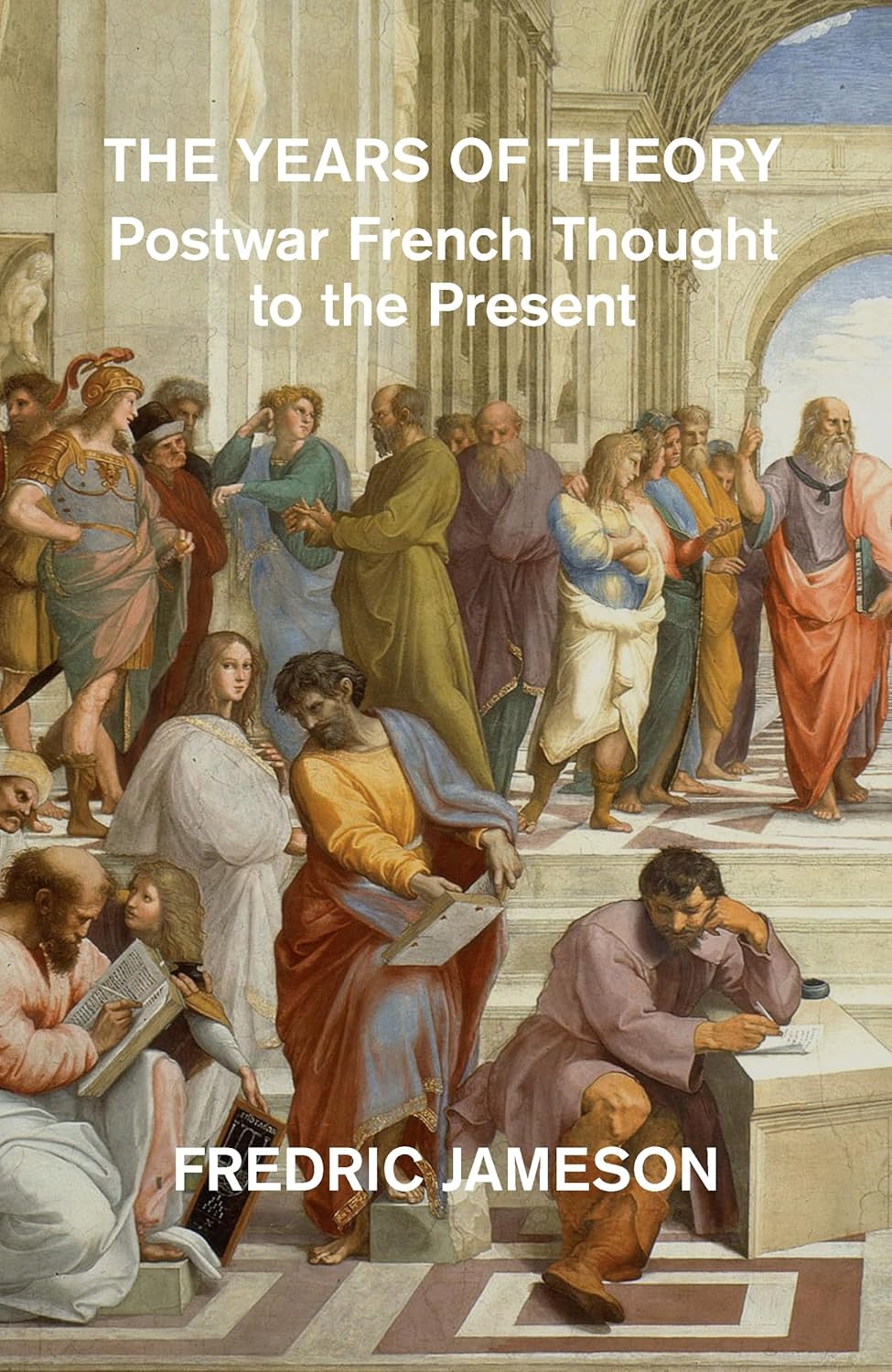
Who was Fredric Jameson? What were the years of Theory? Jameson died last year, leaving behind a thick and rich legacy of, well, Theory. Already in advance, the title of this book of lectures seems to anticipate the possibility that Theory may also be terminal. Has the moment of Theory then passed?
Jameson will be remembered most of all for that brilliant essay published first in New Left Review, this then expanded dramatically as Postmodernism, or, The Cultural Logic of Late Capitalism in 1991. It was and remains a classic, all suggested by the or. Earlier works by Jameson range from those on Sartre, Wyndham Lewis, Adorno, Brecht, later on to Hegel, Marx, Chandler, Benjamin; structuralism, formalism, utopia, and many other things. Theory; literature; but also history, and modernism, and modernity. Capitalism, even. Base, and superstructure. Big reach.
What was Theory? The thing about Theory, if I may be so bold, is that its proclivity for the abstract meant that text would frequently eclipse context. All the world’s a stage? No, all the world is text. Little space for capitalism there; room only for the eloquence of the seminar, the speaking of tongues by the self-elect, the usually male priesthood. Jameson, meanwhile, was in another room.
Jameson was always above this. What made the Postmodernity materials so fruitful was their combination of hard and novel thinking with a plurality of contemporary cultural forms: culture, ideology – ouch! prematurely buried – video, architecture, reading, economics, film, and so on.
Jameson was sufficiently historicist to understand that all these ideas – all these phenomena – had their own historicity. The problem with postmodern was that it was also posthistoire.
Neither good nor bad ideas fall from the sky. But there does seem to be something going on in post-war academic times reminiscent of what irked Marx rather earlier in The German Ideology; a kind of idealism in which ideas become inflated and detached from any putative connections to anything that might be called upon to signify the real. The French Ideology?
So now Jameson is gone, and there is that tail rich and long, and final instalments such as the book under review. This book is a treat, a fly on the wall experience, and it may be the case that the book serves best both as a curio for those in the know and as a possible introduction to those who have recently arrived, in search of Theory. Watching Jameson think, in this minimally edited text, is a fascinating intellectual opportunity.
Jameson inhabited several worlds, but the two central places for him can be reduced by way of image to the world of ideas in Paris, and the world of the North American Academy. As Jameson suggests, the two were mutually constitutive. French theory was vitally mediated via individuals at places like Yale and later Duke. French theory, and Theory was mainly French, was received via its American interlocutors, publicists and representatives. This meant that it was not always recognizable to the French. Yikes. Or, merde! French theory is the American version of French. French, as received, and commodified through the celebrity system. French theory, as Jameson’s editorial collaborator Carson Welch here says, is an American invention. Back to school, or back to the drawing board.
Let’s take note of some of these labyrinths. Twenty four chapters, or lectures, originally delivered online at Duke in the Spring of 2021, COVID time. Zoom time. A world apart from those blockbuster lectures delivered at the College de France by Foucault, standing room only. A list, incomplete: Sartre; Merleau-Ponty, Beauvoir, Fanon; Saussure, Levi-Strauss; Barthes, Baudrillard, Lacan, Althusser, Derrida; Wittig, Irigaray, Kristeva; Deleuze, Ranciere, Debord, Baudrillard, Latour; all this book ended by a list of others, TBA, left outside the door, including Bataille, Blanchot, Bachelard, Serres, Certeau, and so on … Camus! Clearly this is a tour de force.
And there are other, so to say, spectral figures who sneak into Jameson’s mind, and thence into his lecture hall. Henri Lefebvre, for example, that magical thinker of Marxism, philosophy, everyday life and the prelude to Situationism; teacher of Baudrillard, for better or worse. You can hear Jameson’s brain about to explode with everything that is in it, all that is connected, all the laterals which can come to you on a good day, in the classroom if you are teaching this kind of stuff.
Jameson knows he is leading some kind of Cook’s Tour, a brief stop here and there, a gesture at a trace of understanding, a whetting of the appetite. Thus speaks the pedagogue: ‘the point of understanding a philosophical concept is not first and foremost simply to agree or disagree with it … ’ (2024, 59). For truth and historicity, and falsity are both all mixed up together.
All this is given coherence by what Jameson himself calls an autobiographical impulse. This is revealed in what he claims is the apparent unity of all things French, or maybe French American. As Jameson puts it, ‘ anyone who has not lived through this period will not be able to understand how one can provisionally adhere with a certain passion to all of them in turn, without abjuring the Marxism with which they were all in dialogue … ‘ (2024, 4). The big bang for the young Jameson was Sartre, and the efflorescence of non-Party Marxism, including Trotskyism and Maoism in Paris, and its endless refractions through Socialisme ou Barbarie and the Althusserians and their groupuscules. Maoism, as Jameson understands, also had little to do with China, as the abstract conception had little to do the actually existing Cultural Revolution. Marxism, indeed seemed to be everywhere in this intellectual universe, along with existentialism, then structuralism and feminism, until the turn against progressive or radical thinking associated with the New Philosophy. Western Marxism kind of ruled, until this point, Marxist, marxisant, all under the influence somehow. Poststructuralism does not really count, here, as the French regarded it as another American invention. Then Marxism is under attack or eclipsed, and there is a discernible return to academic specialization and the general aesthetization of theory and politics.
This is a busy book. Watch Jameson think out loud:
Context: ‘We might think of the 60’s, first of all, from an American perspective, where the two major domestic political events, which are conjoined, are the civil rights movement and the expansion of the university system … ’ (2024, 211); student revolution, in their own minds at least; connecting to China, cultural revolution, Red Guards. Text: this may be connected to the ‘linguistic terrorism’ of the Althusserians; Mao’s texts ‘On Contradiction’ and ‘On Practice’ connecting directly to the Althusserian canon, even as Althusser’s key text becomes Reading Capital (not reading capitalism); ‘it’s like Lenin and the New Criticism were combined here’ and the invisible is Gramsci, too humanist and too Italian for the French. Yet as Roberts (1994) observed years ago in Reconstructing Theory: the key foundational thinkers for the French were German – Hegel, and Heidegger; and for the Germans of Frankfurt, and especially Habermas, the key inspirational sources were in France, in the practical project of the enlighteners itself.
The paradoxes remain. As these ideas become dispersed, and globalized, what is the proper object of our curiosities? What might this tell us about Theory? What might it tell us about the French? What does it tell us about the Americans? What happened to the Germans, and what about all the rich streams of thinking that persist and transmute outside the global power trio of France, Germany and the Anglos? What does it tell us about ourselves?
So many questions. If you might be given to further considerations on western Marxism and the moment of Theory, Jameson’s generosity of spirit and openness of mind will be of help. For further reading, see Perry Anderson’s eulogy for Jameson in New Left Review 149, 2024, and the attendant novella by Jameson on the Iliad (Anderson 2024) in that issue, and to see Jameson in a different voice; and try Philipp Felsch, The Summer of Theory (Felsch 2022). After theory, we will still need to be puzzling over theory, practice, and at least working towards the impulse of changing the world. Some things don’t change so much, even when they do.
References
Anderson, P. (2024) “Fredric Jameson.” New Left Review 149.
Felsch, P. (2022) The Summer of Theory. Cambridge: Polity.
Roberts, D. (1994) Reconstructing Theory. Melbourne: Melbourne University Press.


