Onur Erdur, School of the South: The Colonial Roots of French Theory. Trans. Andrew Brown (Polity, 2026)
Reviewed by John Lechte
(This is a prepublication version of this review. You can find the published version in Thesis Eleven Journal, on the T11 Sage website)
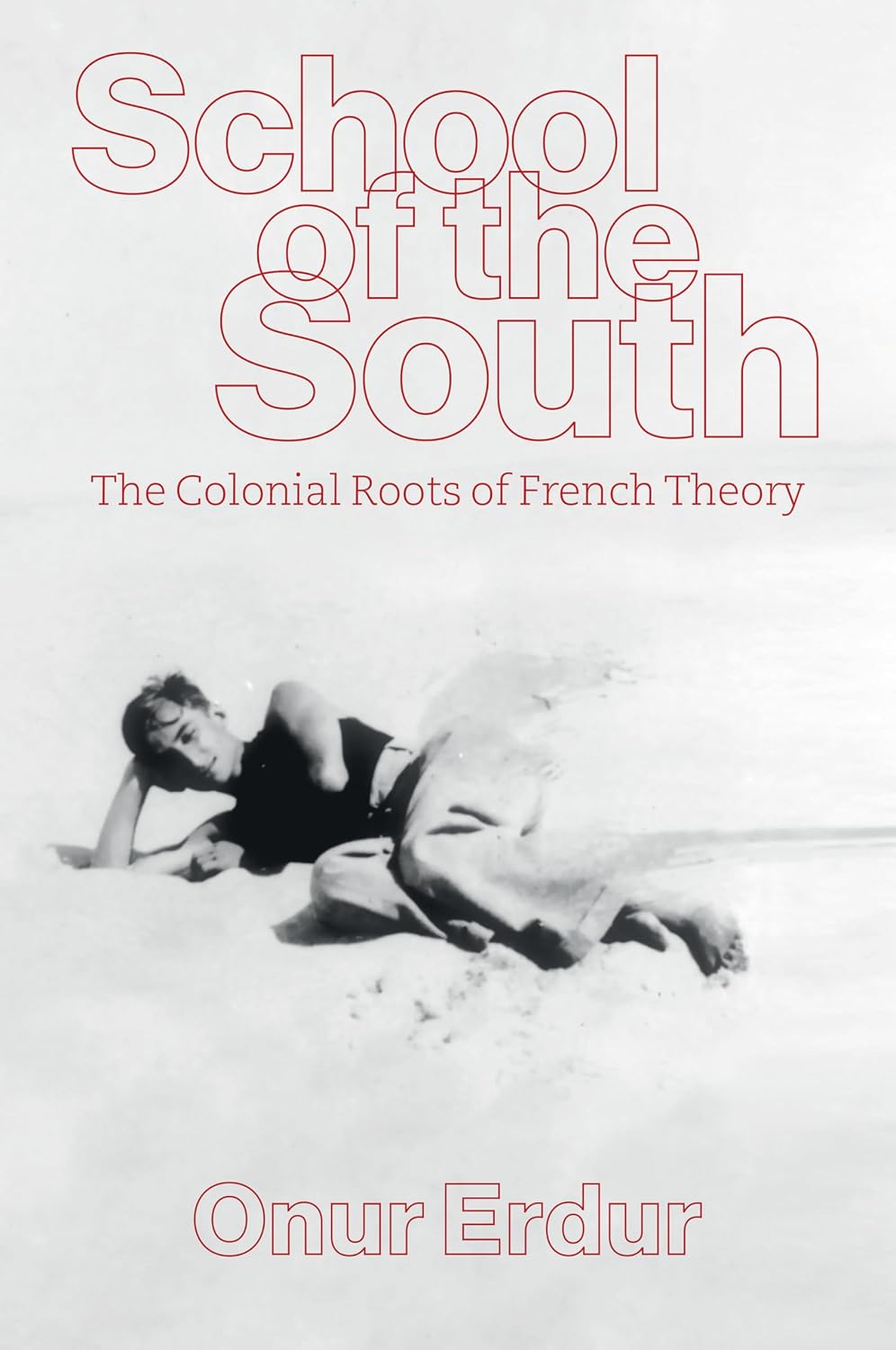
In an extremely engaging and illuminating work written with exemplary clarity, the following passages help to set the scene for understanding Onur Erdur’s aims in his book, School of the South: The Colonial Roots of French Theory: ‘how did the spatial experiences of colonial life affect [the members of French Theory’s] scholarly works and theoretical concepts?’ (2). Note here that French Theory refers not to the reception of the philosophy of structuralism or poststructuralism in France (or should we say, Paris?), but to the reception of the works of French thinkers in the United States from the 1970s to the first decade of the twenty-first century, at which point, it is argued things began to turn sour. That is, as Erdur explains in his concluding chapter, French Theory was blamed for everything from fake news to cancel culture and ‘wokeness’.
Erdur describes his overall approach as follows: ‘In these pages, I have tried to gauge the extent to which the historical effects of colonialism also extended to French Theory and its influential figures’ (214).
While there are unique ‘individual experiences’, Erdur shows how all members of the group called, ‘French Theory’ are touched – or not touched – by the colonial situation:
As different as these individual key experiences were in their significance for the writers’ respective lives, and to some extent in the ways they played out, they all testify to a deep need to link their own intellectual existence and its transformation to fateful moments in a foreign land.
216
Our author importantly draws attention to what he sees as: ‘The colonial amnesia in French society’ (219).
Finally, and in sum: ‘although a vast amount of literature on French philosophy has been produced in recent decades, not a single item has been devoted to the period of decolonization or the time spent by intellectuals in the former colonies’ (219).
Erdur’s book undoubtedly raises a range of important issues. First amongst these concerns the impact on intellectual life of the peculiarly French version of colonialism. Secondly, it engages with how particular emissaries of so-called French Theory related to colonialism and decolonization given that they were born in a colonised country (e.g. for the most part, in Algeria). Thirdly, and most prominently, the work under review endeavours to gauge the extent that the circumstances of colonialism and decolonization are imprinted on the theories and ideas of those purported to be the ‘influential figures’ of French Theory. As to the latter, the thinkers on whom Erdur focuses are as follows: Pierre Bourdieu; Jean-François Lyotard; Roland Barthes, Michel Foucault, Jacques Derrida, Hélène Cixous, Étienne Balibar, and Jacques Rancière. The alert reader will note that others, such as Albert Camus, Louis Althusser and Alain Badiou could have been the focus as they were born in both Algeria and Morocco. As our author muses:’ The only question is why this quite remarkable colonial setting of French thought has remained unnoticed for so long’ (2). The imposing question for the key players in this study concerns ‘how they should react to the political and cultural injustice of colonialism’ (3).
Theory, for Erdur, is linked to ‘lived experience’, but not in a deterministic way (4). Ideas, in short, do not arise in a vacuum. This, of course, is a key issue, the question being: how can a concern for the relation between concrete reality (biography) and theory not be deterministic? Although the author does not mention it, the work evokes the notorious ‘Heidegger question’ – that is, the relation between the content of Heidegger’s philosophical works and his Nazi connections. Indeed, the example of Heidegger’s philosophy and the extent to which it ultimately reflects Heidegger’s politics has become a paradigm case, the majority view being that if there is a connection it is an extremely subtle one perhaps only detectable in very fine notions, such as ‘spirit’ (Derrida) or in the poem as myth (Lacoue-Labarthe).
Ironically, the very theoretical tools available to assess the relation between biography and text are those bequeathed by the members of French Theory itself. For it was French thinkers such as Barthes and Foucault who, in the 1960s, introduced the ‘death of the author’ principle whereby meaning no longer (if it ever did) resided in the author’s intentions (biography), but solely in the text itself. The text, then, can result in the absolute invisibility of the concrete.
For his part, Erdur’s approach is commendable in that crucial elements are provided of the background of each protagonist of the study along with an interpretation of relevant aspects of key works. This is done without a sense that there is a rigid causal relation between background and theory.
To appreciate what is at stake, we should however remind ourselves of the French colonial context as made manifest by the Algerian war of independence which began in 1954 and continued until 1962. What, in good part, made the fight for Algerian independence so intractable was the clash between, on the one hand, the right-wing OAS (Organisation de l’Armée Secrète, consisting of military officers and pieds-noirs (French settlers)) and the left-leaning FLN (Front de Libération Nationale). The OAS, towards the end to the war of independence (‘war’ being a notion denied by the French government), engaged in a terror campaign against the FLN and supporters of independence. Although Morocco (Roland Barthes’s preferred destination) and Tunisia (where Michel Foucault lived for a time) also figure in Erdur’s discussion, the Algerian situation is by far the most decisive when the response to colonialism is in focus.
The event that left its mark on more than one of the thinkers (Balibar and Rancière in particular) was that of 16 October 1961 when the French police, ‘carried out a massacre of Algerian demonstrators who had defied the curfew imposed on them. Hundreds of Algerians were killed; many of them were thrown into the Seine. On 8 February 1962, nine people died during a demonstration organized by the PCF against the fascist OAS terror’ (158).
Perhaps the clearest example of the impact of the colonial situation on a thinker is illustrated by the case of Pierre Bourdieu who, after an agrégation in philosophy, remained in Algeria after completing his military training and carried out research that endeavoured to reach an understanding of the whole of Algerian society, especially the indigenous populations of ‘Muslim Arabs, Berbers, and Kabyles’. The results of this research carried through to The Logic of Practice (1990), where Bourdieu acknowledges that his early works on Algeria (c.f.: Sociologie d’Algérie (1958)) ‘owe much to the emotional context in which they were written’ (1990: 2). Thus, the integration of an Algerian experience into his work arguably comes across more clearly for Bourdieu than for any of the other members of the ‘school of the south’.
Although seduced by the beauty of the Algerian city of Constantine, where he taught, Jean-François Lyotard – philosopher of postmodernity – could not, it is said, have ignored ‘the bloody events of 8 May 1945 when tens of thousands of people were killed by French troops and colonialists following demonstrations for greater self-determination in Sétif and other Algerian cities’ (43). The local population were, despite the promise, continually excluded from being inducted into French culture. In fact, the vast majority of students in Lyotard’s philosophy classes were ‘European’ not ‘Muslim’. The illiteracy rate among the younger Algerian population was higher in 1950 than it was in 1830, the date of the beginning of French colonial rule.
For Socialisme ou Barbarie (both journal and a movement against Stalinism – key members being: Claude Lefort and Cornelius Castoriadis), Lyotard is commissioned to write articles on Algeria. The question is: how many facts are needed to show the influence on theory – in Lyotard’s case, on the thesis of the postmodern as an ‘incredulity toward meta-narratives’ ? So, what are the conclusions that Erdur draws from this?
The first is that Lyotard’s teaching experience in Algeria led, on his return to Paris in 1952, to his political activism as a ‘suitcase carrier’ of cash in support of the Algerian liberation movement. Prioritising activism contributed to the delay in the publication of the philosopher’s first major book at the age of 46 – Discours figure (1971). And the famous Condition postmoderne was not published until 1979 when its author was 55 years old.
Secondly, according to Erdur, the rudiments of the postmodern as an incredulity toward metanarratives first arose for Lyotard in light of the fact that French culture in Algeria had long lost its credibility. For, as noted, the local population was excluded, not integrated, into French culture. Remarks by Lyotard himself tended to support this view.
As regards Roland Barthes’s encounter with Morocco, the situation was different to that of Lyotard. Barthes, like Foucault in Tunis, primarily frequented Casablanca for rest and recreation; the politics of colonialism was thus a distant echo.
On the other hand, it is argued that an experience of otherness is needed to provoke ‘moments of awakening’ (59). In this regard, the ‘epiphany’ of preparing to write a novel comes to Barthes in Morocco. ‘Preparing to write – a novel’ includes consideration of context and all material aspects. Erdur’s point is that ‘thinking is relocated to a context-free, ahistorical space. The only really tangible context is actually the place where the experience is reflected upon, written down, presented, published, and finally celebrated: Paris’ (62).
In recent times, sexual exploitation has emerged as an issue. Was Barthes guilty of this? Erdur: ‘Neo-colonial exploitation, prostitution, sexism, chauvinism, “othering”, Orientalism – there is no doubt about the validity of these criticisms. They enable a long-overdue problematization of Barthes’s stay in Morocco and his corresponding writings’ (69). But there is also the ‘death of the author’ principle and Mythologies – written in the 1950s – a text that deals with colonialism, even if various translations (e.g. the German) only presented, in the first instance, an abridged version of the articles that make up the book.
Michel Foucault, for his part, while in Tunisia in the picturesque village of Sidi Bou Said does not draw attention to colonialism. The influence of Tunisia on Foucault’s writing (e.g. Archaeology of Knowledge) is difficult to discern. ‘Heterotopias’ is also written in Sidi Bou Said but contains no index of the context of its production. As Erdur indicates: ‘In Sidi Bou Said [Foucault] frequently dealt with the accusation previously levelled against him that his work was too structuralist and too unpolitical’ (92). It is, at best, only in retrospect, after his return to Paris in 1968, that the more familiar figure of the politically charged Foucault arises.
It would appear then that Barthes and Foucault represent those for whom the experience of the colonial situation left little or no explicit trace in their theoretical work.
With Jacques Derrida, on the other hand, we have, in the eyes of the author of this study, a case worthy of particular attention because it is from his philosophy that the key term, ‘deconstruction’ arises – the term that certain critics have latched onto when looking with derision at French Theory. But as Erdur explains: ‘Derrida was thus confronted with a double identity problem: on the one hand, the loss of French identity and exclusion from its cultural community, and on the other, the reluctance to accept an alternative constructed identity imposed from outside’ (108). Moreover:
The Algerian genealogy does not explain everything. But it does make it clear how strongly Derrida’s life and work were influenced by this reference to an ‘other’, by the name of Algeria, and that the personal experience of the demand for identity and the philosophical production of difference are by no means mutually exclusive, but rather overlap. In the best case, this genealogy brings human experience so close to the theoretical domain that one can better understand both.
111
Born in El Biar, a suburb of Algiers, Derrida experienced what he called an ‘earthquake’ in his life. In 1940, the French Vichy regime – without German prompting – revoked French citizenship for all Jews. Then, as a Jewish student, he ‘was expelled from the Lycée Ben Aknoun on the first day of school in 1942 and sent home – a shocking moment in his life’. For Erdur, these events find a reverberation in the philosopher’s quasi-biographical text, The Monolingualism of the Other; or, The Prothesis of Origin (1998). And, indeed, the ‘facts of the case’ are recounted in the aforementioned text only to be progressively problematised by the notion that, in the colonial situation, the language in which one ‘is at home’ is the language of the other. But then a putative biographical narrative gives rise to a certain ‘deconstruction’ of origin. So, on one level, Erdur appears to be correct: the facts of the colonial situation play a role in inaugurating Derrida’s deconstructive philosophy, while, for the philosopher himself, it becomes impossible to determine the exact nature and significance of these ‘facts’. In this sense the latter constitute a ‘prosthesis of origin’. To invoke Derrida’s turn of phrase, the biographical data do, and also do not, explain the philosopher’s later intellectual trajectory.
In the case of the theorist of feminine writing, Hélène Cixous, the influence of her Algerian, Jewish background seems straight forward. As Erdur explains:
Cixous herself has made her Algerian origins a crucial theme in her work. Indeed, origin and identity are the starting point for her endeavour to put her own life into writing. She emphasizes that everything that moves her and preoccupies her, including her writing, can be traced back ‘to the gates of Oran’ [Algerian coastal city].
127
The key event in Cixous’s family history of ‘two worlds’ was that ‘being thrown out of the Cercle militaire’ when – as mentioned in relation to Derrida – Jews had their citizenship revoked in 1940. The Cercle militaire was an exclusive garden reserved for officers and their relatives. The expulsion ‘became’, for Cixous, ‘the catalyst for a constant reflection on what she had experienced, a way of processing it in her memories’ (133), ‘transforming what has been experienced into literature and theory’ (134).
Cixous’s and Derrida’s experiences of injustice, for Erdur, become remarkably similar: ‘A remarkable constellation like this is rarely encountered with such intensity in the history of philosophy. It becomes even more remarkable when one realizes that the two central figures of deconstruction both had Jewish-Algerian roots’ (137).
For Étienne Balibar, the infamous day of 19 December 1961 becomes a crucial date in his biography. On that day of protest against de Gaulle’s Algerian policy, Balibar landed in hospital, victim of ‘state-condoned violence and everyday racism towards the Algerian population’ (156). This event, Erdur proposes, largely contributed to Balibar’s defiant and on-going anti-racist stance both while a member of the French Communist party and after his expulsion, that latter being due to his criticism of the party’s racism, a racism that was clearly manifest in the notorious bulldozing of a dormitory occupied by workers from Mali by the communist mayor of the Vitry-sur-Seine working-class commune, 7.5 kilometres south east of Paris.
With Jacques Rancière, Erdur acknowledges that the situation as regards colonial influence is not clear-cut. For, although born in Algeria, the theorist came to France at that age of two years. It is thus problematic as to whether his key concept of ‘disidentification’ owes anything to an Algerian origin.
In his Conclusion, Erdur is careful to point out that, although the sun seems to be setting on the movement, the populist and simplistic characterisations of ‘French Theory’ as the cause of relativism, cancel culture, wokeness and other ills should be rejected.
Finally, whatever one might conclude regarding the relation between biography and theory in the chosen case-studies – the question being: is biography determinate, or not? – the great merit of Erdur’s study is that it forcefully reminds us of the sorry history of French colonialism in Algeria, a history that has indeed been pushed into the shadows, not only by conservatives, but also by those who would see themselves as being ‘left of centre’.
References
Bourdieu P (1958) Sociologie d’Algérie. Paris: PUF.
Bourdieu P (1990) The Logic of Practice. Trans. Richard Nice. Cambridge: Polity Press.
Derrida J (1998) Monolingualism of the Other; or, The Prothesis of Origin. Trans. Patrick Mensah. Stanford: Stanford University Press.
Lyotard J-F (1971) Discours figure. Paris: Klincksieck. Lyotard J-F (1979) La Condition postmoderne. Rapport sur le savoir. Paris: Minuit


