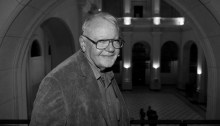
Fredric Jameson 1934-2024
by Andrew Milner
Fredric Jameson died on 22 September 2024, aged 90, at his home in Killingworth, Connecticut.
by Andrew Milner
Fredric Jameson died on 22 September 2024, aged 90, at his home in Killingworth, Connecticut.
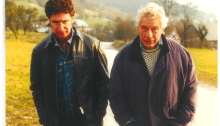
I once met Edward Said early on in my Phd candidature. I told him about my research and he extolled the virtues of John Berger, but then added: “Whatever you do, just don’t go to visit him there. There are pigs and shit everywhere.” I said, “it sounds like my father’s village.” It was not a turn off to me. Once I got there, I didn’t see any pigs. The pig sty was empty. It later became a storeroom for all the books that John published. John, himself did not even keep copies of his books.
by Peter Beilharz
Transatlantic bluesman John Mayall died in California July 24 2024. He was ninety.
What’s the fuss? The record is well enough known. Mayall was a player, musical organiser, entrepreneur and publicist for blues music over six decades. He was champion of JB Lenoir, Sonny Boy Williamson 2, and Elmore James, all of whom he wrote songs for; the Kings, especially Albert and Freddie; Otis Rush and Spann. He was the platform provider for a bevy of brilliant guitar talent, Clapton, Green, Taylor, later Mandel, Trout etc. etc
by John Lechte
This year, 2024, marks the 50th anniversary of the original French edition Julia Kristeva’s epoch-making volume, La Révolution du langage poétique. L’avant-garde à la fin du XIXe siècle: Lautréamont et Mallarmé (1974) (Revolution in Poetic Language. The Avant-Garde at the End of the XIXth Century: Lauréamont and Mallarmé). The work was originally defended in 1973 in Paris as a doctorat d’état ès lettres. On the panel were Jean-Claude Chevalier (supervisor), Henri Lefèbvre, Pierre Albouy and Roland Barthes. The thesis was awarded the highest honour: mention très bien avec félicitations du jury.
by Peter Beilharz
Ian North was a major shaker in the Australian art world. Not that you would guess on meeting him – mild mannered, soft in style, a gentle man who could nevertheless change the way you saw the world with a wink, a raised eyebrow or a single phrase. His personal style was minimal, and this helped make him lovable as well as determined.
by David Roberts
Peter Beilharz captures this ongoing process of exchange, fed by the flow of people, goods, capital and ideas between the old and the new worlds, between metropolitan centre and open frontier in terms of cultural traffic. Cultural traffic in turn can be understood both in the direct and wider sense as translation. As the act of relocation, transformation and recreation, translation epitomizes the idea of supplementarity and in turn the question of identity. In the following, I shall be thinking with and against Peter’s thinking of the Antipodes with the idea of translation in mind.
by Julian Potter
Thirty years separate Peter and Zygmunt, another thirty separate myself and Peter. These are generational spans, time enough for considerable changes that challenge traditions. Through my story, I would like to suggest that the refounding of intellectual traditions on friendship, instead of, and sometimes in spite of institutions, or enframed goals such as politics, is one of Peter’s gifts to his postmodern students and those who have met him along the way. Another is the vital question for scholarly endeavour: ‘Is it interesting?’ And for me, the love of books.
by Margaret Somers
I fell in love with Peter the first time I met him, at an American Sociological Meeting, sometime in the late 1980s, I think. This was, of course, love Beilharzian-style – not the amorous variety but an intimacy of shared political intellectual practice. The ASA was a fitting place to meet as it was one of Peter’s most fertile sites for his Beilharzian love assignations.
Review Essay: The Posthumous Bauman
By Matt Dawson
2023 saw six new books by, and about Zygmunt Bauman published. 6 years after his death, these texts were part of an emerging body of literature we may call The Posthumous Bauman. I explore the key lessons this literature has offered and suggest there are four key themes: our increased knowledge of Bauman’s life and its link, or not, to his sociology; the role of the hinterland for the sociologist; the increased interest in Bauman’s lifelong sociological project before he came to Leeds; and the differing receptions of Bauman’s work.
by Howard Prosser
This is a tale of friendship. Or, more accurately, it’s a reflection on how a friendship based on a few meetings can amount to a lot. I am sure many of us have had a version of this experience. The friendships made during a stint living elsewhere. Or those incidental meetings and interactions with someone at infrequent events which, though it never quite blossoms into something more, we can still define as friendship.