by Howard Prosser
The return of Marx has not been the return of Marxism. No longer anchored solely to the political inheritances of the twentieth century, his work now circulates through debates on climate breakdown, technological transformation, inequality, and the futures of capitalism itself. The reasons are not hard to find: the basic categories of Capital – commodity, value, money, the endless imperative of accumulation – seem to illuminate the present with a clarity that more recent frameworks struggle to match.
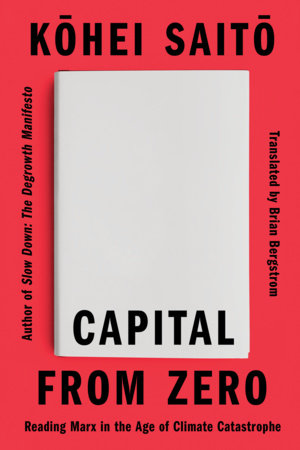
Few thinkers have contributed more to this renewed engagement than Kohei Saito, Associate Professor of Philosophy at the University of Tokyo, whose previous book Slow Down sold over half a million copies in Japan and carried ecosocialist ideas well beyond the academy. His Capital from Zero, now available in English, began as the companion text to a television series. It is at once a rigorous return to Marx’s core categories and an original intervention in debates on ecology, the commons, and digital capitalism. In the conversation that follows – conducted in May 2026 – Saito discusses Marx’s contemporary afterlives, the problem of growth, the intensification of reification under digital capitalism, and where critical thought might turn from here.
Howard Prosser: Contemporary diagnoses – polycrisis, Anthropocene, late capitalism – accumulate without necessarily clarifying. Your return to Marx in Capital from Zero suggests a different level of explanation. What does Marx’s critique make intelligible about the present that these frameworks leave obscure?
Kohei Saito: Today it is beyond dispute that our civilisation faces a profound crisis. It is at once economic, political, ecological and civilisational. Thus, the concept of “polycrisis” is useful insofar as they register the simultaneity and interconnection of these disturbances. Adam Tooze’s (2022) formulation, for example, rightly draws attention to the way in which one crisis sets off another, producing feedback loops that leave us increasingly overwhelmed.
The limitation, however, is that such diagnoses often remain descriptive. They only juxtapose various crises, or bundle them together, without providing a structural account of the socio-economic system that generates them. Tooze starts with the existence of crises without investigating how they are produced as the structural crisis of capitalism. This is where Marx remains indispensable. A Marxian approach insists that the polycrisis is not simply the accidental convergence of separate problems. It is the accumulated result of capitalism’s structural contradictions and of its increasingly unrestrained expansion. Any adequate account of crisis today must therefore place at its centre the limits of a system driven by the imperative of endless valorisation.
The same point applies to the concept of the Anthropocene. I continue to use the term in my books because it is now a broadly accepted scientific concept. But the category of the Anthropocene can easily obscure responsibility by presenting ecological destruction as the work of humanity as such. It risks suggesting that productive capacities, consumption and responsibility are equally distributed across the human species. Capitalism is deeply characterized by various forms of inequality. This is why Jason W. Moore’s term “Capitalocene” remains important: it reminds us that the reified power of capital is central to the ecological crisis (Moore 2015).
In this sense, capitalism has to be placed at the centre of analysis. But here is another problem. Many people assume that Marx is outdated because he wrote in the nineteenth century. Marx’s analysis must be contained to liberal capitalism, and late, financial or digital capitalism requires a fundamentally different theoretical framework. I strongly disagree. What Marx offers are the basic categories and economic forms – commodity, money, value and capital – that are necessary for understanding any capitalism as capitalism. Of course, Marx did not anticipate everything about our present. But it is wrong to dismiss his value theory simply because contemporary phenomena appear very different from those of his time. The task is to explain the divergence between “essence” and “appearance” as he did in volume III of Capital, rather than to abandon the analysis of essence altogether.
Prosser: Staying with that question of capitalism’s underlying dynamics, early in the book you show how everyday life becomes organised around the need to work, earn, and consume once shared forms of wealth are enclosed. How should we understand this condition today? To what extent is capitalism sustained through forms of lived necessity embedded in everyday life, and what role, if any, does ideology still play?
Saito: Traditional Marxism was only concerned with revealing exploitation of the working class and with demonstrating the necessity of economic crisis in order to justify both the moral legitimacy and the historical inevitability of socialist revolution. This approach is no longer valid. In this context, the Neue Marx-Lektüre, represented by thinkers such as Michael Heinrich, Ingo Elbe, and Jan Hoff, has made an important contribution by showing that Marx’s critique of political economy is also a critical investigation of economic forms themselves (Heinrich 2012; Elbe 2010; Hoff 2017).
My work tries to push this insight one step further. Economic forms do not exist independently of everyday practices: extraction, production, exchange, consumption and investment. Yet Marx’s point is that these forms, through their constant reproduction by human beings, become increasingly independent of them and come to exercise power over them. This is what Marx called “reification.”
Put simply, reification names the inversion between human beings and things, or between subject and object. Marx famously described reification as a situation in which social relations between people assume the form of relations between things. It is important, however, to distinguish reification from ideology or fetish. Reification is not simply false consciousness or misrecognition of the reality. Even if I am an anti-capitalist and understand Capital very well, I still have to earn money and act according to economic rationality of capitalist society. Otherwise I go bankrupt and cannot continue even my socialist activities. Capitalist social forms therefore shape our subjectivity from within, no matter what your political standpoint is. The world is really inverted. As a consequence, we even come to believe that the current economic order is natural. This produces “fetish.”
According to Marx, it is not enough to say that something is a fetish, as if naming its historical and social construction would dissolve its power. Marx’s deeper insight is that reification reorganises the material world itself. It penetrates beyond the workplace and into daily life. Our consciousness, desire, imagination and forms of reasoning are increasingly governed and modified by the reified power of capital. Georg Lukács captured this point in History and Class Consciousness when he argued that even the “soul” is subsumed by capital: “The more deeply reification penetrates into the soul of the man who sells his achievement as a commodity the more deceptive appearances are” (Lukács 1971: 172).
Ideology, then, is not something we can dispel simply by exposing it as ideology. It is deeply rooted in the organisation of daily life and in the social system as a whole. Furthermore, reification is not limited to exploitation in the factory. Even capitalists are victims of reification, although in a very different position from workers. It also penetrates the household, school, politics, digital communication and urban space. Correspondingly, the sites of contestation cannot be restricted to the factory alone. They must include the whole terrain of life under capitalism, which requires to abandon the centrality of the proletariat and to engage with ecological, feminist and decolonial movements.
Prosser: One of the distinctive moves in your reading is to expand this analysis beyond the social sphere alone. You draw on Marx’s idea of metabolism – the material exchange between humans and nature – to reframe the critique of capitalism. Does this shift displace the traditional emphasis on class, or deepen it by situating class struggle within a broader ecological contradiction?
Saito: The concept of metabolism deepens the critique of class by placing it within a wider material and ecological relation. It brings the material dimension of Marx’s thought back into focus. The German term Stoffwechsel contains Stoff, or matter, and in nineteenth-century physiology it referred to the biophysical processes through which living organisms interact with their environment. Marx’s Capital defined labor as the conscious and purposeful activity through which human beings mediate, regulate and control their metabolism with nature. Despite the centrality of labour in Marxism, this concept of metabolism has often received surprisingly little attention
Traditional Marxism tended to focus almost exclusively on the exploitation of workers. That focus remains essential, but it is too narrow if isolated from nature. The concept of metabolism concerns human beings, nature and the relation between them. When nature is neglected, Marxism easily falls into a productivist tendency to dominate nature and to marginalise ecological crisis.
Once metabolism is placed at the centre of analysis, it becomes clear that capitalism radically reorganizes and transforms material world through the real and formal subsumption of the labor process. Labor process is increasingly subordinated to the extraction of abstract labor in accordance with the imperative of capital valorization. This process of subsumption under capital ignores the complex biophysical processes of human-nature metabolism and inevitably disrupts them over the long run. The resulting “metabolic rift” appears not only as the exhaustion of workers’ labour power, but also as soil depletion, deforestation, resource exhaustion and climate breakdown.
At the same time, the concept of metabolism also shows that Marx was not interested only in the analysis of economic forms. Rather, Marx thought it essential to deal with the dialectic of form and matter. In other words, he was concerned with the way reified economic forms transform the actual material process of human metabolism with nature. While much of the Neue Marx-Lektüre focuses on economic form, my approach, drawing also on the Japanese Marxist tradition of Samezō Kuruma, Teinosuke Ōtani and Tomonaga Tairako, stresses the dynamic relation between form and matter. This is crucial because, especially in his later years, Marx turned more seriously to the natural sciences and moved toward increasingly ecosocialist insights.
Late Marx became convinced that capitalism cannot repair the metabolic rift and that a transition to socialism is necessary. But this does not mean that a socialist society automatically becomes sustainable once workers gain control over the means of production. Human-nature metabolism is a transhistorical material process; it exists under all social forms. Even in socialism, overproduction and overconsumption would disrupt metabolic cycles. If the central task of socialism is to repair the metabolic rift, it must address both the corporeal rift of human beings and the biophysical disruption of nature. This cannot be a productivist project, so I disagree with ecomodernists like Matt Huber (2023).
As Marx’s thought became less productivist, he paid increasing attention to peasants and Indigenous communities. This was not only because the contradictions of capitalism appear most brutally at its peripheries, but also because he recognized that the vision of ecosocialism does not emerge from the industrial working class alone. Unfortunately, Marx did not provide a name for the new political subjectivity of ecosocialism. Concepts such as “environmentalism of the poor” (Joan Martinez Alier) or the “environmental proletariat” (John Bellamy Foster) help name a broader political subject capable of struggling for ecosocialism in the midst of the global ecological crisis (Martínez Alier 2002; Foster 2002).
Prosser: Questions of growth and ecological limits run through much of your work. Degrowth has been one of your concerns, but as a popular concept it often oscillates between structural critique and normative appeal. In Capital from Zero, you also describe a society driven by the endless expansion of value, in which time itself is organised around productivity and cost-performance. How do you hold together critique and horizon here? And do you see resisting this acceleration – whether in everyday life or intellectual work – as a meaningful counter to capitalist temporality or something that risks being absorbed within it?
Saito: Degrowth certainly contains both a structural critique and a normative horizon. I think this is strength rather than weakness. Earlier forms of degrowth sometimes overemphasized the good life in small local communities. That is important, but it remains insufficiently systemic. There is also ambiguity as if capitalism could be tamed into degrowth, so it is not necessary to fundamentally challenge private property and the market. In contrast, I introduced the term “degrowth communism” because Marx’s critique of capitalism provides a stronger structural framework against capitalism. Capitalism, as a system of endless expansion, is fully incompatible with degrowth.
Some ecosocialists are critical of degrowth, and they continue to believe that socialising the means of production would be sufficient to establish a green economy. I think this is mistaken. Economic growth in socialism will not be sustainable after a certain point. This is because economic growth has historically been tightly coupled with rising energy and resource use. Socialism itself can therefore become destructive when it is conceived in productivist terms. Degrowth is necessary for ecosocialism. We can debate whether Marx himself became a degrowth communist in the end, but the convergence of socialism and degrowth is becoming increasingly unavoidable amid ecological breakdown.
At the same time, resisting acceleration at the level of personal lifestyle is not enough. Hartmut Rosa’s work can sometimes give the impression that practices such as yoga or spiritual forms of deceleration already point toward an alternative to capitalist temporality (see Rosa 2013). From a Marxian standpoint, that is insufficient, because it reduces resistance to individual endeavour and consumption. Such practices can easily be absorbed by capitalism as new lifestyle commodities.
The real difficulty is that ecosocialist degrowth still appears utopian. It is easier, as people often say, to imagine an end of the world than an end of capitalism. Unlike democratic socialism, degrowth has hardly any institutional or party-political representation. In Japan, too, the political horizon is extremely narrow. This is partly because the traditional model of revolution, in which the proletariat seizes state power, is no longer adequate. In fact, reification penetrates the whole social system, so it cannot be overcome simply by replacing private property with nationalisation. The failure of the Soviet Union showed that workers’ domination could be replaced by bureaucratic domination while the growth imperative remained intact.
For this reason, the transformation of capitalist society requires the restraint and partial suspension of reification. This is why Capital from Zero emphasizes the role of the commons. Marx himself moved away from the earlier expectation that economic crisis alone would automatically produce socialist revolution. After repeated disappointments in the 1840s and 1850s, he increasingly stressed reforms such as the shortening of the working day and public vocational education. These were not merely moderate reforms, however. They created the material conditions for collective self-transformation.
Higher wages are necessary, but Marx did not believe that higher wages alone challenge the reified power of money and commodities; they can even deepen dependence on them. By contrast, the collective reduction of working time increases free time and weakens the domination of value over life. André Gorz (1980) later called this “revolutionary reformism”. I understand the rehabilitation of commons as an attempt to generalize revolutionary reformism in a period when immediate social overthrow is not on the horizon. Commons in capitalism create a space independently of the logic of capital accumulation and market competition and replace them with caring and mutual aid.
Prosser: Related to that, your discussion of reification raises interesting questions about digital capitalism. If reification names a condition where social relations appear as relations between things, what happens when those “things” are increasingly immaterial – data, algorithms, predictive systems? Does this intensify reification or alter its form?
Saito: First of all, digital capitalism is not immaterial at all. Semiconductors require rare metals. Data centers are also full of metals, cables and cooling systems, and they consume enormous amounts of energy and water. AI intensifies this tendency even more. This is why the United States and other countries are rapidly investing in new power generation, including nuclear power. The apparent immateriality of data rests on a very material infrastructure of extraction, energy and labor, exacerbating climate breakdown.
What decisively changes in today’s capitalism is the form in which reification operates. Algorithms, platforms and predictive systems present themselves as neutral technical objects, but they embody social relations of property, monopoly and rent extraction. They do not merely mediate social life; they increasingly organise it. They shape visibility, attention, desire and even political affect. In this sense, digital capitalism intensifies reification by making the domination of capital appear as the objective functioning of technical systems. Following Étienne Balibar (2019), we can call it “total subsumption” of life.
This does not mean, however, that there is no space of resistance against capital. From a broader historical perspective, the present crisis of capitalism may be even more serious than the crises of capitalism in the twentieth century. The earlier crisis occurred during an interregnum of capital accumulation, namely the transition from the Britain-coal regime to the United States-oil regime. Today we are experiencing another interregnum, this time marked by the decline of the United States-oil accumulation regime. Yet what lies beyond it is unlikely to be a new stable regime of accumulation.
For the past half century, capitalism has struggled with stagnation. It has muddled through by means of post-Fordism, financialisation and neoliberal restructuring. These strategies are now reaching their limits. Under these conditions, capital appears to be moving less toward a new regime of accumulation than toward a regime of dispossession: rentier capitalism. This means enclosing monopolizable commons, especially those whose reproduction cannot be secured in the short term, and extracting structurally guaranteed excess profits from them. The enclosure of the digital sphere by Big Tech must be understood in this context.
Contemporary capitalism is therefore increasingly centred on the dispossession of social wealth. Even if this transition succeeds, it is unlikely to produce stable social integration comparable to Fordism. On the contrary, crisis will persist. Since the source of profit in rent capitalism lies precisely in enclosing and exhausting the commons, economic, political and social instability are likely to intensify. This trajectory may culminate in what Sandro Mezzadra calls a “permanent state of war” (Mezzadra and Neilson 2024): The future will be characterized by instability and stagnation, which will certainly open up new sites of political contestation.
Prosser: This returns us to another theme that runs through the book: the fate of shared forms of wealth. Capitalism advances through successive enclosures of shared wealth, yet also seems to depend on commons such as knowledge and social cooperation. Does capital both require and undermine the commons?
Saito: Yes. Capital both requires the commons and undermines them. Capitalism often presents itself as a system that creates abundance through technological innovation. But it also creates artificial scarcity. This contradiction is central to understanding rent capitalism today.
The new frontier of enclosure is knowledge as commons. The problem with a rentier economy is not simply that it produces monopoly and widens inequality. The deeper problem, as Marx already saw in relation to ground rent, is that dispossession destroys the wealth of society as a whole. The source of rent lies in the monopolisation of powers that capital cannot itself produce. In the classical case of ground rent, this means land with favourable natural conditions. In the case of platforms, it is knowledge, communication, social cooperation and, above all, the data generated by our everyday lives.
What is being monopolised, then, is precisely something that should not be monopolised. Land, knowledge, culture, communication and ecological conditions are not freely producible by capital. They are commons, forms of shared wealth that belong to society as a whole. Indeed, the commons properly belongs to no one, because it is something everyone needs and that no one should destroy for private gain. Marx expressed this point clearly when he wrote in Capital:
From the standpoint of a higher socio economic formation, the private property of particular individuals in the earth will appear just as absurd as the private property of one man in other men. Even an entire society, a nation, or all simultaneously existing societies taken together, are not the owners of the earth. They are simply its possessors, its beneficiaries, and have to bequeath it in an improved state to succeeding generations, as boni patres familias (Marx 1981: 911).
Capitalism, however, exhausts the soil and depletes the land in pursuit of ground rent. This is why ground rent was, for Marx, a symbolic expression of capitalism’s irrationality. From the standpoint of humanity as a whole, the monopoly and destruction of the commons for private enrichment is utterly irrational.
Today, because growth is stagnating and the dispossession of social wealth is intensifying, the rent-seeking method of using up the commons for immediate profit is becoming generalised. Digital rent is even larger in scale and broader in scope than classical ground rent. The result is the anti-civilisational tendency of techno-capitalism: the intensification of enclosure, widening inequality, the plunder of social wealth and the destruction of both nature and society.
This is especially dangerous in an age of climate breakdown. As nature’s biocapacity shrinks and environmental regeneration can no longer keep pace with economic activity, the maintenance of the commons should become more important than ever. Yet techno-capitalism deliberately worsens scarcity by monopolising and destroying the very things necessary for our survival.
Prosser: There is also a question of mediation at the level of writing itself. Capital from Zero adopts a deliberately lucid, conversational style. How does this mode of writing intervene in the historical mediation of Marx and in the formation of new readers of political economy?
Saito: The lucid style is central to the project. Capital from Zero is an introductory book. Capital from Zero was originally written as the textbook for a Japanese television programme, 100 Minutes de Meicho, broadcast on NHK in January 2021. I then added two chapters for the book version, which was published in Japan in 2023. Like my previous book Slow Down, it reached a surprisingly broad audience and sold more than 150,000 copies.
Of course, there are many introductions to Marx in Japanese, and Ryuji Sasaki’s A New Introduction to Karl Marx: New Materialism, Critique of Political Economy, and the Concept of Metabolism is an important example with which my work shares several concerns (Sasaki 2021). But my aim was somewhat different: to create an entrance into Marx for readers who would never begin with the value-form theory or the reproduction schemes.
The popularity of the book may seem surprising, but post-war Japan has a strong tradition of Marxian economics. Although its influence has declined in recent decades, there are still many readers in their fifties and sixties who are not necessarily politically active but are familiar with Marxian and socialist ideas. I wanted to use that residual familiarity as a bridge to younger readers.
My own experience as a translator convinced me that a different approach was necessary. In 2014, I translated Michael Heinrich’s An Introduction to the Three Volumes of Karl Marx’s Capital. I also translated, with Ryuji Sasaki, Marcello Musto’s Marx Revival. Both are valuable works (Heinrich 2012; Musto 2020), but many Japanese readers found them too abstract. I became convinced that if we want to revive Marxist thought, especially among younger readers, we must connect Marx’s categories with the problems they already feel: overwork, precarity, climate anxiety, rent, debt and the exhaustion of everyday life.
This does not mean simplifying Marx in a bad sense. It means finding a better mediation. Many people already know that capitalism is wrong and that they are alienated. What they need is not another abstract declaration of that fact, but a way of naming and analysing what they experience every day. Television, radio and YouTube have given me opportunities to test how Marxian concepts can be explained in close relation to the contemporary world.
People sometimes say that I am lucky because my philological research on the Marx-Engels-Gesamtausgabe connects so directly to contemporary issues such as ecology and the rentier economy. But this is not a coincidence. I read Marx not because I am attached to Marx as an authority, but because his categories help us understand contemporary problems. For me, today’s political and social problems come first; Marx provides one of the most powerful frameworks for analysing them.
Prosser: That question of mediation perhaps opens onto a broader one about Marx’s contemporary afterlife. Your book contributes to a renewed reading of Marx beyond the certainties of “Marxism” as an -ism. At the same time, Marx now circulates as a fragmented cultural and political signifier – refracted through contemporary China, invoked in US politics as a kind of bogeyman, and returning within theory in more selective ways. How do you understand this afterlife? Does it create the conditions for a more precise engagement with Marx or further diffuse and neutralise his critique?
Saito: The afterlife of Marx is deeply ambivalent. On the one hand, Marx can easily become a cultural signifier, a scare word, or an academic reference detached from the radical force of his critique. On the other hand, the collapse of Marxism as a unified doctrine also allows us to return to Marx without treating him as a sacred authority. The task is neither to defend Marxism as an -ism nor to consume Marx as a fashionable signifier, but to use Marx critically as a weapon for critically understanding the present.
To see this, it is helpful to look back one hundred years. As Immanuel Wallerstein argued, the left at that time faced two crises (Wallerstein 2002). First, social democracy, which had sought to reform capitalism through the labour movement and representative democracy, could not maintain its anti-war position at the outbreak of the First World War. It became integrated into the existing order and eventually turned against those Marxists who refused to abandon revolutionary principles.
Second, the forces that criticised social democracy and defended anti-war and anti-systemic principles were themselves transformed by the success of the Russian Revolution and the failure of revolution in Europe. In order to defend the revolution, they made compromises. As the revolutionary tide receded and Stalin rose to power, the international communist movement was incorporated into the top-down leadership of the Comintern. This current, too, became conservative. Those who resisted, such as Luxemburg, Korsch and Lukács, were murdered, exiled or forced into submission.
For much of the twentieth century, the left struggled to overcome these two conservative forms: social democracy and Stalinism. The emergence after 1968 of new social movements, such as ecology and feminism, and new labour movements, such as operaismo, made it possible to reconstruct a new vision of revolution. Michael Hardt and Antonio Negri’s theory of the Multitude is one important example (Hardt and Negri 2004). Contemporary communist movements no longer have a theoretical centre like Marxism-Leninism or a political centre like the Comintern. They tend instead to imagine diverse movements forming solidarities from below and aiming less at the capture of state power than at social revolution itself.
Today, however, even this vision of the Multitude is in crisis. The digital sphere, controlled by giant Tech Capital, has fundamentally transformed communication. Rapid and large-scale communication is possible, but individuals are also directly connected to platforms whose algorithms organise attention, affect and desire for the extraction of rent. When Negri asked whether the communicative society produced by information technology might open a path to communism, Gilles Deleuze replied that “speech and communication have been thoroughly corrupted by money” (Deleuze 1995: 175). He was right, and that situation has now become reality.
This transformation has intensified the individualisation of social movements and weakened the possibility of solidarity. As rentier capitalism develops, the common sphere of communication is eroded, while many movements are converted into bourgeois rights claims or dispersed into fragmented identities. At the same time, the destruction of the commons and the resulting instability intensify the desire for authoritarian solutions. We see this in the attraction, even among some on the left, to authoritarian regimes or to arguments such as Andreas Malm’s “war communism” (Malm 2021). The climate crisis is real and urgent, but the direct exercise of coercive state power cannot itself solve the problem either.
We therefore face a double crisis again: a crisis of capitalism and a crisis of anti-systemic movements. Existing visions are reaching their expiration date. Just as Luxemburg and Korsch criticised not only social democracy but also the Leninist alternative that emerged against it, we must now critically examine the visions that sought to move beyond both social democracy and Stalinism, including the post-1968 horizon associated with Negri and others.
This is difficult because there may appear to be no social force capable of grounding a new vision. Yet our age differs from theirs in one decisive respect: capitalism’s capacity to function as a regime of accumulation is being exhausted, and its remaining path is increasingly a regime of dispossession in rentier economy. It preserves power by making crisis permanent. Under such conditions, we must take crisis itself as the premise and ask what kind of political vision can be drawn from within it.
In doing so, nothing is gained by merely following fashionable theories or academic authority. Luxemburg returned to Volume II of Capital to understand the circulation of total social capital. Lenin, after the collapse of the Second International, returned to Hegel’s Science of Logic. Korsch continued to read Marx critically in order to search for a communism that would overcome Marxism itself. Today, too, Marx remains powerful only if we read him not as scripture, but as a resource for principled thought and as a weapon for rethinking our present.
Prosser: Finally, a question looking beyond this book. Which thinkers or traditions are currently most generative for you and how are they reshaping the direction of your work? Where is your thinking heading next?
Saito: A great deal has changed in the last five years. When Slow Down and Capital from Zero were published in Japan, Marx experienced an unexpected resurgence amid the dual crises of the pandemic and climate breakdown. There was a sense that ecological crisis might produce a new opening for socialist and ecological politics.
That initial momentum faded quickly. The world was soon engulfed by right-wing populism, war and genocide, while the 1.5°C target of the Paris Agreement has been effectively overshot. Current projections point to a trajectory well above 3°C by the end of the century. This means the irreversible loss of the Holocene climate stability that underpinned human flourishing and the beginning of an era of climate breakdown defined by chronic emergencies.
Rather than a future of abundance, progress and emancipation, we now confront a future marked by scarcity, instability and disaster. This socio-ecological collapse signals the end of progress. It requires a decisive break with modern Enlightenment thought, especially its faith in unilinear and unlimited progress.
This end of progress forces us to rethink future society. Progressive social and environmental movements have often remained within the Enlightenment framework, treating the climate crisis as an opportunity to build a better future. They have mobilised slogans such as “now or never”, Ende oder Wende, and “system change, not climate change.” This orientation ultimately derives from Rosa Luxemburg’s “socialism or barbarism.” But after the irreversible crossing of planetary boundaries and tipping points, that formulation is no longer adequate.
In short, crisis can no longer be understood simply as an opportunity. The Earth has already been irreparably harmed, and barbarism will become a chronic condition. The best-case scenario for our era is not socialism instead of barbarism, but socialism in barbarism. As Philipp Staab points out, socialism is no longer primarily a project of emancipation and self-realisation (Staab 2022). Rather, socialism becomes a project of adaptation, rescue and survival in the midst of social and ecological collapse. It remains crucial because the worst-case scenario is end-time fascism under capitalism.
The task, then, is to avoid the worst and to protect democracy and equality within the ruins of capitalism. In this vein, I propose Dark Socialism, which is my latest book’s title, as the only viable path for preventing socio-ecological collapse from becoming a new regime of domination.
Dark Socialism is the political expression of socialism in barbarism in the Anthropocene. It is “dark” not because it is nihilistic or anti-democratic, but because it recognises that barbarism has become unavoidable after the overshooting of planetary boundaries. If techno-capitalism continues unchecked in the age of climate breakdown, inequality will intensify and the monopolisation of wealth will accelerate. For this reason, a renewed socialism remains indispensable even after overshooting. But it should no longer be understood as a utopian blueprint. It must be understood as a means of safeguarding human survival, democracy and equality in the ruins of capitalism.
Prosser: Dark Socialism is just out in Japan – we look forward to it appearing in English soon. Thank you for taking the time to share your thoughts with us.
Saito: Thank you, Howard. This has been a great opportunity.
References
Balibar É (2019) ‘Towards a new critique of political economy: from generalized surplus value to total subsumption’, in P Osborne, É Alliez and E-J Russell (eds) Capitalism: Concept, Idea, Image — Aspects of Marx’s Capital Today. Kingston: CRMEP Books, pp. 36–57.
Deleuze G (1995) Negotiations, 1972–1990, trans. M Joughin. New York: Columbia University Press.
Elbe I (2010) Marx im Westen: Die neue Marx-Lektüre in der Bundesrepublik seit 1965. Berlin: Akademie Verlag.
Foster JB (2002) Ecology Against Capitalism. New York: Monthly Review Press.
Gorz A (1980) Farewell to the Working Class, trans. M Sonenscher. London: Pluto Press.
Hardt M and Negri A (2004) Multitude: War and Democracy in the Age of Empire. New York: Penguin.
Heinrich M (2012) An Introduction to the Three Volumes of Karl Marx’s Capital, trans. A Locascio. New York: Monthly Review Press.
Huber M (2023) Climate Labourism: Ecology and the American Left. London: Verso.
Hoff J (2017) Marx Worldwide: On the Development of the International Discourse on Marx since 1965, trans. N Engel. Leiden: Brill.
Lukács G (1971) History and Class Consciousness, trans. R Livingstone. London: Merlin Press.
Malm A (2021) How to Blow Up a Pipeline. London: Verso.
Martínez Alier J (2002) The Environmentalism of the Poor: A Study of Ecological Conflicts and Valuation. Cheltenham: Edward Elgar.
Marx K (1981) Capital, Vol. III, trans. D Fernbach. London: Penguin/NLR.
Mezzadra S and Neilson B (2024) The Rest and the West: Capital and Power in a Multipolar World. London: Verso.
Moore JW (2015) Capitalism in the Web of Life: Ecology and the Accumulation of Capital. London: Verso.
Musto M (ed.) (2020) Marx Revival: Key Concepts and New Interpretations. Cambridge: Cambridge University Press.
Rosa H (2013) Social Acceleration: A New Theory of Modernity, trans. J Trejo-Mathys. New York: Columbia University Press.
Sasaki R (2021) A New Introduction to Karl Marx: New Materialism, Critique of Political Economy, and the Concept of Metabolism, trans. M Schauerte. Cham: Palgrave Macmillan.
Staab P (2022) Anpassung: Leitmotiv der nächsten Gesellschaft. Berlin: Suhrkamp.
Tooze A (2022) ‘Welcome to the world of the polycrisis’, Financial Times, 28 October. Wallerstein I (2002) ‘New revolts against the system’, New Left Review II/18: 29–39


