An interview with Yanis Varoufakis.
by Maya Papastergiadis
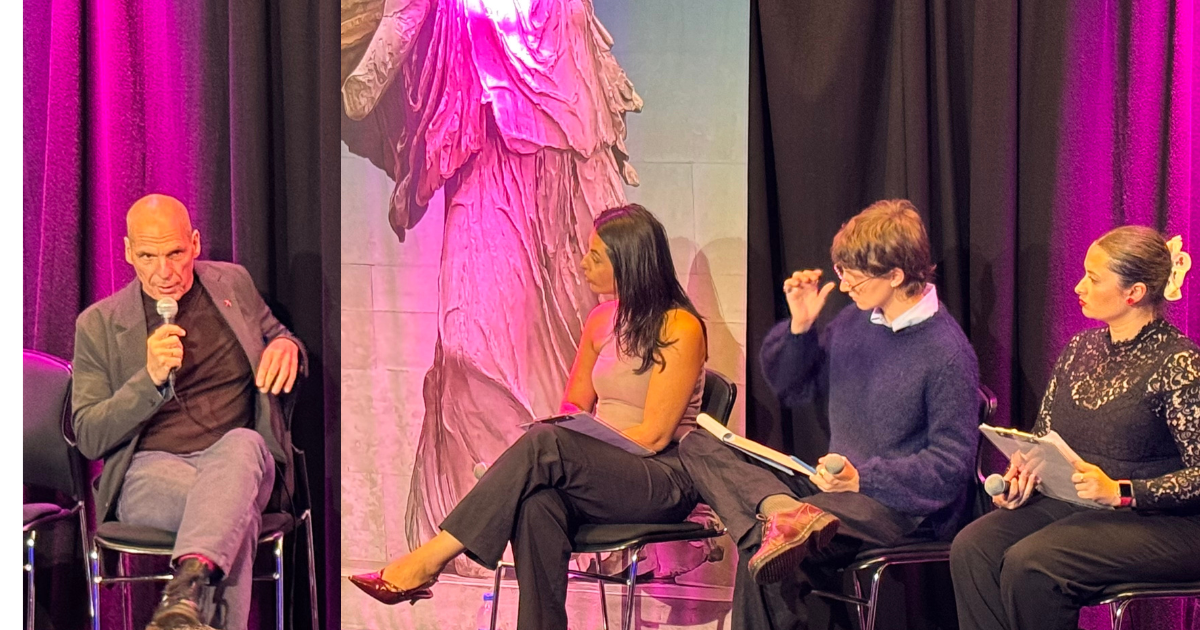
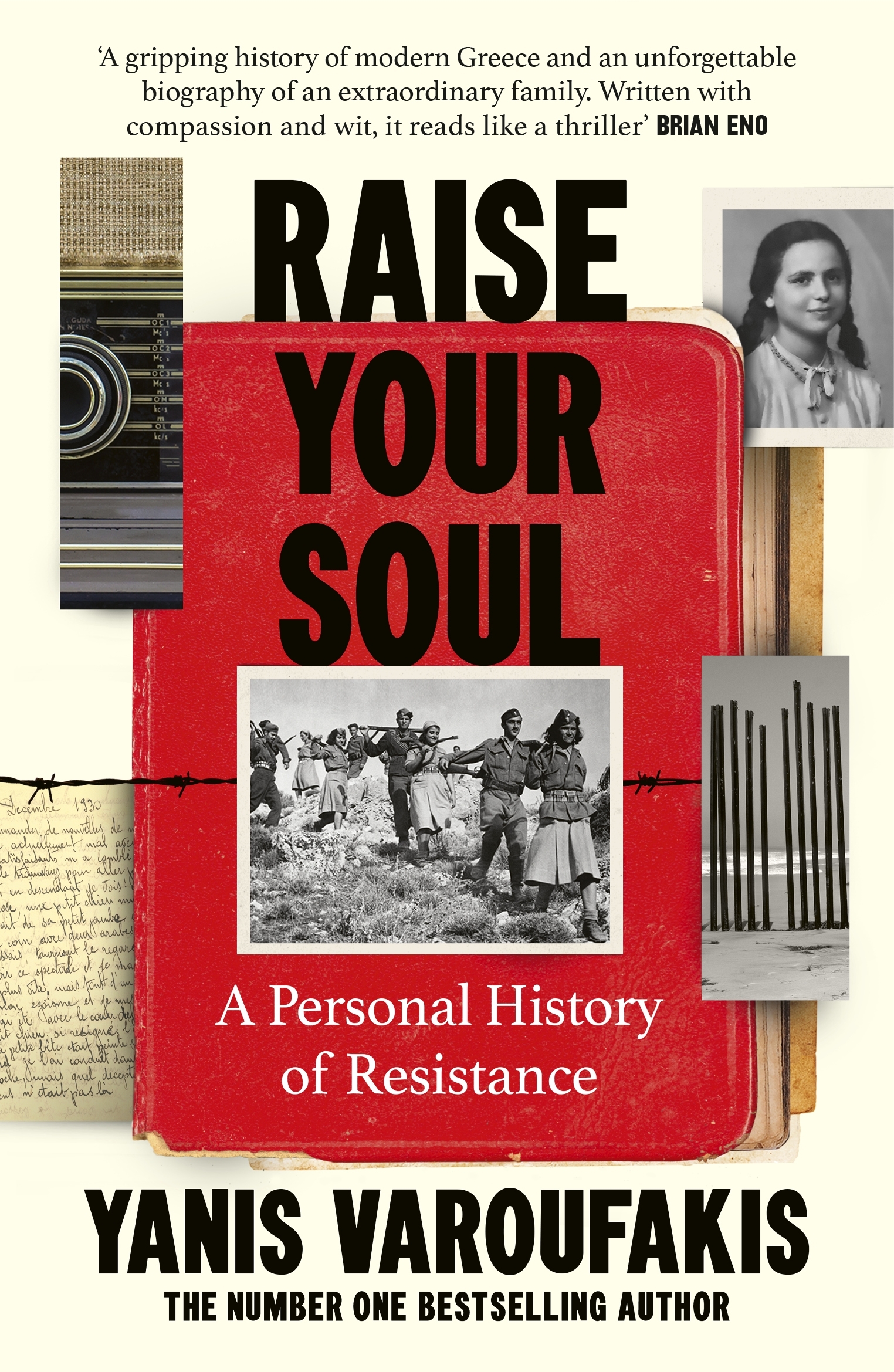
On the occasion of his recent visit to Melbourne, Maya Papastergiadis had the opportunity to be in conversation with Yanis Varoufakis who leads MeRA25 in Greece, is co-founder of the pan European movement DiEM25, and is on the council of the Progressive International. He is an academic economist who served as Greece’s Finance Minister in 2015, and is the author of best-selling books including Raise Your Soul (Penguin, 2025), Technofeudalism: What Killed Capitalism (Penguin 2023), Another Now (Penguin 2020), Adults in the Room (Penguin 2017), Talking to my Daughter (Penguin 2017), And the Weak Suffer What They Must? (Penguin 2016), The Global Minotaur (Zed Books 2011). The conversation below was part of a wider conversation that included Charisa Bossinakis and Sophia Menidis, held at the Greek Centre in Melbourne on the 3rd of March 2026.
Yanis Varoufakis came into the public spotlight as a commentator on the Global Financial Crisis. He has the rare gift in clearing away economistic jargon, presenting clear accounts of causes and consequences, and providing vivid analogies so that the rest of us could make sense of the chaos. His book Adults in the Room which was adapted as a film by the legendary Costa Gavras provided a unique view into the secret process of deliberation and deal making in the EU. It was a chilling and depressing exposé of both the democracy deficit and intellectual corruption of our political institutions. In his new book, Raise Your Soul, Varoufakis tells the story of five women, whose courage and wisdom were inspirational in his life.
Maya Papastergiadis, 13th of May 2026
Raise Your Soul: Female resistance, storytelling, and democracy. In Conversation with Yanis Varoufakis.
MP: Your recent book, Raise Your Soul, begins with an admission of defeat – an “unrelenting personal slump”, a slump marked by political turmoil. You revealed that the answer to electoral defeats, political turbulence, to the rise of fascism and authoritarianism, is not just a political one, but an emotional one. You reported carrying the stories of five women, like a “secret flame”, whose strength inspired you to raise your soul. Prior to writing this book, what part of this private story of resistance do you think was helpful in overcoming political despair, and what did that look like for you?
YV: Let me start by thanking you for reading my book. I mean, when one writes a book, it’s a very lonely enterprise. And I wonder, when I write anything, why would anyone want to read this thing, especially this book, because of the emotional engagement with the material well before I decided to write anything. I think it would be remiss of me not to explain that I never intended to write this book. When I get depressed, which is not very often, because as Danae Stratou, my wife, will tell you, I’m annoyingly chirpy. But I do have moments when things get to me. And when I do, then I write. It’s my therapy. Usually, I then delete it. I approached that book not as a book, but as a piece of therapy. I was also carrying another kind of emotion in me when I finished writing my penultimate book called Technofeudalism. It’s about big tech and it’s about cloud capital. It’s about AI and all that. And because I am afflicted by an academic condition: to express things that everybody knows in a language that no one understands. Many years ago, Danae Stratou, my wife, said, “stop writing that way because it is appallingly boring”. The only way I could extract myself from the academic mindset was to try to write it as a letter to Xenia, my then 12-year-old daughter. I wrote a history of capitalism without mentioning capitalism, as if I was narrating it to Xenia. And then when I wrote Technofeudalism, I followed the same practice. I wrote it as a very long letter to my father who had just died. As if I was trying to have a conversation with him. When I finished writing this book, Technofeudalism, I felt guilty because I thought, where’s my mom? My mother was my mentor. When I lived in Australia for 20 years, I would call her almost every day. I would bankrupt myself on phone bill in order to talk politics with her. I had this guilt that she was not anywhere. I had not written anything about her. During that period of an emotional slump, I started writing in a manner that ameliorated my guilt for not having written anything about my mum. What is the first memory I have of her politicizing me without lecturing me? I remember the moment in 1969 when she put me in a taxi and took me to the northern suburbs of Athens to go and visit my favourite uncle, her brother. He was incarcerated by the Greek Gestapo, the ESA, the military police, and he had been tortured and all that. I’m trying to give you a very human answer as opposed to a conceptual answer. It was an emotion that combined guilt for not having written anything about my mum, the memories of my politicization, and it so happened, of course, that this was also my initial exposure to fascism. The moment we arrived there, I saw these Nazis. One of them hit my mother in front of me within 10 minutes of our arrival. At the time when fascism is on the rebound, it is surging everywhere, across our societies, in Australia, in Greece, in America, everywhere, I thought it was quite pertinent.
MP: You’ve mentioned how important memory is. Memory itself is quite fallible, which is something you acknowledged in your prologue, where you describe the book as a “fictionalised history”. How did you navigate the boundaries between historical facts and imaginative reconstruction in shaping this book? Did you have any guiding principles that shaped your writing process?
YV: I had three principles. One is that I should be true to these women’s voices, which is not an easy thing for a man to do, and to get as much of myself out of the writing as possible. In the end, when my wife read it, she said, you realize you wrote an autobiography without you in it, to the extent that this is possible. The first principle is to be true to the women. And the second principle was to be true to the context within which these women lived. And then finally, the third part, if you want, is to bring it all together in a manner that makes sense to people who read it today. But it’s exactly the opposite of an academic piece of work. When you’re writing somebody else’s history, then you must start with archival work. You must consult your sources to see what other people have written about it. This is what the historian does. I’m not a historian, but you know what I mean. Even if you are writing economic history, the history of capitalism, you must do meticulous academic work. You must go through this process. I chose not to do that, because I was imbued with all those memories. I didn’t really care very much about, when my grandmother was telling me the story of what was happening in her village in the early part of the 20th century in the Peloponnese, to go to the archives and find out this was true or not true, because my point was to write down the story as told by my grandmother. So, I had all these fragments of memory. The second part of the book is called Anna. Anna was my father’s mother. I never met her because she died in 1954, but it is as if I grew up with her because my father was in love with his mom. Sometimes, I would say to dad, “you haven’t mentioned Anna for at least 5 minutes”. Anna lived in Cairo, and my father was born and raised in Cairo. I’ve never been to Cairo, on purpose. My father never went back after his mother’s funeral, and he made me take a vow that I won’t go back until Egypt is free, as he put it. You know, we have 1,000,000 political prisoners in Egypt as we speak, so I haven’t gone back. But I reconstructed in part 2 of the book, Cairo, as seen through the eyes of my father watching his mother.
When the Civil War began between December 1944, early 1945, the Nazi collaborators were essentially adopted by the British. and turned against the left. The British strategy, which was first developed in Malaysia and then brought to Greece, was to arrest the communists, or anyone who was a fellow traveller or lefty centrist even and make it a condition for their release to sign a declaration of condemning communists and communism’s fellow travellers. If you signed in the early parts of the Civil War, then you went home. My father didn’t sign. Interestingly, they turned him into a communist because he wasn’t a communist when they forced him to sign it. But his mother, Anna, who was French educated, had raised him in the traditions of the French enlightenment, of the separation of powers and all that rubbish. He said to the policeman, “Sir, I’m not a Muslim. I’m not a Buddhist. But if you ask me to denounce Buddhism and Islam, I’m not going to do it because it’s none of your business what I believe. It’s none of the state’s business”. And of course, he spent four and a half years in a concentration camp because of that. And as you said, it was a story. I mean, these people were being tortured daily for a signature, for a mere signature. When I was hearing these stories, I thought, my God, I wouldn’t last 5 minutes. I would have signed the damn thing. So, the big question was, why didn’t they? And I think what you’re referring to is at some point my father was telling me, I’m now talking about in the 1990s, because he was refusing to talk too much about it. The trauma was palpable. And he didn’t want to make himself sound like a hero or anything. But I was pushing and saying, come on, how could you have not signed… I mean, the torture was unbelievable. There were times in Makronisos, when they would put him in a large sack together with the snake and the cat and throw him in the sea. So, the snake and the cat would tear him apart while he was drowning and then pull him out and say, will you sign? And he’d say, no. Back in the sack. I thought, bloody hell. My father said to me, “look, if the first time I was at the police station when they said sign here, if I knew what was going to happen to me if I had said no, of course I would have signed. But I didn’t want to sign immediately. I wasn’t going to give them the satisfaction. I was going to wait for an hour. And then they beat me for an hour. They put a hood over my head and they beat me up”. When they took the hood off him and started being nice to him, the good cop came, put a bit of ice on his head and all that, he said, “I can last another 10 minutes”. And so, he lasted 4 1/2 years, bit by bit, incrementally.
Now, I didn’t want to sully that with historical research. I just wanted to convey that story. Of course, all these fragments need to be connected and need to be embedded in a historical reality. The archival work I did was almost accidental. I was writing a part for Anna, when my poor sister, after the death of our father, had the task of emptying our paternal maternal home. She found albums, photographic albums from Cairo, letters by my grandmother and diaries, and she brought them on to me. As I was writing that, I was discovering another dimension of my grandmother. Then I did a little bit of work because when I saw in her letters that she was a card-carrying member of the Egyptian Feminist Union in 1923. The Egyptian Feminist Union was the name of the organization, an underground organization, a legal organization, that the British had banned. I did some historical research to find out what was this organization. The story was fascinating. So that’s what I meant by fictionalized history or historicized storytelling. I put the fragments of the table and then connected them with a little bit of light research because I didn’t want to sully the emotional storytelling and the fact that this was meant to be an exercise of committing memory to paper.
MP: Looking back at these stories and retelling the events these women endured, it would be easy to use a contemporary context, one framed by your own political opinions. Especially, considering you were retelling stories for women you had never met. How did you navigate retelling their stories without, as you put it, “colonising the past with your myths?”. Further, as readers progress through the book, we learn more about your own life story too – we hear stories from your studies in mathematical economics at “red Essex”, and your mission to “stop the rot in Greece”. Do you see these stories differently now, compared to how you saw them, say, 30 years ago? Is this reflected in your retelling of these stories?
YV: Oh, no doubt about that, because we evolve. 30 years ago, I was overly proud as an academic. Now I’m not proud to be an academic. You know, one grows out of these illusions and delusions. This was something that these women and my father imbued me with, which helped me be less intolerable when I was an academic, especially an academic economist. Have any of you had the ill fortune of studying economics? My condolences. Now you see, the moment you enter an economics department as a graduate student, you are presented with a model of man, Homo economicus, who is the foundation of all economic models. This is a model of man who is rational but deeply self-interested, it is something like an unsympathetic version of Robinson Crusoe. This is when economists, financial experts, bankers, central bankers, finance ministers, when they talk about the economy and you hear them on television, go on about growth and about fiscal policy and monetary policy. They have this idea of Robinson Crusoe, homo economicus, who is the main character that they are addressing in the economy. I was always very sceptical of that from day one. It had to do with my upbringing, the critique of the model of man. I say man, because in economics textbooks, there are no women. If you’re a woman and you look at the way humans are portrayed in economics textbooks, you feel that this is in a different universe. Homo economicus is a person that likes what he does and does what he likes, who has no capacity of having a conscience. He’s operating on the basis of constantly maximizing any net gain possible. For homo economicus, the notion of the other doesn’t exist unless it is filtered through his preferences. So effectively, you have a psychopath who is at the heart of economic models. And this tradition that I came out of was enough for me to reject it. So, my economics career as an economist, as an academic economist, all those decades, was based on subverting and undermining the basic economic models. I was effectively a traitor within. I was the fifth columnist in every economics department. I built up a career by writing academic mathematical papers, and debunking economics. And I think that has to do with this tradition. I was already rejecting, for instance, the notion that there is a difference between emotional intelligence and rationality. I always thought that this was a joke. It is true about AI, it is true about computers, but it is not true about human beings. If you think that it is true, then you are producing really bad economics.
Maybe you must tell me whether I succeeded in not colonising the past with my myths. It’s ever so easy to project your own prejudices on the past that you’re trying to narrate. All I can tell you is that I was mindful of that trap and I was constantly trying to avoid it. I also put a lot of effort into ensuring that they were not cardboard cutouts. They were not unidimensional. It was portraying their full humanity, their contradictions and the annoying aspects of them. In this process an inner dialogue came out. But as you say, the funny thing is that I never met Anna. Yet, I had my father’s voice in my head telling me all those stories about her, and I had her letters and her diaries, which were an utter revelation about her own conflict, internal conflict. She was a privileged woman. She lived a charmed life in Cairo. Her husband, my grandfather, was the director of Thomas Cook in Egypt. They would travel first class in the best steamships and trains and so on. But they were part of the expat British, French, Italian, European establishment. Essentially, they were the oppressors of the Egyptians. However, she was also a feminist and a radical. She was connected to the Egyptian women of the Egyptian Feminist Union without anyone knowing. She loathed herself for being simultaneously the wife of a powerful man, a very decent man, but a man totally blind to the nastiness of the colonial regime that they were milking for all it was worth, while organizing herself with her Egyptian comrade’s industrial strikes in the textile factories. And in the end, she had to sacrifice her well-being because of that clash. I tried to bring out these contradictions and to do justice to the dilemmas that they faced.
MP: Were you concerned at all about any potential criticism about you being a man who gets to retell these stories? Historically, male writers have fallen into the common literary trap of presenting women one-dimensionally. Do you think capturing these women as flawed individuals, as opposed to idealised archetypes, was particularly important to you?
YV: Absolutely. That was the whole point of writing it. Because they were such powerful characters. I was privileged to have been raised by these women. So just so that you know who these women are, the first chapter, the first part is my mom. And as I said, my mother was my political instructor, my mentor, the person with whom I clashed constantly about politics and through this clash I became a political animal. The second is my father’s mother, Anna, who was my father’s mentor. My father was a very powerful introduction to feminism. because he was raised by a feminist, a member of the Egyptian Feminist Union. It’s really important, in a patriarchal society to have a father who says: “do the washing up now, your mother is not doing it. You are doing it. We are doing it. We do it together.” It was important to watch my father support my mother’s political career, her activism, her scientific endeavours and so on. Therefore, there was no way I could have written up the story of women as the mothers, the creators of men. It was the opposite.
But I was terrified. Firstly, because I felt guilty. I felt it wasn’t that I was worried that I would be criticized. I was criticizing myself. Who am I? You see, I say this in the preface. I believe that feminism needs to be experienced through a woman’s body. We, the men, can be feminists, but never fully fledged. We ride on the wings of feminism. I knew that I was going to be criticized for cultural appropriation. But then again, as I said before, if you take my mother, very few people remember her. And no one remembers all these nuances and all those subtleties that I believe need to be preserved. Not even my sister Anna knew the stories that I knew, especially after my father died. Trisevgeni, my mother’s mother, had completely been obliterated from history. She was a peasant girl with wisdom. She knew the futility and wastefulness of patriarchy. Such a woman should have been Head of the United Nations. And yet, she was just a housewife that nobody knew anything about. If I didn’t write this story, it would have evaporated in the ether. Similarly with part four of the book, Georgia, who is not my flesh and blood. She’s the great-grandmother of my daughter. In other words, she was the grandmother of my first wife, a Greek Australian. Even though we divorced on good terms, I asked myself: ‘did I have the right to write up the story of her grandmother?’ That was a hard one. Then I decided I’m going to write it up, firstly because, by God, that woman had to be immortalized. And I very much feared that my first wife wouldn’t do it, because it was too difficult for her emotionally. I think that she would have broken down if she tried to write up that story. That’s one reason. The other reason is because I knew that woman. And I discovered, together with my former wife Margaret, the dirty, horrible secret buried in her life. A secret that, when it is revealed, – and I’m not going to reveal it here, you’ve got to read the book, because otherwise we’d spoil it and it was very poignant, the kind of secret on which good movies turn, – when that was revealed, and we exposed that, I thought that this had earned me the right and the duty to write it up. The easiest one, and hardest at the same time, was the last part, because it’s the only person who is still alive. It’s my wife Danae Stratou. And she was the only one who had the opportunity to read the first draft and say, what the hell are you writing here? Especially when I was describing her artworks from my perspective. And she would come to me and say, that’s not what I meant that art to be, you got this art wrong, this installation wrong… and I said, no, the moment you put it out there, you lose property rights over it. I can tabulate it any way I like.
MP: I wondered how you went about navigating your positionality when retelling these stories. I was interested when I learnt that your mother’s involvement in the second feminist wave was inspired by Virginia Woolf’s A Room of One’s Own. Having a room in which to write isn’t something that Woolf or your grandmother could claim. Storytelling, in all its forms and stages – its production, access, distribution, interpretation – has served to bolster patriarchy and silence female voices. The foundation of storytelling and democracy, two central themes in this book, are rooted in Ancient Greece. But this bedrock is plagued with an institutionalised, misogynistic exclusion of women from storytelling in the democratic polis. This is something that you specifically mention in the book, and obviously times have changed since then, but it remains that women’s voices are relatively novel. Considering this, can you speak to any sense of struggle with patriarchy and storytelling you had in writing this book?
YV: It is a constant struggle, as it should be. A constant struggle. When this book came out last October in London, I was interviewed on BBC television about it. And I stunned the interviewer when I said that I, despite the fact that I was raised by feminists, both women and a man, my dad, I was socialized through misogyny. Because this is how every man in a patriarchal society is socialized. I came out of a house where I was taught to never succumb. I mean, I wasn’t exposed to patriarchal norms in my family because I have my mother, my father, and my grandmother. But then from kindergarten onwards, the moment you put boys together, a pecking order is established, a hierarchy between boys. Immediately, there is a top dog, like monkeys, like a pack of dogs. Immediately, there’s top dog, second dog, third dog, fourth dog, and tenth dog… you know, the one that everybody bullies. And this pecking order is extremely oppressive for boys, but it is the only way they can be socialized in a patriarchal society. And very quickly, there is violence between the boys, it doesn’t have to be physical, these patterns can be very sophisticated, very nuanced, but it is like a pack of dogs. This is how boys are. And they are socialized in juxtaposition to the girls. And very soon, property rights of the girls, even from kindergarten, develop. Together, the contest for the hierarchical build-up amongst boys is combined with the way they objectify the girls, bully the girls, possess the girls, you know, chuck the girls up. It doesn’t matter if you’re gay, if you are this or that, this is how the social order begins in kindergarten. Any man who denies that is simply not being truthful to themselves. So, I said on the BBC, yes, I mean, I have, my life is a constant struggle against the misogyny that is being imbued in the patriarchal societies and the fascist within. Because we are all a fascist. We all have a little Nazi in ourselves. Freud has taught us, to recognise this dark side. The dark side is patriarchy and misogyny inside of us. Men, women, everyone. But it’s okay, if you understand that and you fight it. So, happiness is to give this, to have this struggle and to prevail, and to prevail over the Nazi within, the misogynist within. You can imagine how that went down in Nigel Farage’s country. You see, the manosphere, which is returning now, is simply the revenge of patriarchy. And the reversion of patriarchy against an awful form of degenerative feminism, the feminism of Hillary Clinton, for whom if 50% of the CIA torturers are women, that’s fine. This is not the feminism that those five women in my book fought for.
MP: You’ve just highlighted the role of resistance in self-understanding, and its wider contexts. Resistance, itself, is a deeply personal endeavour. Much of it derives from our own life stories, stories such as these five women, which you have immortalised. Incidentally, you have also demonstrated how storytelling has changed over recent generations. For those of you who haven’t read the book, I’ll give a quick summary of what I’m referring to here. In part one, we see how your mother devoured mystical stories from the neighbours that her family generously fed. To her, these verbal stories filled a hunger that the German occupation of Greece gave her and provided a remedy that imbued within her a desire to fight against fascism. In part two, the novels that your paternal grandmother carried with her, along with the poetry she wrote herself, shaped both hers, and your fathers, political activism. Here, we see the power of the written word. She shared novels such as Marguerite de Navarre’s Heptameron and carried a little red book that your grandmother would write French poetry in, which would go on to inspire your father and yourself. Jumping forward, part five shows us how globalization and developments in digital cameras have permitted the installation of Cut – Seven Dividing Lines, which tells the story of dividing walls, spanning from Belfast to the West Bank. These different examples demonstrate two important facets: one, how technology shapes the ways we tell stories; and two, how stories shape the way we fight against occupation and fascism. While globalization has done incredible things for how we share stories, it has also led us to an age where AI and tech companies now dominate the technology, we’re dependent on. My question is, from the perspective of this book, Raise Your Soul, and Technofeudalism, and all the other books you’ve written in the past, how do you imagine storytelling will continue to change alongside the development of technology? And do you think obviously for a long time it’s facilitated resistance against fascism. Do you think that role of facilitation will change?
YV: No, it won’t change because the stories we tell frame our conception of what is possible. The technologies that we develop crash mercilessly on the shoals of the antiquated relations we have with one another. So together these two processes drive history. The Aboriginal communities in this country told stories that drove their societies, that regulated their relationship with nature, that reflected in the art and in the song, the way they managed to maintain an equilibrium. Simultaneously, the technologies they developed, like, the boomerang, right? The first flying object with any degree of precision, or if you go back to ancient Greece, the discovery of iron is what shifted societies from prehistory to history. Before we had copper dominating prehistory. The moment smiths learned how to harden steel, then suddenly history starts moving at a much faster rate. And then, we have the industrial revolution with the steam engine, and then it proceeds year in, year out. Now we have AI. Everything is shifting so fast that we don’t even have enough time to notice the pace of change. But stories are what allows us to make sense of these processes, and to create resistance to the misuse of the technologies, because this was what the Ancient Greek poet Hesiod was lamenting. He was not against iron itself. He was lamenting the age of iron because humans were not capable of taking the good from the technological innovation that was iron without the bad, which was carnage, slaughter, The fact, as he says, that we can no longer rest at night thinking that our deeds are consistent with our nature. You could be saying this about AI today. So, and to close this loop, if you look at the manner in which fascism is rising, and going back through the pages of my book you can see how these women lived through different kinds of fascism. If you look at the role of the political party One Nation today here in Australia, if you look at the party Alternative from Deutschland in Germany, the surge of fascism, Trumpism, go to a MAGA event in the United States, you see stories. They tell stories very well. They spin their narratives in ways that reinforce their politics and create movements. So, it’s a clash of stories. We need to have our stories with which to fight the surge of fascism. And, you know, technology and storytelling brought together is the stuff of history.
MP: Finally, what is one message you want people to take away from Raise Your Soul
YV: In the end, what matters is to have fun while resisting. Because politics is, if it’s done professionally, it is soul destroying. Electoral politics in particular sucks big time. You know, kissing babies and getting people to vote for you. But if you think of it as an extension of the resistance to the fascist within, to the misogynist within, and if you see it as something that is fun doing, because you don’t give a damn in the end about the outcome, if you care about the outcome, if of course you’re, you know, you’re running into elections, and I do run in elections and usually lose, you’ve got you’ve got to run to win, but the actual running, the actual process, the actual journey, must be something that you enjoy independently of whether you win or not. When I resigned from the ministry, it was one of the happiest days of my life, because I didn’t care to be a minister. If you don’t care about being an MP, being a minister, then you can be free. If you care about your personal status and prestige, then you compromise.


