Michael Symonds, Why Should We Still Read Max Weber? (Routledge, 2027)
Reviewed by Harry Blatterer (Macquarie University)
(This is a prepublication version of this review. You can find the published version in Thesis Eleven Journal, on the T11 Sage website)
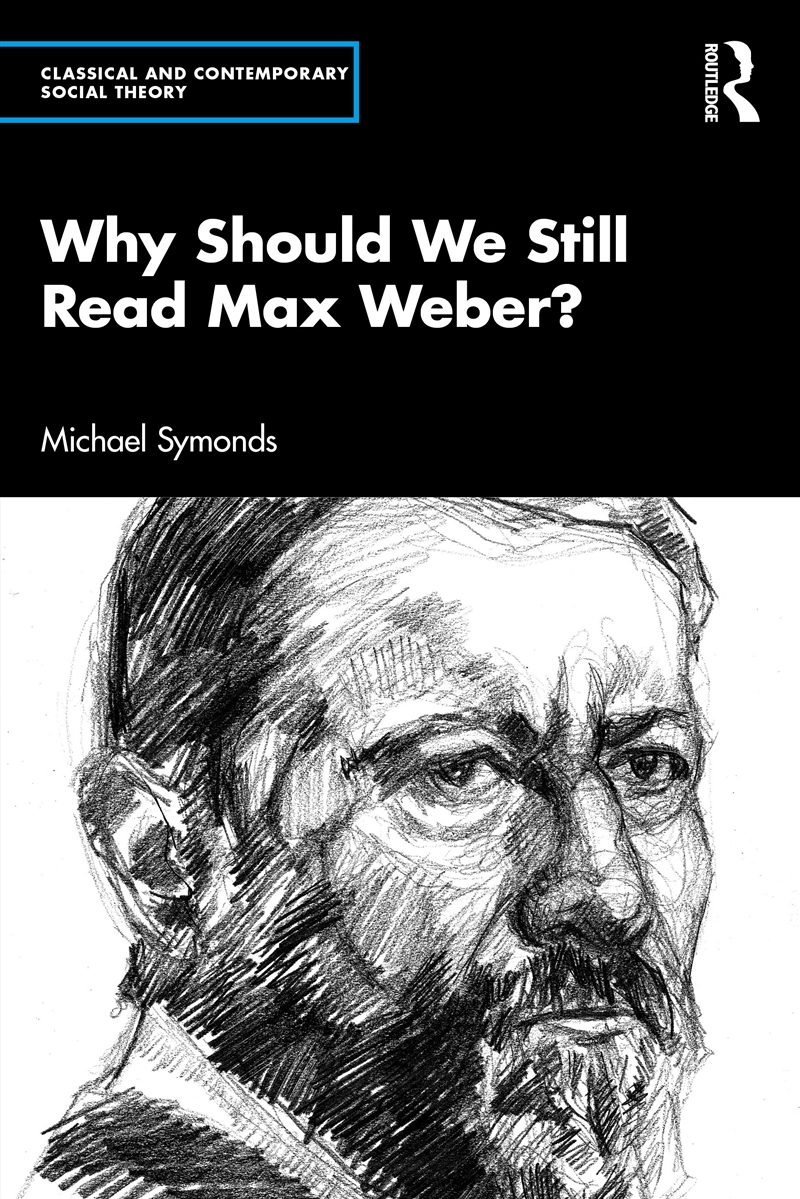
In Why Should We Still Read Max Weber? Michael Symonds dismantles a number of enduring misconceptions about Weber’s theory of Western modernity that have become sedimented through decades of largely anglophone textbook orthodoxy. It is therefore fitting that the book is presented as an introduction. Readers encountering Weber for the first time are given the opportunity to engage with his central arguments before the familiar clichés of the ‘iron cage of rationalisation’, wholesale secularisation, or disenchantment as little more than a psychological malaise to be cured through acts of re-enchantment, take hold. Yet it soon becomes clear that this is no ordinary introductory text. It is indispensable reading for anyone seeking a better foothold in Weber’s theoretical universe. That foothold is provided through a level of scholarship made possible only by decades of sustained engagement with Weber’s formidable oeuvre. Why Should We Still Read Max Weber? follows Max Weber’s Theory of Modernity (2016) and A Weberian Perspective on Home, Nature and Sport (2024), extending Symonds’ long-standing project of reconstructing Weber’s architecture of modernity.
The book is comprised of three parts. Following the introductory chapter and a brief, orientating note on Weber’s ideal type, Part I contains chapters on disenchantment, legitimation and status. Symonds reminds us that Weber’s work seeks to unearth the religious antecedents that shaped Western culture. Hence Weber’s close study of Confucianism, Hinduism and Judaism allows us to appreciate more fully that disenchantment is an achievement of a religious take on the world that banished all magic, while Eastern religions developed sophisticated ethical and intellectual traditions that retained a ‘magical garden’ (Weber’s Zaubergarten) offering a reality parallel to the mundane. In contrast, Judaism’s covenant between Jews and Yahweh eschews the magical, and Protestantism, especially as lived in the Calvinist limit case, utterly divested itself of the supernatural mediation between humanity and God preached by the old Church. We need not here rehearse Weber’s analysis of the doctrine of predestination, the transformation of the calling from a religiously ordained to mundane cultural demand, itself premised on the moral transformation of money and wealth from sinful avarice to a desirable end in itself. What needs to be noted, however, is that it is Symonds’ reaching into Weber’s comparative work on religion that affords us the appropriate distance to our own culture and the fundamental meaninglessness that is its hallmark.
Equally instructive is the book’s parsing of legitimation, the processes by which authority comes to be seen as rightful. Charismatic authority, more than merely sitting alongside tradition and legal-rational authority, attains its power by virtue of its functional erasure of competing sources of authority. As Symonds reminds us in a later chapter, Weber’s concept not only explains major aspects of the rise of Donald Trump in the United States but, more significantly still, the undermining of the democratic rule-based order so characteristic of his dispensation (cit. Weber, pp. 101-3). Charisma trumps legal-rational authority – this is its power, even if its time is always necessarily limited.
In case there is still any doubt that Weber’s class analysis is not simply antithetical to Marx’s, this book shows that Weber’s addition of status, or social honour, to the Marxian repertoire serves as a warning against any kind of reductionism. In fact, he said so himself when finishing his The Protestant Ethic and the Spirit of Capitalism with the avowal that it was never his ‘aim to substitute for a one-sided materialistic an equally one-sided spiritualistic causal interpretation of culture and history’ (cit. Weber, p. 69). Symonds has Weber dispel the well-worn half-truth about his supposed neglect of material class antagonism by complicating the matter and so enriching it. High status, after all, needn’t go hand in hand with high income and vice versa.
Part II turns to the value-spheres that render modern societies bereft of a single, unifying and ‘steering’ organising principle. Economy, politics, science, art and erotic life – the spheres discussed by Weber – are each governed by its own logics. Not only have the ‘rational’ spheres of economy, politics and science rendered collective human action highly calculable and efficient and have prolonged life for many, but, unable to provide overarching meaning, they are central to the fragmentation of human experience, leaving us moderns to navigate competing and often irreconcilable value commitments. The ‘irrational’ value spheres of art and erotic life resist – and cannot but fall short of (re)enchanting the world with meaning. Instead, they exist alongside other value-spheres, contributing to the plural and often conflicting character of modernity. It’s worth noting here that Michael Symonds has offered his own extension of Weber’s value sphere in A Weberian Perspective on Home, Nature and Sport (2024), so adding to the pantheon of the many gods that vie for our allegiance.
With Part III, Symonds brings to bear his original research on the centrality of ‘brotherly love’ in Weber’s ethics (Symonds and Pudsey, 2006, 2007). To say that modern life is meaningless is not to say that individualised meaning cannot be found. If the Protestant Ethic, transformed into the ‘spirit of capitalism’, made the ‘calling’ the nomenclature for meaningful work, and if the rationalisation of the world fostered the belief ‘that one can, in principle, master all things by calculation’ (cit. Weber, p. 24), it also relegated the easy sociability of friendship to the private sphere. Or, better put, it has banished relations from human to human – Mensch to Mensch – following the Puritan injunction against idolatry of the flesh, to the nooks of private life. But whether brotherly love is lived or not, it remains ever-present as a reminder that we ought to do something about the suffering of others like and unlike ourselves.
There is, of course, more to this book, to the story it tells about Weber’s central concerns about the modern world and the possibilities of a meaningful life, mostly in Weber’s own words and sprinkled, here and there, with Michael Symonds’ own interpretations and reflections. Several aspects recommend it to the classroom, some of which I have already touched upon. For one, there is the fact that the book not only goes beyond the usual texts. Weber’s work on other-than-Western religions functions here as a constant backdrop, as calibrating contextualisation of the better-known, and certainly more commonly used writing. When Symonds discusses the value spheres, he again doesn’t only draw on the one piece of writing but seeks clarification in other texts, cross-references them.
Secondly, and this might have been gleaned by now, this is no ‘Weber lite’. Symonds invites us and our students to think – to think with him, to think with Weber who is extensively quoted. Thinking with Weber here first and foremost, and justifiably, is about understanding in order to find one’s own points of critique, ruptures as well as continuities between theory and societal developments. Michael Symonds, in other words, takes students seriously, refuses to buy into the notion that students no longer want to read, have lost interest in ‘old’ material, prefer digital media over the printed page, condensed summaries over thoughtful exegeses, etc.
Third, the book responds to the question it has set for itself – why we should still read Max Weber – with utmost clarity and conviction. We should read Weber, amongst other things, because he explains why and how modern societies are organised around rational institutions; because he understands the de-centralised and highly pluralised constitution of modern societies and the constant negotiation of values this presages; because he explains the trade-off between scientific and economic progress and the loss of shared meaning without offering a trite panacea; because, though an economist, he rejected economic reductionism and showed us how and why; and because Weber explains us to ourselves like no other theorist of modernity.
There can be little doubt that Michael Symonds has found his ‘daemon’. Not only undergraduate students – the cohort to which this book is marketed – but all of us who are interested in Weber’s work will benefit from Michael Symonds’ encyclopaedic knowledge of Weber’s work and his hermeneutic sensibility.
References
Symonds M (2016) Max Weber’s Theory of Modernity: The Endless Pursuit of Meaning. London and New York: Routledge.
Symonds M (2024) A Weberian Perspective on Home, Nature and Sport: Disenchantment and Salvation. London and New York: Routledge.
Symonds M and Pudsey J (2006) The Forms of Brotherly Love in Max Weber’s Sociology of Religion. Sociological Theory 24(2): 133–149.
Symonds M and Pudsey J (2007) Heroic Love: The Ethic of Brotherliness in Max Weber’s Vocation Lectures. Max Weber Studies 7(1): 63–87.


