Oscar Guardiola-Rivera, A Hopeful Political Imagination: Courage and Fantastic Critique in the Age of Meltdown (Bloomsbury, 2025)
Reviewed by Costas Douzinas
(This is a prepublication version of this review. You can find the published version in Thesis Eleven Journal, on the T11 Sage website)
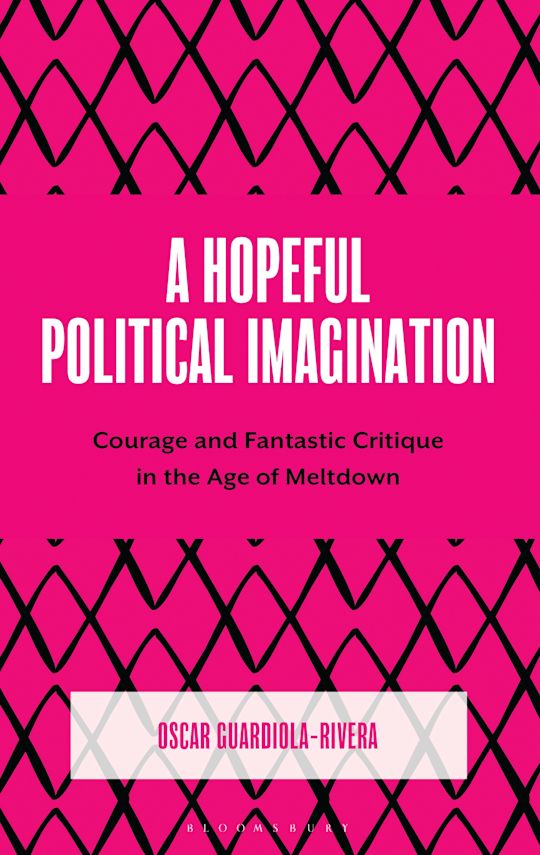
The museum of curiosities
Certain books carry a little bit of magic; they offer a kind of surplus-value. They tell a story. How does a people lose all sense of hope, their vision blinded through utter loss. For example, how they regain hope when someone (an oracle, a shaman, a judge) recalls memories and calls poetically, prophetically to justice. Their surface texture is full of philosophical detail, mathematical precision, and artistic adornment. But their underground structure is made of dreams of delivery and poems of resistance sung by sages and gods, children and Bacchae. To this library of curiosities, to this garden of forking paths belongs Oscar Guardiola-Rivera’s “A Hopeful Political Imagination”.
After a talk at the British Museum, Guardiola-Rivera was taken by Neil McGregor, the Museum Director, to see the black mirror, an Aztec shewstone made of volcanic obsidian that the Spanish conquistadores stole from México. It was acquired by Dr Dee, the famous astrologer, alchemist, scientist and celestial necromancer, a larger-than-life magus, adviser to Elizabeth I and proponent of empire. Guardiola asked the distinguished director about stories associating Dr Dee’s mirror with curses, abominations and hauntings. To his great surprise, McGregor pointed toward “a seemingly endless corridor opening into a dark void”. Later, a museum warden said cryptically that when such a corridor breaches the Earth’s surface, it leads to a sprawling system of underground stores and tunnels.
This story captures the spirit of the book, a confrontation and uneasy truce between Master and matter, between the logonomocentrism of Western civilisation, epistemology, normative systems and the materialism of non-masterly, non-managerial images, secret and sacred objects, oblique traces of the past. The book transcends the standard divisions of theory and practice, history and philosophy, law and justice. It lists or implies the many juxtapositions and bipolarities of Western civilisation: North-South, science-fiction, public-private, to let a third decolonial, deconstructive, decryption force emerge. The bon mot “In the beginning was the Word”, with its property propriety and form becomes “In the beginning was formless, subversive substance and force” leading to decolonising ethics, new ways of seeing and hearing, better moving with each other. As Guardiola says in his “What if Latin America Ruled the World” we would all dance better. Dancing better is a metaphor of being together in justice.
Eye and ear
One of the many juxtapositions that have defined the division West-North vs East-South is that between vision and hearing. The scopic field has always been Western and divided. The eye, vision and visibility belong to theos/theorein/theoria, God and sun, brightness and clarity, light and En-lightenment. At the same time, however, the eye identifies and separates, abandons and excludes. The vista opened by the penetrating eye, the enframing action of vision applies a window on the world and rejects the non-lit, dark side, to the unseen, the non-existent. There is more: The fascinum of the evil eye, the aggressive aspect of vision, mimics and mirrors the eye as its double. Separation, splitting, demarcation is the business of the eye; this is how the eye acts on the I. The eye, like the I, is split. On one side, eyesight is the noblest of senses. For Plato, the eye is heliotropic, sun-like and turned to the sun. Vision, the companion of intelligence and the soul while the mind’s eye sees the essence of things. Theoria, the attentive look that beholds, breaks through the mists of perception, doxa and empirical experience and directs material being. In monotheistic religions, God is omnipotent, omniscient, all-seeing.
On the other side, the eye is evil. The evil gaze causes bad luck and illness. Evil derives from the eye’s intrinsic malevolence (Italy) or expresses the malice of the person bearing it (India). But the duplicity of the eye, its ability to see itself seeing, gives it a supernatural force that can turn it into a homeopathic apotropaic device against the evil eye. In the pantheon of prophylactics, the eye joins the phallus, the other great defence from evil. The famous Antioch mosaic depicts a large evil eye attacked by weapons (nails, swords, tridents) animals (snakes, dogs, birds) and the huge phallus of a dwarf. Both the evil eye and the phallus are fascina, bringing vision, desire and emotion together. Eyes, phallic amulets and coloured beads are still worn as defences against the evil eye. The obsidian played a similar role for the Aztecs. They used it for medicinal purposes; distinctive agency was attributed to objects made of this dark volcanic glass. Its reflective surface was a shield against bad spirits. But the black mirror was also associated with death, the underworld, capturing the image and soul of a person. An Amerindian fascinum and apotropaic. Et in Arcadia ego. The Aztecs saw mirrors as doorways to other worlds. Dr Dee used it in divination, the occult and “scrying”, talking to angels, the dead and otherworldly creatures. Scrying is a hearing reflection that opens to the ghost and the storyteller, women and men who sing their past and dance their future.
We must open our ears, prick up our ears, develop an active hearing. What does it mean to have keen ears? As Derrida intimates, there is an imperceptible difference and a deferral, a time lag between the speaking and the hearing, even if I am only hearing the inner voice. In telling a story, I hear myself speak but in doing so I hear myself through the ear of the other. I hear myself and constitute my own self through the ear of the other. In hearing, recognition becomes effective not when the word is uttered but later when the ears have managed to receive the message. While the eye is given to permanence and to a fullness of presence, the phone, the voice and hearing, belongs to temporality, to a diachrony of moments and therefore the possibility of hearing otherwise. Whether hearing can transform whatever befalls it, the word of law and of the various jurisdictions is the crucial question of our times. And it is here that the clash of jurisdictions, of particular and universal might give us some clue.
If according to the Greeks, juris-diction is law-speaking, the giving of dike as order, our response is to try and hear through the ear of the other and confront the community of the sovereign, of the One and All, with the plurality of many ears. In this sense, critique attaches itself today to the clash of sovereignties and the conflict of laws, to the break up of unitary territories and all-capturing laws. If vision and the eye stand for mastery, theory and the law, hearing and the ear are the organs of empathy, equity and justice. And then there is the vision of the black mirror. It allows communication with angels, the dead, ghosts. It is the hearing vision that opens to the storyteller and the shaman. We must open our ears, prick up our ears, develop an active hearing.
Utopian time
It is this time deferral and hearing otherwise that animates the utopian moment of hope and this book. Utopia, as a weapon against the claustrophobia of the present, is not the design for the perfect future. Phenomenologically time is neither united nor uniform; we live simultaneously in several overlapping temporal cycles – some short and dense, others long and slow. Time is fragmented and multidimensional. This is how the individual utopian impulse and the collective time of utopian design come together in everyday acts, fantasies and dreams. For Ernst Bloch, day dreaming is the site of utopian desire. Its fragments lurk in songs of suffering and courage of refugees and indigenous populations, in religious ceremonies of forgiveness, redemption and memory, in films about the oppression of states and the exploitation of corporations, in images of refugees on boats sailing to their Cythera of love or Arcadia of hope, in asylum cities, in Instagram images and hip-hop riffing about resistance, in the play of children in the bombed streets of Gaza and Ukraine, in Extinction Rebellion amd Gaza protesters sitting down in London, in the stories of redemption of Ursula Le Guin, Margaret Atwood and Plenty Coups, the last Crow Chief. They are embedded in cultural products and representations where imagination competes with and unsettles the linearity of historical time. In such images and texts, the present foreshadows and pre-figures a future not yet and, one should add, not ever. The ideal colours and directs the real, the future animates the present. In the utopian fragment the empirical time of ‘now’ and the utopian time of the ’not yet’ combine, the act is pregnant with the future.
Utopianism is a dream of a redeemed future, fuelled by the wrongs of the past and their traces in the present. In Bloch’s vision, the ‘present’ world is not complete or closed. It is being constructed daily through continuous struggle; its authorised meaning, however, is given by the dominant forces. Conflict and resistance are key components of the existing world opening it to a non-predetermined future. The utopian blueprints and plans must be read therefore in the temporality of the future perfect. They are what will have happened after the removal of the great and the amelioration of the lesser evils of capitalism. This is what gives hope in these times of hopelessness, what feeds the courage of the defeated.
The British (?) Museum
Universal logos reflects and reveals the structure of reality which follows the demands of theoretical necessity. The traces of this ontological totalitarianism litter the body of epistemology, philosophy and law. Over the last thirty years there has been a decolonising bonanza. There are calls to decolonise everything with orientalism becoming an “occidentalism” that does not always avoid naïve superficiality. Colonialism and imperialism do not only change the way we look at the world but also the way of experiencing it. It is not easy to return to the lost world. Sometimes it may not be possible to separate the Northern from the Southern perspective because they have been molded together so tight that they can no longer be distinguished. As the Argentinian scholar Walter Mignolo puts it, ‘border epistemology’ and ‘border thinking’ refer to knowledge production in liminal spaces that straddle intellectual repertoires. Epistemic resistance can be as much Northern as Southern. Decolonisation as epistemological practice falls prey to well-known pitfalls. Decoloniality, on the other hand, reclaims existence and releases the captive mind, today is necessarily pessimistic, to become active and hopeful, to move from the symbolic to the imaginary order. And this is the great advantage of this book: pessimistic toward projects of mastery but optimistic toward the many forms of resistance that exceed the diktats of the masters of the universe.
In their vision as mastery, display becomes the purpose of objects, visibility the end of their function and history. There is nowhere better to observe this substitution of matter and function by a system of signs and obedient objects than the museum. It is significant that archaeology and museology have been the privileged sites of the new decolonial episteme. The display removes and decontextualises the captive objects from their natural place and time and recontextualises them as inert signs for the consummation of busy tourists. Guardiola-Rivera and Linda Martin-Alcoff, his interlocutor, invite us to think of the museum as a structure of ignorance in which everything comes to its “final resting place of display”.
No museum represents the essence of museums better than the British Museum, which has pride of place in this book. Its design follows the “gift that was Greece”, imitated by both German romanticism and English neo-classicism, in order to present the Empire as its final apostle and representative. Like the Parthenon, the British Museum has an octostyle front imitating another temple to Goddess Athena at Priene in Asia Minor. The museum is five-minute walk from my office in Gower Street. In the 1990s, I used to visit it at lunchtime, sitting in the magnificent rooms of the Parthenon marbles looted by Lord Elgin in the 1800s and the object of a heated political and cultural debate between Greece and Britain. The famous Caryatid maiden stands melancholically alone separated by her five sisters in the Erechtheion and now the Acropolis museum. I always marvelled at the arrogance of a museum calling itself British with only a few minor exhibits from native soil while surrounded by the wonderful artefacts from all over the world looted by the Empire. This is the Imperial Museum euphemistically masquerading as British.
And yet, there are museums of curiosities, of atrocities, of lost things, libraries of Alexandria and Babel. Endless corridors that open into the dark void. Guardiola imagines a museum of cocaine and another of AI on drugs. But even the colonialist museum contains the Parthenon marbles, the Aztec black mirror, the Egyptian mumies. They hold the promise of return and restitution. Dr Dee, scientist and magus who owned the mirror, is perhaps a symbol of the Janus face of the colonial and the decolonial. This is a book that speaks to both.


