by Howard Prosser
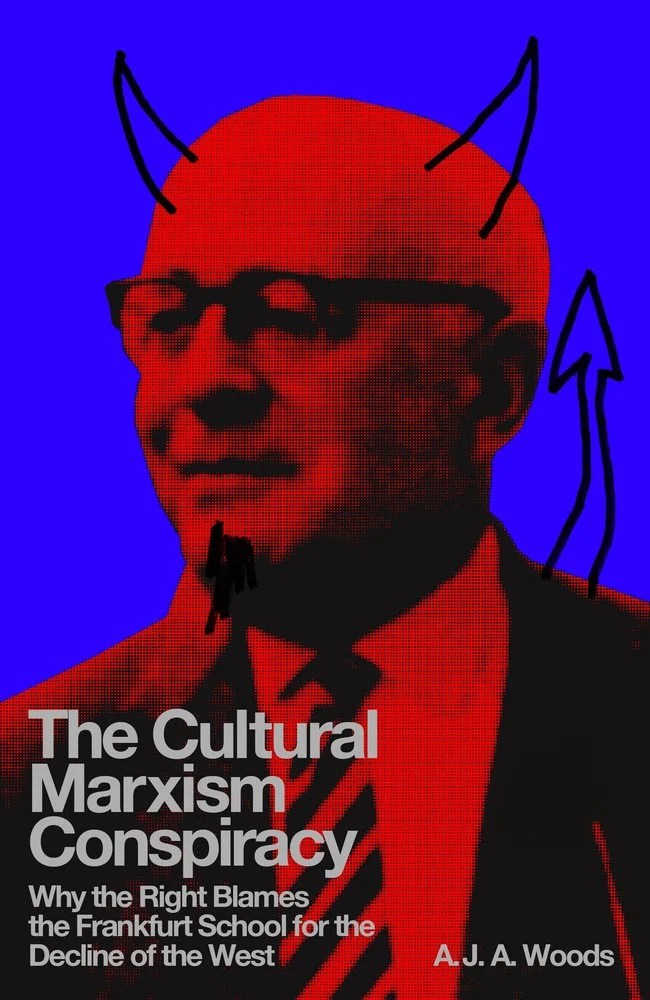
Few recent conspiracy theories have proved as adaptable or persistent as the claim that the Frankfurt School somehow engineered Western cultural decline. “Cultural Marxism” now circulates as a versatile rhetorical weapon in some right-wing political and media circles – reached for by politicians, pundits and online agitators to explain almost anything they dislike, from feminism and anti-racism to immigration, LGBTQ+ rights and environmentalism. Yet for a term invoked so freely, its origins and workings remain little understood. The claim, in its standard form, runs like this: a group of Marxist theorists who fled Nazi Germany for the United States, having given up on economic revolution, set out instead to destroy Western civilisation from within – seeding the universities and the culture with feminism, multiculturalism, sexual permissiveness and political correctness.
A.J.A. Woods is an intellectual historian based in Brighton, UK, whose work spans social and political theory, British cultural studies and the history of conspiracy theories. The Cultural Marxism Conspiracy: Why the Right Blames the Frankfurt School for the Decline of the West, published by Verso in 2026, provides the basis for the present interview. Drawing on years of archival research, it reconstructs how a group of German émigré thinkers came to be recast as the masterminds of a plot against Western civilisation, tracing the idea from the fringes of the 1960s to its champions among today’s reactionary governments and movements.
What distinguishes the book is its refusal to treat the conspiracy merely as a falsehood to be corrected. Reading “cultural Marxism” less as a body of ideas than as a political weapon – reforged at particular moments to serve particular ends – Woods offers less a debunking than an anatomy of the movements that have declared war on an enemy largely of their own invention. Conducted in July 2026, the interview discusses the making of the conspiracy theory, the currents of anti-communism and antisemitism that run beneath it, and where these ideas may be heading next.
Howard Prosser: You open the book by describing “cultural Marxism” as the political right’s attempt to explain cultural change in Western societies. You also show that it isn’t a single invention but something pieced together over time. How should we understand it as an object of analysis, and how does it come to take the form of the bogeyman it has become in contemporary political discourse?
A.J.A. Woods: I wrote this book to challenge what I call the “relay race” model of the history of conspiracy theories. Those who adopt this methodological framework argue – either directly or implicitly – that conspiracy theories essentially stay the same as they get passed from person to person, resulting in a continuous timeline of a conspiratorial narrative – like the narratives about the Freemasons or the Illuminati – that stays consistent throughout history.
When I was reading other analyses of cultural Marxism, most of them stuck to this existing model. They portrayed this narrative like it was an internally consistent organism or a disease passed from one carrier to another. Contrary to this existing corpus of work, I wanted to shift the emphasis from the object of “cultural Marxism” onto the practices of the people who promoted the idea. Each chapter starts by describing the historical context in which certain ideas spread – the conditions that gave rise to a particular type of intellectual practice – and then I look at how particular intellectuals developed the idea of “cultural Marxism/s” within political movements.
Prosser: At a certain point, the Frankfurt School becomes the central conspiratorial reference point. Why does this particular lineage end up carrying so much weight in this way of thinking?
Woods: I trace some of the earliest uses of the Frankfurt School as a conspiratorial scapegoat to the Lyndon LaRouche movement in the 1960s and 1970s. LaRouche was a Trotskyist-turned-semi-fascist who felt that he and his followers represented an intellectual elite engaged in a battle with a sinister counter-elite – represented variously by the Rockefeller family, the British royal family, or “Aristotelians.” The Frankfurt School appeared within that larger revolving cast of enemies in the mythos of the LaRouche movement. If you go through the movement’s newspapers, magazines and books, you will see that the Frankfurt School turns up on a few pages here and there, sometimes used interchangeably with other groupings like the Fabian Society or the Tavistock Institute – other institutions the LaRouche movement saw as a driving force behind an underground fascist establishment.
The Frankfurt School only really became a central facet of what we’d call the cultural Marxism conspiracy theory when the story was picked up by the New Right in the 1990s. William S. Lind, a New Right think-tanker associated with the Free Congress Foundation, was looking for a bogeyman to explain why political correctness had come to the United States. He encountered the writings of various LaRouche activists and adapted them to his own critiques of political correctness and multiculturalism. The idea of cultural Marxism that we know today originated with Lind’s work – but, as I stress in the book, his version of cultural Marxism/s should not be mistaken for the essence of cultural Marxism just because his version is the most popular or well-known. The narratives of cultural Marxism/s are constantly shifting. You can see this versatility and changeability in how they were updated for the anti-CRT scare in the United States in the 2020s or the politics of Bolsonarismo in Brazil in the twenty-first century.
Prosser: In the later chapters you turn to more contemporary cases – Trump-era politics, Bolsonarismo, and the language of “wokeness.” The conspiracy doesn’t just persist; it seems to return with force at particular moments. How does this way of thinking differ from the earlier versions in LaRouche and Lind, and what conditions have made it especially potent again in recent years?
Woods: Some things remain quite similar. When you compare what Lind did in the 1990s with what Christopher Rufo was doing in the early 2020s, they’re effectively performing the same role on the American right. Both are intellectuals based in think tanks, responsible for producing ideas to change not only public opinion but government policy. They use the technique of genealogy to delegitimise certain progressive decisions and initiatives – whether that’s affirmative action, anti-racist training, or gender-affirming healthcare – by tracing them back to their supposed Marxist antecedents and inspirations. There are also continuities in the way cultural Marxism and critical race theory are each supposed to function as discursive weapons: both Lind and Rufo judge that there’s something innately repellent in those terms to who they see as ordinary Americans. Lind assumes that everyone will be turned off by the thought of “Marxism”; Rufo thinks that most Americans dislike seeing things in racial or theoretical terms. They want to exploit this apparently instinctive repulsion and use it to encourage a negative response to even the most basic and watered-down liberal reforms.
Yet, there are clearly unavoidable differences. Ideas spread more easily and internationally through online channels. There is a greater blending of transnational buzzwords – wokeness, for example – with existing tropes, discourses, and framings of anti-leftist scapegoating in various countries. The very vagueness of Cultural Marxism – it can mean anything from portrayals of divorce in popular movies to the existence of organic grocery stores – means that anything can be attached to that label (even if the person using it lives in a country where the Frankfurt School thinkers never lived!). You can, of course, trace the history of the today’s transnational right to earlier formations in the 1960s – or even earlier – but I think that right-wing politics nowadays is much more smoothly integrated – on a global level – through institutions like CPAC and the National Conservatism conference and social media platforms like Twitter/X.
Unlike some people who think that “Cultural Marxism” is a uniquely or inherently “American” story, I would suggest that its uses in other countries reveal how it was always already a global story about the dominance of the West, the crisis of a certain form of capitalist civilisation, and the crumbling of U.S.-led geopolitical order. Gramsci once said that capitalism is always in crisis, but that crisis manifests in different domains as symptoms or local crises (e.g. a crisis of culture, a crisis between generations, the 1929 crisis). I think that the continuing use of anti-Frankfurt School narratives around the world represents something deeper about the crisis of the forms of social reproduction that persist within different capitalist societies.
Prosser: That connects to something running in the background across the book – a longer history of anti-communism and at times antisemitic tropes. How do you see those older strands persisting, or being reworked, within the contemporary versions of the conspiracy?
Woods: I try my best to be a consistent Gramscian, and one term that I borrow from Gramscian studies is “plural temporality.” Gramsci was very attuned to the fact that there’s material or detritus from history floating all over the place, and that at certain points it can be reused or picked back up, depending on whether it’s useful for particular political projects – for certain narratives people want to tell about the nation, the people, the culture they live in.
I wanted to avoid a straightforward A-to-B account – that Cultural Marxism is just an updated “cultural Bolshevism,” or a twenty-first-century revamp of John Birch Society Red Scare anti-communism. Our notions of Cultural Marxism were actually forced to resonate with older tropes, rather than the other way around. In the book, I discuss Lind’s appearance at a Holocaust denial conference in 2002 where he shares his own story about the Frankfurt School inventing political correctness to take down the United States, implanting Cultural Marxism into American society, in front of an audience of avowed antisemites. People in that audience then take the idea and refer it back to older tropes and stories – cultural Bolshevism, and Francis Parker Yockey’s ideas about Jewish people as destroyers of culture – before bringing those ideas back to inform their own theories about the “great replacement” in the twenty-first century. So these ideas can come back, but you have to place the stress on the people doing the work of recovery and revision. They don’t work by themselves; they’re put to work for very specific reasons, in particular conjunctures.
Prosser: You’re quite explicit about working with a conjunctural approach that draws on Gramsci and Stuart Hall. How did that shape the way you approached this history?
Woods: It’s always a bit of a struggle to be a Marxist in the field of intellectual history, because ideas are supposed to belong to this superstructural level that, in some cruder approaches, is treated as much more individualistic, autonomous, relatively free-floating. I wanted to try an approach that would be better for contextualising ideas that are used in political battles. The conjuncture, as theorised by Gramsci and Hall, is the site where politics happens. Politics is contingent – it depends on how various tactics are used and on the balance of forces. For Gramsci there’s that analogy between political struggle and warfare; he was very interested in the relationship between military strategy and political strategy, and in the conception of strategy in general.
The conjuncture is where different political forces battle it out to win hegemony, and intellectuals are a key part of that struggle because they play an organising role. They define what a political movement is about, work with different groups to build a political force, and identify an enemy or opposition to overcome. That’s how the idea of Cultural Marxism – all these ideas about the Frankfurt School – functions. It isn’t meant to be judged on its own scholarly merit; it isn’t supposed to sit there as a historical account. It’s supposed to do things in politics. For the LaRoucheites, it let them define themselves as an intellectual elite, powerful enough to liberate the masses, while giving them a damning portrait of the counter-elite they wanted to overthrow. For Lind and the Free Congress Foundation, cultural Marxism is a way to explain away the crisis of a particular American social order, to show that they’re the defenders of the natural American people, and to encourage a more conservative society. Conjunctural analysis lets me show not just how these ideas developed, but how they functioned within wider political conflicts.
Prosser: As I was reading the book, I found myself wondering whether there’s a risk that a project like this could be folded back into the very discourse it’s analysing. It could be taken up as further “evidence” of the kind of influence it’s trying to complicate. How do you think about that?
Woods: I have been repeatedly criticised, from the right, for using Marxist theory to dispel the myth that Marxist theory is responsible for cultural decline. I’m quite direct in the introduction that you can’t really have a neutral approach to this topic, because it’s so caught up in political to-and-fro. I wrote an article called “The Braverman Incident” (Woods 2024) for the journal Patterns of Prejudice, discussing a British Conservative politician named Suella Braverman who used the term “cultural Marxism” in a speech. Over the following weeks, there was a significant debate in the British press about whether it was legitimate to use the term – whether it meant Braverman was far right or was just using something people see as common sense. We’re now entering a period in the history of “Cultural Marxism” where the discourse around the term is used as proof for the theory itself (i.e. that the Left dominate public institutions). In that article, I joked that it’s ironic to denounce people who use the term “cultural Marxism” as neo-Nazis or fascists, because that’s exactly what the narrative teaches those people to expect: that the Frankfurt School embarked on a project of demonising conservatives, denouncing them as fascist or politically incorrect.
Cultural Marxism has always had this self-defence mechanism built into it; it’s almost invulnerable to criticism. That’s why I say in the introduction that there’s no point to academic debate here, in a way – the debate is almost impossible to have, because you’d have to have a whole conversation about world history for the last eighty years, and it simply wouldn’t matter. It would just bake in the positions of both sides rather than move toward what people might hope for as an objective or value-free account – which, at the same time, I don’t think is possible. We have to confront the fact that it’s a political weapon. You can only ever acknowledge that it’s a political weapon; I don’t think you could ever develop a neutral historical account of it, separate from existing political discussions.
Prosser: That stands to reason – the logic of an objective version of history is that politics would somehow stand outside of it. That leads to the final couple of questions. The book leaves a strong sense of how durable and adaptable this conspiracy has been, while also pointing to ways it might be challenged. As you step back from writing it, what feels most urgent to understand about where this conspiracy might go next?
Woods: I don’t really address Palestine in the book – partly because the cycle of struggles in which Palestinian solidarity became most urgent kicked off while I was finishing the text, so I wasn’t able to reflect on it as much as I’d like. However, I’ve had a few conversations over the past few months that made me realise the notion of “Islamo-leftism” might be the next label these ideas about the Frankfurt School will be used to support. In the United States and Europe, there’s a substantial Muslim population that has been thoroughly politicised by their governments’ involvement in the Middle East, and that has entered into alliances with progressive political forces. In the 2024 UK general election, for instance, there was the phenomenon of the “pro-Gaza independents” – candidates who ran on progressive platforms and were explicit about their solidarity with Palestine. The term “Islamo-leftism” was used to delegitimise those campaigns, in a way that’s functionally very similar to cultural Marxism.
As conflict in the Middle East continues, and with anti-immigration scares across Europe and the United States and the continuation of Islamophobic rhetoric in the press and in government, the pertinence of a term like “Islamo-leftism” will only increase – as a right-wing way to delegitimise an alliance between progressive forces and the Muslim community. You saw this quite significantly with Zohran Mamdani’s campaign for New York mayor: a blending of Islamophobia and anti-communism. I don’t know whether we’ll see the term “cultural Marxism” itself rise in popularity, but I think elements of the story will be scavenged – like taking parts out of an engine – and reinserted into narratives about Islamo-leftism, with the emphasis on the “leftism” part. Something along the lines of it being an assault on white Christian culture, or the idea that The Authoritarian Personality is secretly an Islamic text. I don’t know – we’ll see.
Prosser: Finally, what’s next for you, both in terms of your intellectual work and beyond?
Woods: I’m currently co-authoring a book on the far right in Britain and the future of anti-fascist organising. It’s growing out of my work as an organiser for an eco-socialist group called Anti-Capitalist Resistance. We’ve been involved in counter-protests against the far right in a number of UK cities, and I feel there’s a shift toward a more coalitional, community-based and confrontational model of anti-fascist organising – one that isn’t rooted in the relatively old-school, secretive black-bloc approach, and that unites people from a number of different progressive projects, whether they’re involved in anti-raids activity, trade unions, or pro-Palestine work. It’s an interesting time to be an anti-fascist on the streets, and I want to investigate which tactics and strategies can be used elsewhere.
My intellectual work nowadays is much more directly shaped by political experience. This effort to integrate theorisation and activism has been very clarifying for me. At the same time, I miss spending afternoons in the archive, hunting for random documents no one has touched for decades. And, of course, there’s always the book on Muppets from Space, which I’m constantly revisiting and reworking. For now, those are my projects.
Prosser: Those both sound like fitting next steps, and true to the Gramscian approach you’ve described. Thanks for talking your work through with me. We look forward to seeing those projects come to fruition.
Woods: Thanks for having me.
References
Woods, A. 2024, ‘The “Braverman incident”: Mainstreamings of the Cultural Marxism conspiracy theory’, Patterns of Prejudice, vol. 58, no. 1, pp. 1–22. https://doi.org/10.1080/0031322X.2024.2373578


